Security · IT Support
Could Your Business Survive a Bad Week?
6 July 2026
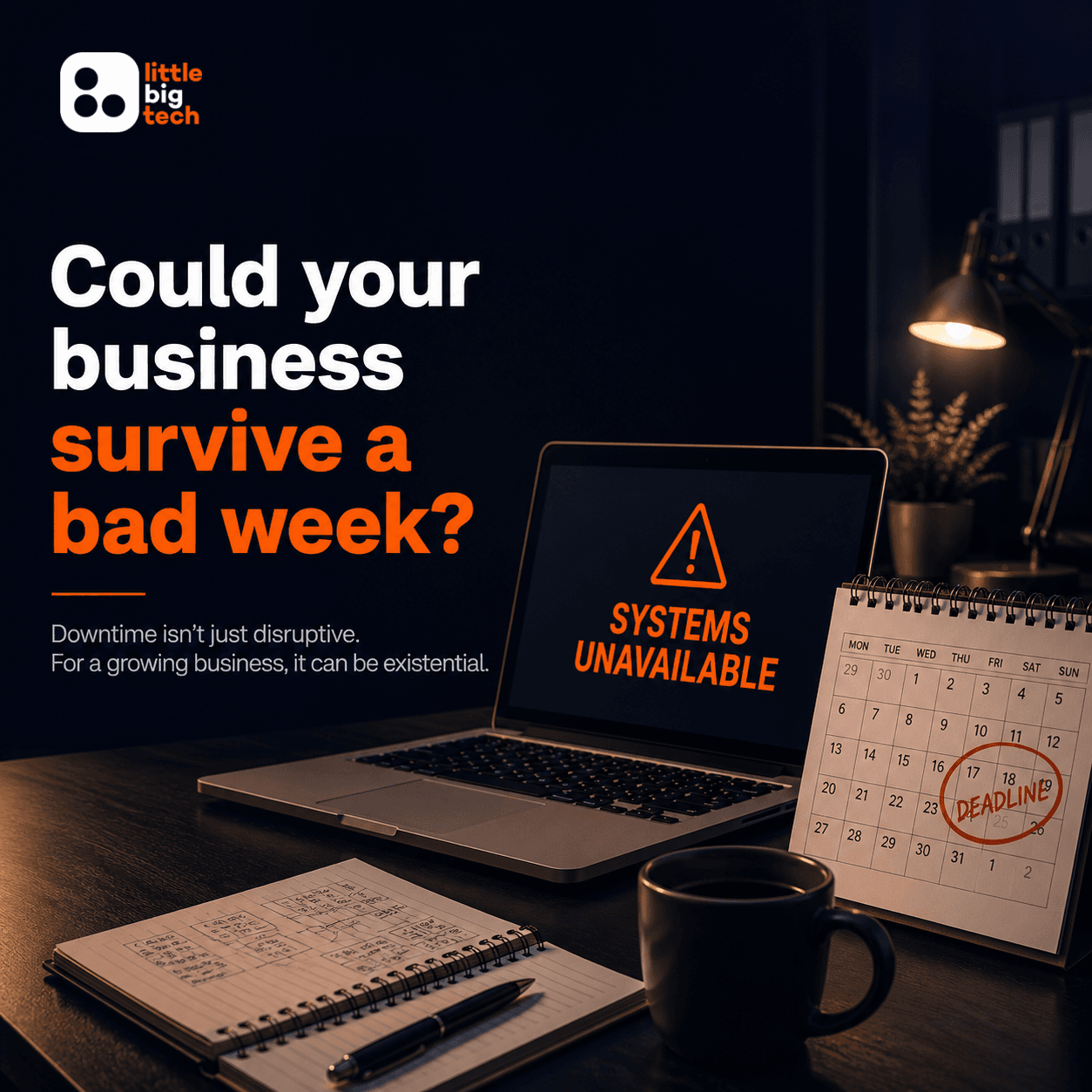
Every business has a bad week eventually. A server fails, an employee clicks the wrong link, a flood takes out the office broadband, or a supplier goes down taking your invoicing system with it. The question that matters isn't whether disruption will happen — it's what happens to your business in the hours immediately afterwards.
For a growing SME, the honest answer is often: nobody quite knows. There's a vague sense that backups exist somewhere, that someone would sort it out, that it probably wouldn't be too bad. That vagueness is the problem. Resilience isn't a feeling — it's a plan that's been tested.
This article relates to the Business Continuity & Disaster Recovery domain of the Technology Resilience Score. It looks at whether your business could keep operating through disruption, and recover its systems and data afterwards, without the whole thing turning into a crisis.
Why business continuity matters for growing businesses
Business continuity and disaster recovery is the combination of planning, systems and processes that let a business keep operating during disruption and recover systems and data afterwards. It isn't one product you buy — it's a set of decisions made in advance, so that when something goes wrong, people aren't improvising under pressure.
- Knowing which systems are critical to daily operations and which can wait
- Having backups that are tested, not just scheduled
- Having a written plan for who does what during an outage
- Understanding how long the business can survive without key systems before real damage is done
Without these basics, a manageable technical fault can turn into a genuine crisis — lost revenue, missed deadlines, and a reputation hit that outlasts the outage itself.
Why this matters as you scale
Fast-growing SMEs rarely have a dedicated IT function thinking about continuity full-time. Systems get added as the business needs them — a new finance package here, a cloud storage tool there — and nobody steps back to ask what would happen if one of them disappeared overnight. Budget gets allocated to growth, not insurance policies for problems that haven't happened yet.
That's understandable, but it leaves a gap. The businesses that get caught out badly are rarely the ones with no systems — they're the ones with systems nobody has stress-tested. The key question becomes: "If our main system went down right now, would we know exactly what to do in the next hour?"
Is your business's technology environment resilient?
Find out how prepared you really are to keep operating and recover quickly if disruption hits.
Get your Technology Resilience ScoreThe problem with informal continuity planning
Many SMEs believe they have continuity covered because backups run automatically or because a supplier has mentioned disaster recovery somewhere in a contract. In practice, this often means nobody has actually verified that recovery works.
- Backups exist but have never been tested by actually restoring data
- No documented order of priority for which systems come back online first
- No plan for communicating with staff, customers or suppliers during an outage
- Recovery time expectations that have never been discussed, let alone agreed
An untested plan is not a plan — it's an assumption, and assumptions tend to fail at the worst possible moment.
What weak business continuity looks like in a growing business
Weak continuity planning tends to show up in familiar patterns as a business scales past its early, informal stage.
- Backups stored in the same location or account as the live data they protect
- No one person clearly responsible for continuity planning
- Recovery has never been rehearsed, even informally
- Critical supplier or software dependencies are undocumented
- New systems are added without anyone updating the continuity plan
- Staff wouldn't know who to contact or what to do if systems went down tomorrow
None of this is unusual — it's simply what happens when growth outpaces planning.
What strong looks like
A resilient SME has backups that are automated, encrypted, stored separately from live systems, and tested on a regular schedule so recovery is proven rather than assumed. There's a written, current plan that names who does what, which systems matter most, and how the business keeps functioning — even in a limited way — while full recovery is under way.
Just as importantly, the plan is revisited as the business changes. New systems, new staff and new suppliers all get folded into the continuity picture, rather than left as an afterthought from two years ago.
How this TRS domain helps businesses improve
The Technology Resilience Score assesses Business Continuity & Disaster Recovery as one of ten domains that together describe how well a business can withstand and recover from disruption. Rather than guessing at your exposure, the assessment gives a structured view of where the gaps actually are.
- Reviews whether backups exist, and whether they are actually tested
- Assesses whether recovery priorities and responsibilities are documented
- Identifies single points of failure across systems and suppliers
- Benchmarks your continuity posture against comparable businesses
The result is a score out of 5 for this domain, giving you a clear baseline and a structured improvement path rather than a vague sense of unease.
Building resilience before you need it
Continuity planning is one of those things that's easy to postpone, because the cost of not doing it is invisible until the day it isn't. Growing businesses that get ahead of it tend to recover from disruption in hours rather than days, with far less damage to customer trust.
The Technology Resilience Score gives ambitious SMEs a benchmark across 10 domains, including Business Continuity & Disaster Recovery, so you know exactly where to focus before disruption forces the issue.
Related reading
Is your business's technology environment resilient?
Find out how prepared you really are to keep operating and recover quickly if disruption hits — with a free Technology Resilience Score™.
Our services