IT Investment Check
Am I Paying Too Much for My IT?
- Find out in under 5 minutes
- Completely free, no obligation
- Plain English — no jargon, no IT knowledge needed
What you get
Three answers, not a sales brochure
Your report arrives by email as soon as you finish, with your headline result on screen straight away.
What you should be paying
A benchmark built from your own numbers — headcount, servers, offices — against Little Big Tech's standard commercial rates. Support, licences, network and the project and hardware budget most contracts leave out entirely.
What that money should buy
Twelve plain-English questions on what you're actually covered for. Price on its own proves nothing: a cheap contract that leaves you exposed is not a saving, and an expensive one is not automatically a bad deal.
Where you stand, and what to do
Your investment position, the specific gaps we'd prioritise, and how each one maps to your Technology Resilience Score™ — so you know exactly which conversation to have with your provider first.
Why it's a hard question
Nobody publishes what IT should cost
It's one of the hardest questions to answer honestly about your own business, because there's no published price list and no two IT contracts describe the same thing. In under five minutes, this benchmarks what you pay against what a business of your size and shape should be investing — and, just as importantly, against what that investment should be buying you.
IT pricing is deliberately hard to compare. One provider quotes per user with licences included; the next quotes a flat fee with licences billed separately and projects charged on top. Both look reasonable in isolation, and neither tells you whether you're getting a good deal.
The bigger problem is that price is only half the question. A contract can be genuinely cheap and still be poor value if it leaves you carrying risks you didn't know you had — and the cost of those risks doesn't disappear, it just arrives later and unbudgeted. That's why this check looks at cost and coverage together.
Why the answer matters
Loading the check…
Questions people ask first
How long does it take?
Under five minutes. Three short steps: your setup, what you pay today, and twelve questions on what that covers. Estimates are fine throughout — the comparison holds up on approximate figures.
Do I need to know technical details?
No. Every question is written for a business owner or finance director, not an IT manager. "Not sure" is an available answer on all twelve coverage questions, and it's a useful one — if you can't confirm you're buying something, that's worth knowing in itself.
Is this a sales pitch?
It's a benchmark, and it can just as easily tell you that you're getting good value. Roughly speaking, if you're paying a fair rate and receiving a full service, the report says so and recommends you verify quality rather than change provider.
What if my provider does things differently?
Then the report will tell you where and by how much, which is the point. It's an indicative benchmark rather than a quotation — it can't account for something specific to your contract that we haven't asked about. What it does do is give you a defensible basis for the conversation.
What happens to my figures?
They're used to build your report, which is emailed to you. We don't share your data. If you'd like us to walk you through the result we'll offer a call, and you're free to decline it.
What's the difference between this and the Technology Resilience Score assessment?
This answers a commercial question: am I paying the right amount, and getting the right things? The Technology Resilience Score™ assessment answers a quality question: how well is each of those things actually working? Most people start here and move on to the assessment once they've seen where the gaps are.
Worth reading first
The things the check asks you about
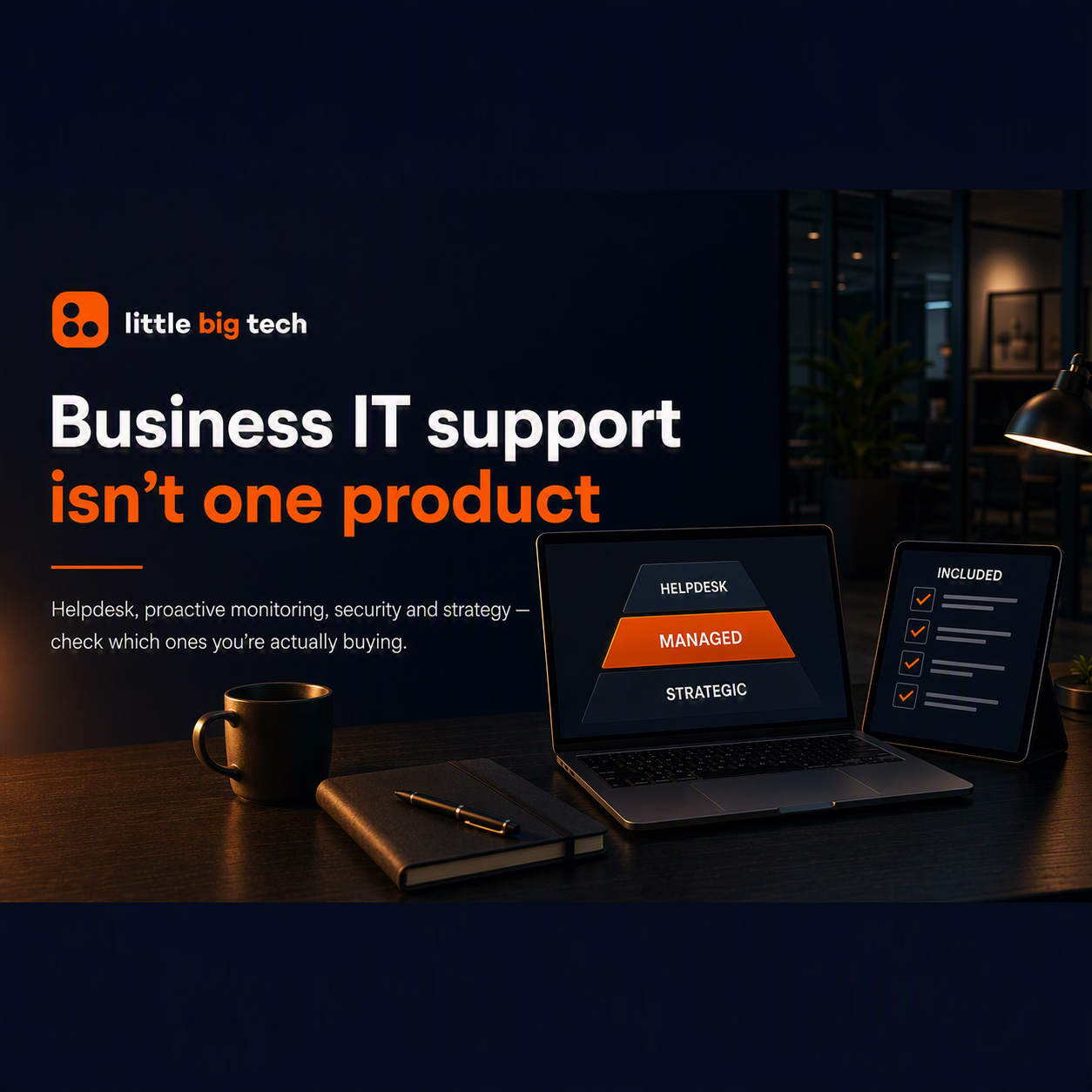
If any of the twelve questions leave you unsure, these explain why the element matters and what good looks like.


Already know your costs are fine?
The Technology Resilience Score™ assessment answers the other half of the question: not what you're paying for, but how well it's actually working. It measures your ability to prevent, withstand and recover from technology and cyber risks, and gives you a baseline you can improve against.
Get My Technology Resilience ScoreSector-specific versions
Want to know what's included in our managed IT service? IT Support for SMEs.