IT Support
How Much Does IT Support Cost in the UK?
22 July 2026
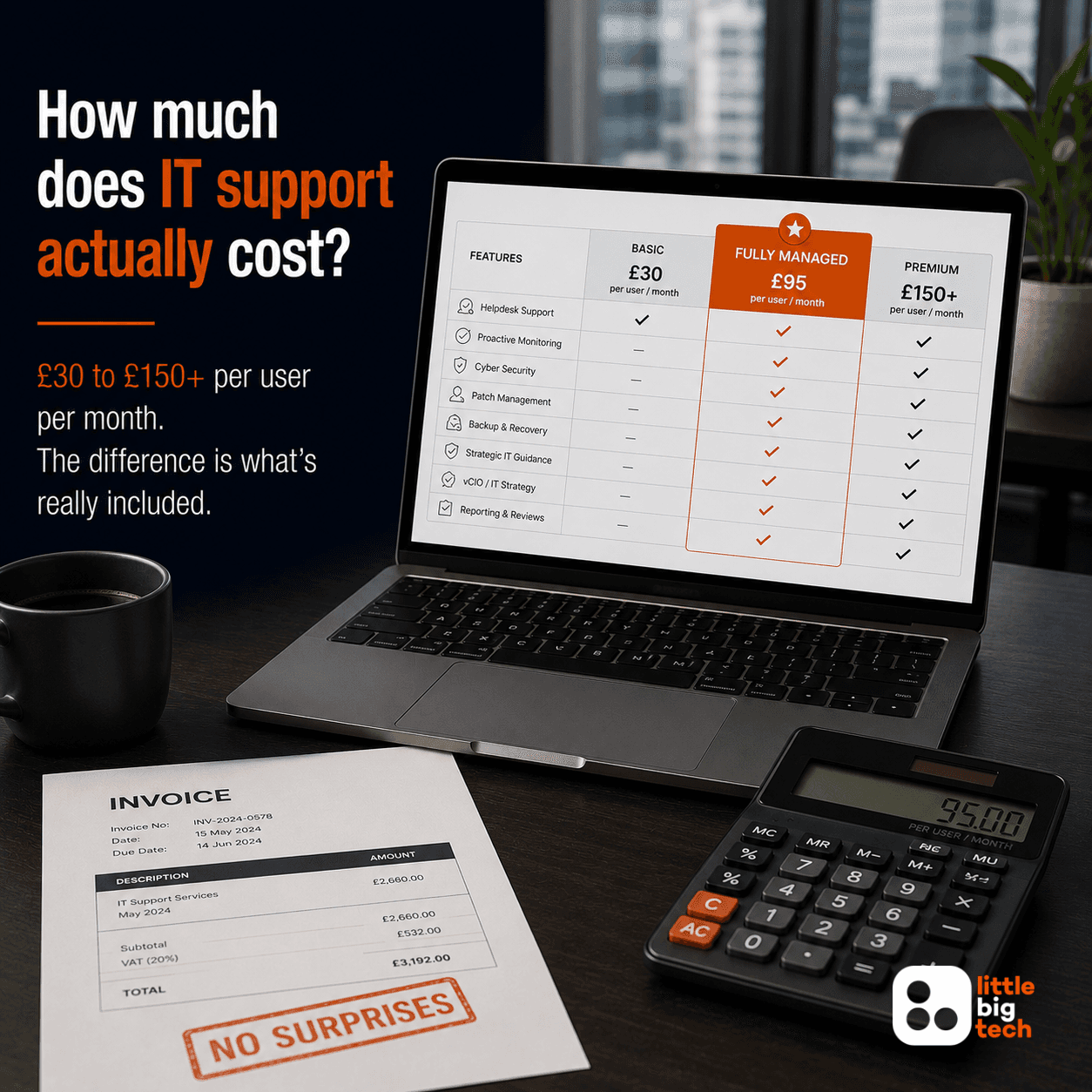
It's the first question every business asks when they start looking at IT support — and the one most providers are strangely reluctant to answer on their website. So here's the straight version, with real numbers.
The short answer
Fully managed IT support in the UK typically costs between £30 and £150+ per user, per month. Where you land in that range depends on the depth of security included, whether strategic guidance is part of the deal, and how much of the work is genuinely proactive rather than waiting for things to break.
For context, our own pricing is public: Resilience-Fixed is £750 per month all-in for teams of up to 10 users, and Resilience-Flex is £75 per user per month for teams of 11 and above. Everything below explains what sits behind numbers like these — ours and everyone else's.
The four ways UK providers charge
1. Per user, per month (managed)
The most common model for fully managed IT support services. You pay a fixed amount for each member of staff, and the provider takes responsibility for keeping your environment running and secure. Typical range: £30–£150+ per user per month. The spread is wide because the word "managed" hides enormous differences in scope — a £35 contract usually means a helpdesk and antivirus; a £75+ contract should mean around-the-clock security monitoring, backup, patching, phishing training and someone thinking strategically about your technology.
2. Fixed monthly fee
A single price for the whole business, common for smaller teams where per-user billing produces silly numbers. This is how our Resilience-Fixed package works: £750 per month for up to 10 users, with the full security stack included. The advantage is total predictability — the invoice never surprises you.
3. Block hours (pre-paid time)
You buy a bank of hours — say 20 hours for £1,500–£2,500 — and draw it down as issues come up. It feels flexible, but notice the incentive: the provider gets paid more when you have more problems. Nothing in this model rewards preventing issues.
4. Break-fix (pay as you go)
Hourly rates in the UK typically run £75–£150 per hour, billed when something goes wrong. It looks cheap in a quiet month and becomes very expensive in a bad one — and a bad month for IT is usually a bad month for revenue too, because the cost of the engineer is rarely the biggest cost of the outage.
What actually moves the price
When you compare quotes, these are the factors doing the work:
- Security depth. A 24-hour Security Operations Centre, vulnerability management, credential theft monitoring and incident response cost genuinely more to deliver than antivirus and a spam filter — and they're the difference between a provider that prevents breaches and one that watches them happen.
- Compliance requirements. If you're regulated — legal, financial services, healthcare — expect the price to reflect the extra governance, reporting and evidence your sector demands.
- What "support" actually covers. Helpdesk hours, device patching, Microsoft 365 or Google Workspace backup and configuration — check each is included rather than assumed. This is where cheap contracts quietly exclude things.
- On-site visits. Most day-to-day support is delivered remotely. On-site IT support is usually priced separately — at Little Big Tech it's a separate agreement alongside the managed packages, and any provider bundling "unlimited on-site" into a cheap per-user price is worth questioning.
- Strategic input. The gap between an IT supplier and an IT partner is whether anyone is accountable for where your technology is going, not just whether it works today.
The cost that doesn't appear on the quote
Cheap IT support is priced on the assumption that nothing goes wrong. The UK Cyber Security Breaches Survey found the average self-reported cost of the most disruptive breach was £1,600 per business — rising to £3,550 once you exclude businesses reporting zero cost. And UK businesses lose an estimated £3.7 billion a year to connectivity failures alone. A well-scoped managed contract typically pays for itself in risk reduction before you count a single productivity gain.
This is why we anchor every engagement to your Technology Resilience Score™ — a verified measure of your organisation's ability to prevent, withstand and recover from technology and cyber risks. Most organisations we assess start below the 3.5 benchmark typical for their size. That's not a criticism; it's a costed opportunity. It tells you exactly where investment reduces risk fastest, and it gives you a trajectory you can track — so you can see what your monthly fee is actually buying, quarter after quarter.
How to budget sensibly
For a team of 5–100 users, a realistic budget for genuinely managed IT support services — security monitoring, backup, patching, real engineers and strategic guidance included — is £70–£100 per user per month, or a fixed fee in that spirit for smaller teams. Budget below that and something on the list above is missing; find out what before you sign, not after.
Three checks before you commit:
- Get the full inclusion list in writing: our guide to choosing managed IT support covers exactly what to look for.
- Ask the awkward questions about contracts, data and exit terms: we've written up the questions to ask any outsourced IT provider.
- Check the contract length. Ours is a 3-month rolling agreement, and providers confident in their service don't need 3-year lock-ins.
Frequently Asked Questions
Is it cheaper to hire an in-house IT person instead of outsourcing?
Rarely, once you factor in salary, cover for holiday and sickness, and the reality that one person cannot deliver round-the-clock security monitoring alone. A managed contract in the £70-£100 per user range above buys you a team with more depth of cover than a single hire, at a cost most SMEs find comparable or lower once the full picture is counted.
Why do IT support quotes for the same size business vary so much?
Because "IT support" is not one fixed thing. Two quotes for the same 20-person office can differ by £2,000 a month or more, because one includes 24-hour security monitoring, patching and strategic guidance, and the other is a helpdesk and antivirus. The scope, not the headline price, is what you're actually comparing, so use the pricing models above to check what each one includes.
Is a 3-year IT support contract cheaper than a rolling monthly one?
Rarely, in practice, even if it looks that way on paper. Providers use long lock-ins to secure revenue, not because the service costs less to deliver over three years. A provider confident in what they deliver should not need a multi-year tie-in to make the numbers work, which is why we run a 3-month rolling agreement.
What's a realistic monthly IT support budget for a 20-person business?
Based on the £70-£100 per user range that covers genuinely managed support, a 20-person business should budget roughly £1,400-£2,000 a month for security monitoring, backup, patching, a responsive helpdesk and someone accountable for where your technology is going. Below that, check exactly what's excluded before you sign.
Know what you're buying before you buy it
The honest answer to "how much does IT support cost?" is: less than the cost of not having it done properly. The best starting point isn't a quote — it's a baseline. Get your free Technology Resilience Score™ assessment and you'll know exactly where your risks are, what fixing them is worth, and what a fair price looks like for your business. From there, the buying decision gets a lot simpler.
Is your business's technology environment resilient?
Find out how prepared you really are to keep operating and recover quickly if disruption hits — with a free Technology Resilience Score™.
Our services