AI · IT Support
Build vs Buy Is the Wrong Question Now — Here’s the Right One
9 July 2026
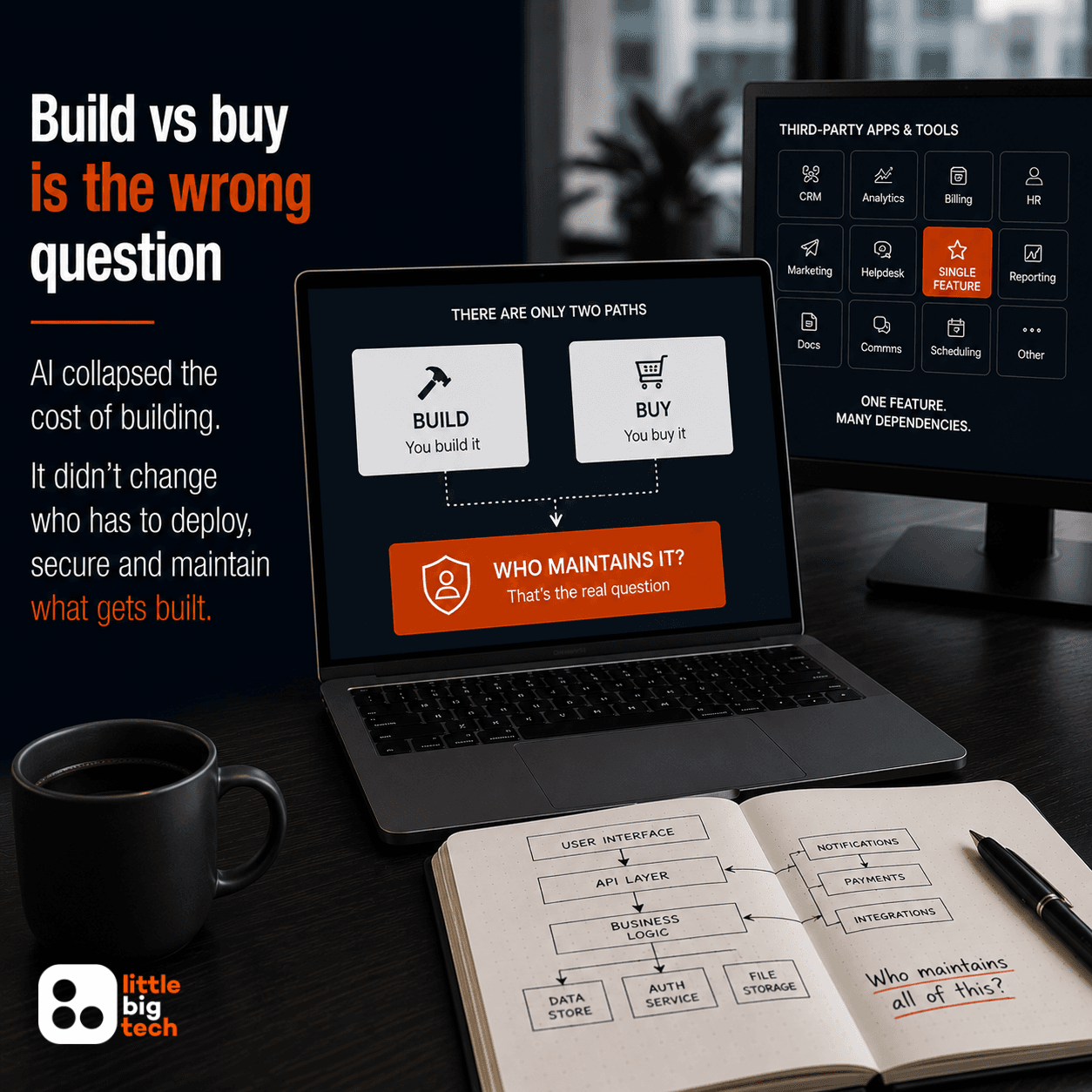
Every growing business eventually hits the same wall: the software you’re running doesn’t quite fit how you work, and you’re stuck choosing between bending your business to fit someone else’s product, or paying a digital agency a small fortune to build something that does. That trade-off has defined build vs buy for twenty years. It doesn’t work like that any more, and most businesses haven’t caught up.
The old trade-off
Buy, and you’re live fast, on a proven product, with someone else handling updates and fixes. The cost is fit — you adapt to the tool, and you pay for the 20% you never use.
Build, and you get exactly what you need, shaped to your model, changeable on demand. The cost is everything that comes after launch — you own the running and maintaining, forever.
Buying isn’t wrong. It’s often the right call. The point is choosing with your eyes open — and until recently, “build” meant engaging a digital agency, a lengthy project, and a fresh invoice every time you wanted to change it. For most businesses, that made “build” a non-starter regardless of how much better the fit would have been.
What actually changed
We run Little Big Tech the way we want to run it — and when we went looking for tools to match, nothing off-the-shelf aligned. So we built. Not with a digital agency: with Claude. A friend who ran a digital agency looked at what we had built two and a half weeks into the project and estimated that, through a traditional agency route, it could easily have been a six-month, near-£100,000 project. We built it in around fifteen days of effort between two people who aren’t developers.
The skillset of writing software is now commoditised by tools like Claude. That doesn’t mean the judgement disappears — it means the constraint that used to make “build” unaffordable for most businesses has moved. The question is no longer whether you can afford to build. It’s whether you have a framework for building, deploying, securing, integrating and maintaining what gets built.
The real question: who governs, deploys, integrates and maintains what gets built?
Getting something working on your own laptop feels like the finish line. It’s barely halfway. From there, it has to go somewhere — a hosting platform, properly secured, properly accessed, kept patched. Then it has to stay alive: monitored, fixed when it breaks, updated when something it depends on changes. Skip that step and the thing that made you faster becomes a liability sitting quietly in your business, waiting to be a problem.
Most “I built this in a weekend” stories stop at the exciting bit — an idea becoming code, running on a laptop. Deploying it, securing it, integrating it and keeping it alive is the actual job, and it never ends. That is the piece a framework, not a free-for-all, is built to cover — which is exactly what Efficiency Engine is for.
How to build without painting yourself into a corner
If you’re going to build, build small, single-feature apps. The temptation with tools this capable is to keep adding to one growing application until it does everything — and then one small change risks breaking all of it. We work the opposite way: one feature, one app, doing exactly one job well, connected to everything else through a single integration layer. It’s exactly how we run our own quoting tool and onboarding tracker — change one, and you haven’t touched the other. A fault stays contained instead of becoming a domino run through your business.
That’s backed by guardrails, not good intentions — architectural rules that flag scope creep before it happens, a security standard tied to your Technology Resilience Score, and brand and business-context guidance so what gets built actually looks and sounds like your business, not a generic tool wearing your logo.
Where this leaves you
Build vs buy was never really about cost — it was about fit versus effort. AI has cut the effort dramatically. What hasn’t changed is that anything you build needs a home, a lock on the door, and someone checking on it through future versions, not just version one. Get that right, and building small, single-feature, AI-built apps to your exact model is now a genuine option for businesses that could never have justified it before. Skip it, and you’ve just moved your risk from “the product doesn’t fit” to “nobody owns what we built” — the exact trap explored in technical debt from AI-built apps.
Start with one app
Pick the one process costing your team the most time — a quote, a report, an onboarding form, a tracker — and use it as the first test of whether small AI-built apps can improve how your business works. Efficiency Engine gives you the structure to build that app safely, then we deploy it, connect it through the integration layer, monitor it, and maintain it through future versions. You bring the process knowledge. We provide the framework that stops the app becoming another unsupported system in your business.
Not ready to commit to the full framework? Book our one-day, on-site Efficiency Engine Workshop (£2,500 one-off) and shape and build a first working version live with your team — no ongoing commitment required.
Is your business's technology environment resilient?
Find out how prepared you really are to keep operating and recover quickly if disruption hits — with a free Technology Resilience Score™.
Our services