AI · IT Support
The Technical Debt Bill Always Arrives — Even for Apps You Built With AI
9 July 2026
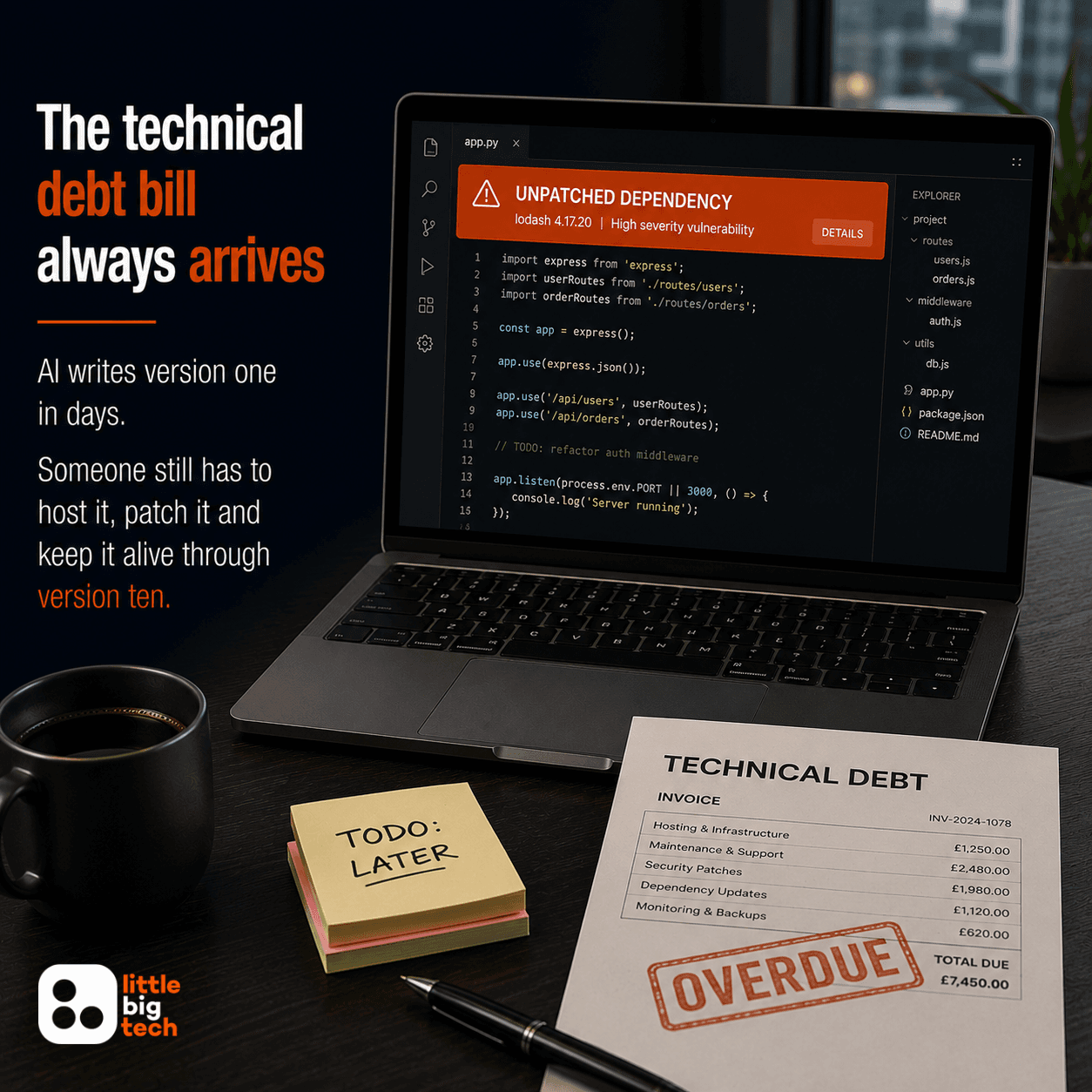
Anyone can prototype working software in an afternoon now. Describe what you want, and tools like Claude will hand you something that runs, looks right, and does the job — on your machine, today. That speed is genuinely new and genuinely useful. It also hides a bill that arrives later: technical debt, and it doesn’t care how fast you built the thing that racked it up.
The risk is not that your team can build something useful. The risk is that nobody owns what happens after it starts being used.
What technical debt actually costs you
Technical debt is simply the cost of the shortcuts you took to ship fast — the corners cut on testing, on security, on what happens when the thing you built needs to change. It’s always been part of software. What’s changed is that the shortcuts are now available to everyone, not just development teams, so a lot more debt is being taken on by people who’ve never had to pay it back before.
The debt itself is invisible at first. The app works. Everyone’s pleased. Then something the app relies on changes, or someone tries to extend it, or — worse — nobody patches it and it quietly becomes the softest target in the business. That’s when the bill lands, usually at the least convenient moment.
The part everyone skips: the last mile
Getting an idea to run on your own laptop is the exciting bit, and it genuinely does feel like the finish line. It isn’t — it’s barely halfway. Real software still has to be tested against real data and edge cases, deployed somewhere reliable, secured properly, integrated with what it needs to talk to, and then kept alive indefinitely: monitored, patched, fixed when an API it depends on changes underneath it. Deploying and securing are one-off hurdles. Keeping it alive is permanent, and it’s the part almost nobody budgets for.
That ongoing piece is what actually decides whether a fast build was a genuine productivity win or an expensive lesson. Skip it, and the thing that made your team faster in month one becomes the thing quietly costing you in month twelve.
Debt compounds fastest in one giant app
The fastest way to build up technical debt is to keep adding capability into one growing application until it does everything. Every change then touches everything else, testing slows down the more you add, and one fault can take the whole thing down. We work the opposite way: one feature, one app, doing exactly one job, wired together through a single integration layer. Change the quoting tool, and the maturity tracker never notices. A fault stays contained to the one thing that broke, instead of spreading through everything connected to it — the same principle behind why build vs buy has changed.
How to build without racking up debt you can’t see yet
- Scope tightly. One app, one job, a clear picture of what goes in and what should come out, before anything gets built.
- Build secure by default. Authentication, access control and monitoring designed in from the start, not bolted on when something goes wrong.
- Treat “keep it alive” as a service, not a hope. Patching, monitoring and troubleshooting need an owner and a schedule — not “whoever remembers”.
This is exactly what a framework, not a free-for-all, is for — architectural rules that stop scope creep before it starts, and a security standard tied to your Technology Resilience Score so “secure” isn’t a step you get to later. The apps that avoid racking up debt are the ones built inside a system designed to prevent it, not the ones built fastest.
What this means for your Technology Resilience Score
A Technology Resilience Score below 3.0 signals elevated operational risk — and unmanaged, unmonitored, AI-built apps sitting quietly in your business are exactly the kind of gap that drags a score down. The opportunity is real: the same speed that lets you build fast also lets you build well, provided deployment, security, integration and monitoring are treated as part of the build, not an afterthought. Get that right and every app you add moves your score forward instead of racking up a bill you haven’t seen yet.
Pay it down before it’s due
If your team is already building with Claude or experimenting with small internal apps, the answer is not to slow everything down. The answer is to put a framework around it before those tools become hidden technical debt. Efficiency Engine gives your team the guardrails to build small apps safely, then provides the deployment, integration layer, monitoring and ongoing maintenance once those apps are ready to run.
The speed is still there. The difference is that what gets built has an owner, a structure, and a plan for what happens after version one. Not ready to commit to the full framework? Book our one-day, on-site Efficiency Engine Workshop (£2,500 one-off) and scope and build a first working version live with your team — no ongoing commitment required.
Is your business's technology environment resilient?
Find out how prepared you really are to keep operating and recover quickly if disruption hits — with a free Technology Resilience Score™.
Our services