Security · IT Support
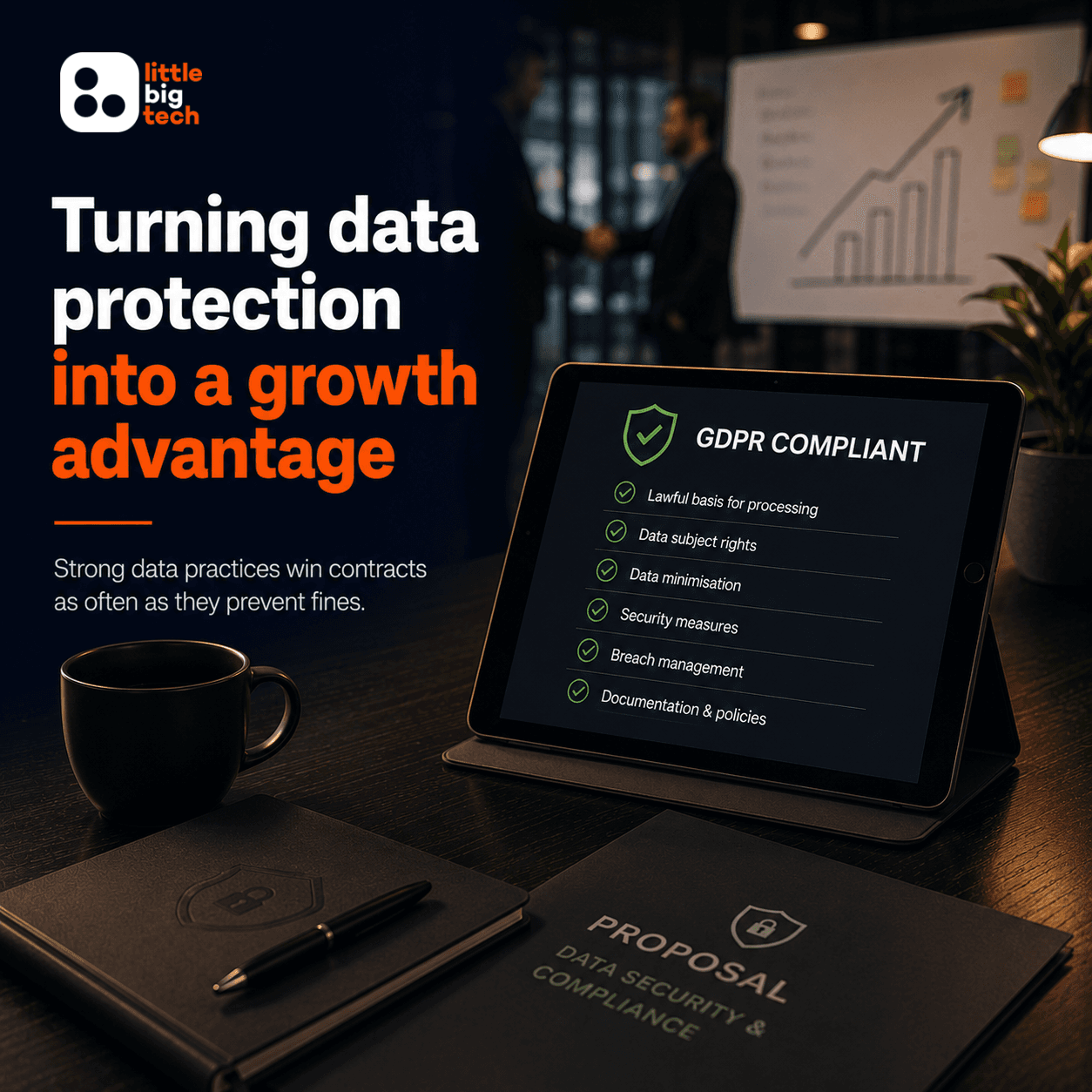
Turning Data Protection Into a Growth Advantage
6 July 2026
Ask most SME owners where their customer data lives and you'll get a pause before the answer. Some in the finance system, some in email, some in a shared drive somebody set up two years ago, some in a tool the marketing team subscribed to without telling anyone else. It's not that anyone's being careless — it's just that data accumulates faster than anyone documents it.
Data protection tends to get filed under compliance — a box to tick, a policy to have somewhere. But businesses that treat it properly find it becomes something more useful: a way to build trust with customers and partners who increasingly ask hard questions before they sign a contract.
This article relates to the Data Protection & Compliance domain of the Technology Resilience Score. It looks at whether your business knows what data it holds, where it lives, and how well it's protected.
Why data protection matters for growing businesses
Data protection and compliance is the process of identifying, managing and protecting personal and sensitive data to meet legal and commercial requirements. It includes knowing what data you hold, where it is stored, and how it should be handled at every stage of its life.
- A clear picture of what personal and sensitive data the business holds
- Knowledge of exactly where that data is stored and who can access it
- Processes for handling data requests, retention and deletion correctly
- Protections in place that match the sensitivity of the data being held
Without this, a business is exposed not just to regulatory risk, but to the much more immediate risk of losing customer trust after a mishandled breach.
Why this matters as you scale
A growing SME typically didn't set out to become a data-heavy organisation — it just happened as customer numbers grew and more tools got bolted on to manage them. Nobody was appointed to own data protection full-time, so it lives in the gaps between everyone's actual job.
That's a normal consequence of growth, but it becomes a liability once the business is handling meaningful volumes of customer or employee data. The key question becomes: "If a customer asked us exactly what data we hold on them and where, could we answer confidently?"
Is your business's technology environment resilient?
Find out whether your data protection practices would stand up to real scrutiny.
Get your Technology Resilience ScoreThe problem with treating data protection as a formality
Many SMEs have a privacy policy on their website and consider the job done. That's a document, not a practice, and the gap between the two is where real risk sits.
- No accurate record of what personal data is held or where
- Data retained indefinitely with no review or deletion process
- Access to sensitive data not restricted to those who genuinely need it
- No clear process for responding to a data subject access request
A policy that isn't backed by practice offers no real protection when something goes wrong.
What weak data protection looks like in a growing business
These signs tend to surface as customer numbers and data volumes grow.
- Customer data spread across email, spreadsheets and multiple systems with no central record
- No one person accountable for data protection decisions
- Sensitive data shared over email or chat with no encryption or access control
- Data retained long after there's a legitimate business reason to keep it
- No documented process for handling a data breach
- Staff unclear on what counts as personal or sensitive data
Each gap increases both regulatory exposure and the potential damage from a breach.
What strong looks like
A resilient business knows exactly what data it holds, where it's stored, and who can access it. Retention periods are defined and enforced, access is limited to those who need it, and there's a clear, tested process for responding to both data subject requests and potential breaches.
Increasingly, this discipline becomes a selling point. Customers and partners — particularly larger ones — ask pointed questions about data handling before they'll commit to a contract, and a business that can answer confidently wins the deal that a vaguer competitor loses.
How this TRS domain helps businesses improve
The Technology Resilience Score assesses Data Protection & Compliance as one of ten domains, giving a clear, structured view of your current position.
- Reviews what personal and sensitive data is held and where it's stored
- Assesses access controls and retention practices
- Checks whether breach response and data request processes exist and work
- Benchmarks your data protection posture against comparable businesses
The result is a score out of 5 for this domain, giving you a clear baseline and a structured improvement path.
From compliance chore to commercial asset
Data protection done well isn't just about avoiding fines — it's about being the supplier that larger customers trust with their information. As procurement processes get more rigorous, that trust increasingly has to be demonstrable, not just claimed.
The Technology Resilience Score gives ambitious SMEs a benchmark across 10 domains, including Data Protection & Compliance.
Related reading
Is your business's technology environment resilient?
Find out how prepared you really are to keep operating and recover quickly if disruption hits — with a free Technology Resilience Score™.
Our services