IT Support · Security
What Good IT Support for Law Firms Actually Looks Like
10 July 2026
Reviewed by Nick Haley, founder of Little Big Tech. Last updated July 2026.
Law firms and solicitors don't need "IT support" in the generic sense — they need IT support built around client confidentiality, SRA and ICO obligations, and the reality that a data breach at a legal practice isn't just an inconvenience, it's a professional conduct issue. Here's what IT support for law firms should actually include, and how to tell a genuinely sector-aware provider from a generalist one with a legal page bolted onto their website.
Why Generic IT Support Doesn't Fit a Legal Practice
Solicitors and legal professionals are among the most targeted by cybercriminals, precisely because client files carry financial, personal and often highly sensitive information in one place. Email compromise, ransomware and client data theft aren't rare events for firms without the right protections — they're an everyday threat. A generalist IT provider can keep a document syncing; it takes a provider that actually understands legal practice to keep a firm compliant, audit-ready, and trusted with the data clients hand over.
Compliance Isn't Optional: SRA and ICO, Not Just "GDPR"
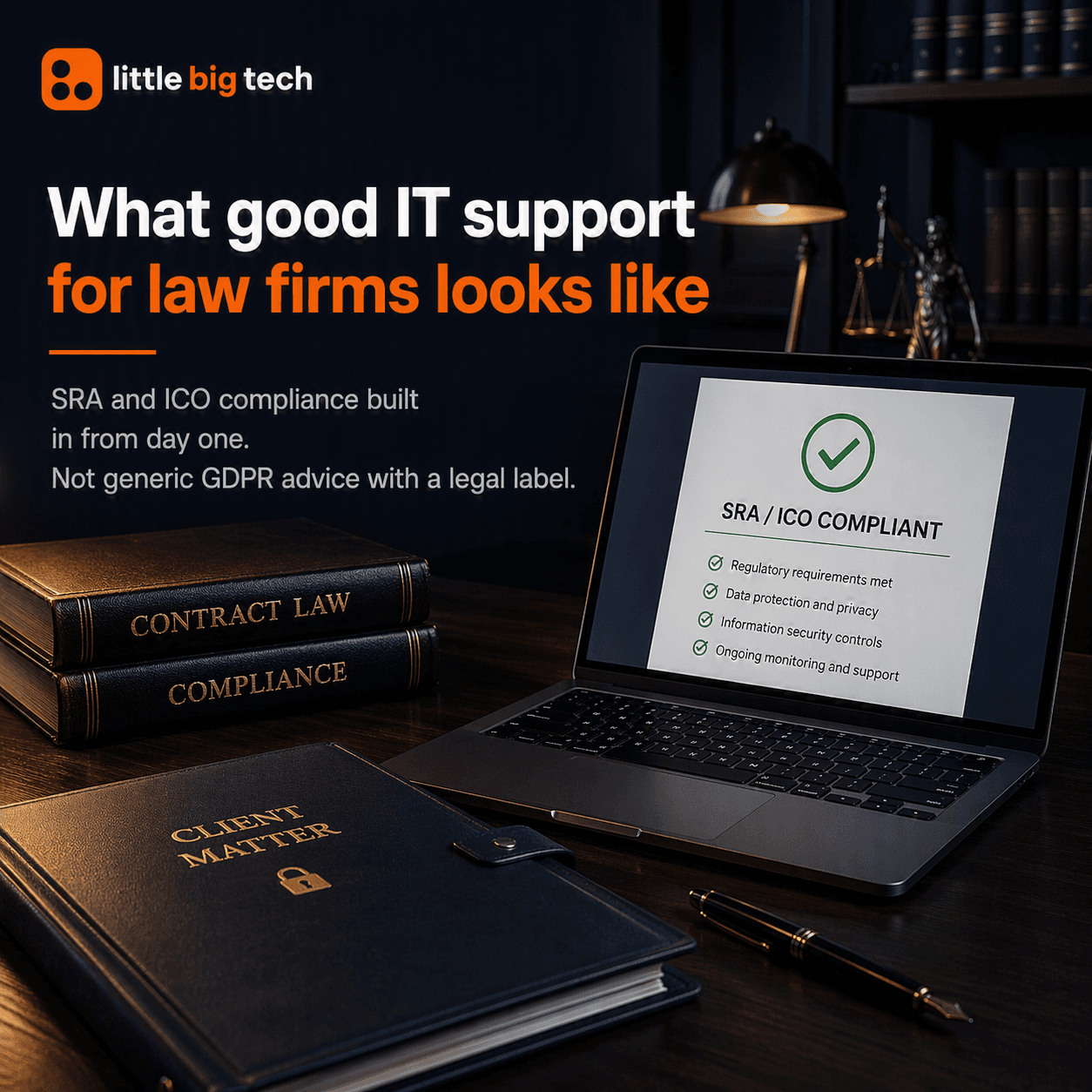
A lot of IT support content talks about "GDPR compliance" as if that's the whole picture for a law firm. It isn't. Legal practices sit under SRA requirements as well as ICO data protection obligations, and the two aren't interchangeable — client confidentiality and conduct rules add a layer that generic data protection advice doesn't cover. Proper legal IT services are built around both from the start: security frameworks aligned with SRA guidance and ICO requirements, not a generic compliance checklist repurposed for law firms.
This is exactly the kind of gap a Technology Resilience Score™ is designed to surface — not just whether your systems technically work, but how well-positioned your firm actually is against the specific risks and obligations that come with practising law. Most firms of similar size and complexity operate at 3.5 or above; a score below 3.0 signals elevated operational risk and makes stabilisation the priority before anything else.
What Core Legal IT Services Should Include
- Document and case management — secure, organised systems that make files easy to find and hard to lose
- Cybersecurity built for confidentiality — MFA, email filtering and anti-phishing, encryption, and device patching, not just antivirus
- 24/7 security monitoring as standard, with day-to-day helpdesk support on business hours and critical issues triaged in under 15 minutes — round-the-clock helpdesk cover is available as an add-on where a firm specifically needs it
- Secure remote access that lets fee-earners work from court, chambers or home without compromising client confidentiality
- Tested backup and disaster recovery, because losing case files isn't just costly — it can be a professional conduct problem
- Staff cyber awareness training that reflects how phishing and social engineering actually target legal teams specifically
Worth flagging directly: on-site support — an engineer physically attending your offices — is typically a separate arrangement on top of a managed IT support package, not bundled in by default.
Cloud and Remote Work, Done Securely
Cloud solutions let legal teams access documents and collaborate from anywhere — useful for fee-earners splitting time between court, client meetings and the office. The risk isn't the cloud itself, it's a cloud environment that's been switched on without being properly configured: access controls, encryption and monitoring all need to travel with the data, not just sit around it.
Choosing an IT Support Partner Who Actually Knows Legal Practice
Not every provider that lists "law firms" as a sector on their website has actually built for one. Worth asking directly: how many similar firms do they support, do they reference SRA and ICO requirements specifically rather than generic GDPR language, and can they describe their onboarding and triage process clearly before you've signed anything? A provider that can't answer those precisely is telling you something.
How Little Big Tech Approaches Legal IT Support
We build every legal engagement around your Technology Resilience Score™ — a clear, evidence-based baseline of where your firm's technology and compliance posture stand today, and a prioritised roadmap to strengthen it. Our security frameworks are aligned with SRA guidance and ICO requirements from day one, not adapted after the fact, so client data protection and audit-readiness are built in rather than bolted on.
Frequently Asked Questions
Why do law firms need specialist IT support rather than a generalist provider?
Because legal work carries specific regulatory obligations — SRA guidance and ICO requirements — on top of the confidentiality and conduct risks generic data protection advice doesn't fully address. A generalist provider can keep systems running; a legal-sector specialist keeps you compliant and audit-ready at the same time.
What's included in legal IT support as standard, versus billed separately?
Expect helpdesk support, 24/7 security monitoring, cybersecurity tooling, backup and disaster recovery, and strategic guidance as standard. On-site support and round-the-clock (rather than business-hours) helpdesk cover are typically separate arrangements — worth confirming explicitly with any provider.
How quickly should a provider respond to a critical issue?
Critical issues should be triaged well ahead of routine requests — at Little Big Tech, that means triage in under 15 minutes, not a vague "as soon as possible."
How do I know if our current setup is actually compliant and secure?
A Technology Resilience Score™ assessment gives you an evidence-based baseline against your actual regulatory and security position, rather than a generic checklist — so you know exactly what's worth fixing first.
Is IT support for solicitors different from IT support for law firms?
Not fundamentally. Solicitors are the people SRA and ICO requirements actually apply to, so IT support for solicitors and IT support for law firms describe the same need from two angles — the individual practitioner's obligations versus the firm's. A sole practitioner or small partnership carries the same compliance requirements as a larger firm, just with less internal resource to manage them.
If you want to know exactly where your firm stands, get your free Technology Resilience Score, or see how our IT support for law firms is built around SRA and ICO requirements from the ground up.
Is your firm's technology environment resilient?
Find out how well protected your matter files, client account and email really are, with a free Technology Resilience Score™ written for law firms.
Our services