Security · IT Support
Why Finance Firms Need Real IT Governance
6 July 2026
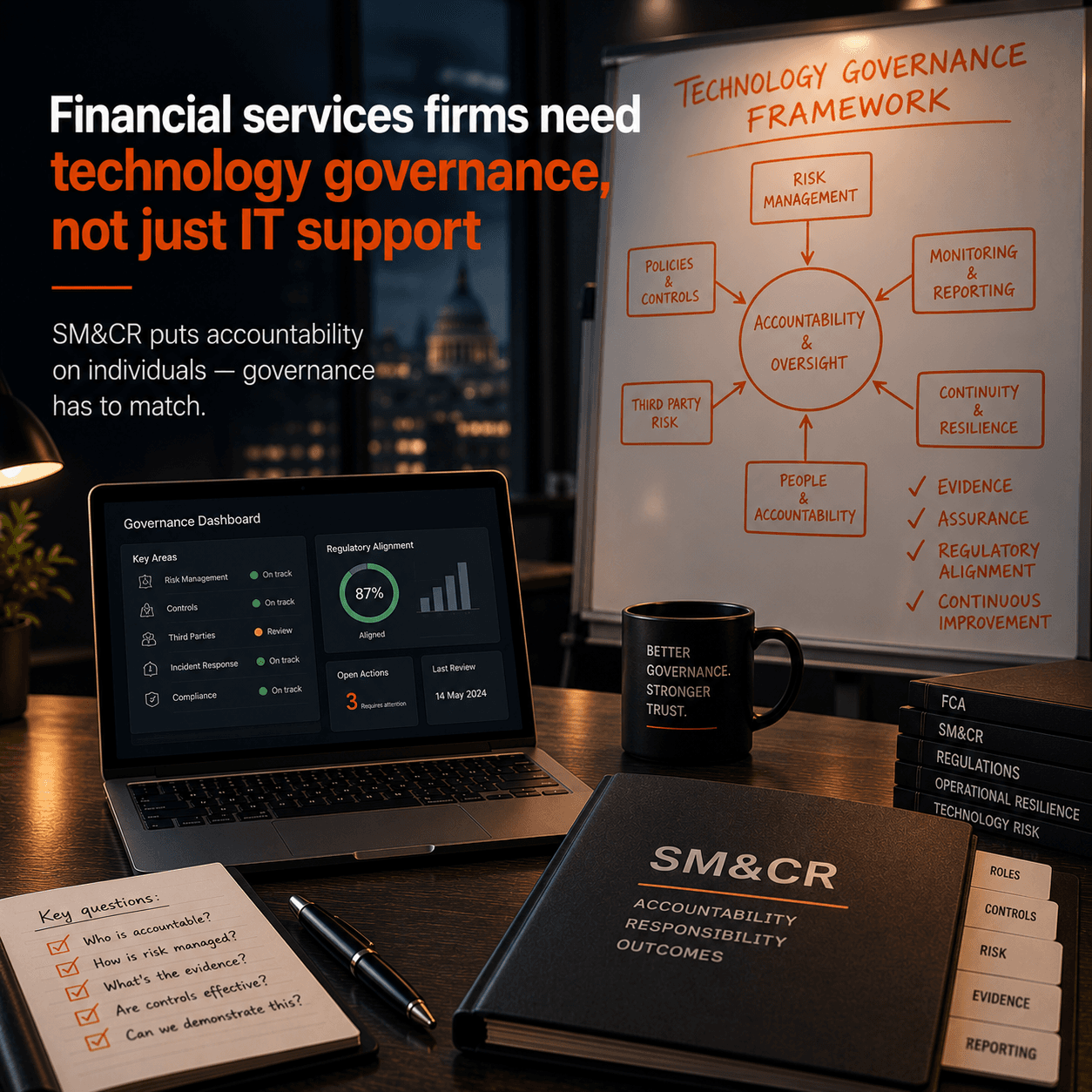
Somewhere between a founding partner and the office printer sits a gap that many financial services firms never quite fill: who actually owns technology decisions? Not who fixes things when they break, but who decides what the firm invests in, what risk it's willing to carry, and what happens when priorities compete.
Most firms have IT support. Fewer have technology governance. The difference matters more than it sounds.
This article relates to the IT Strategy & Governance domain of the Technology Resilience Score. It looks at whether your firm makes deliberate decisions about technology, or simply reacts to whatever comes up next.
Why governance is different for financial services firms
In a boutique investment firm, technology decisions are frequently made informally — a partner picks a platform, an associate signs up for a tool, an IT provider is asked to sort out a problem without anyone stepping back to ask whether it fits the wider risk picture. That approach can work for a while. It doesn't scale, and it doesn't hold up to regulatory scrutiny.
- Technology risk decisions are often made without reference to the firm's overall risk appetite
- No one is clearly accountable when a technology decision goes wrong
- Investment in systems tends to be reactive, driven by problems rather than strategy
- Growth and new hires expose gaps in governance that were previously hidden by small scale
Without governance, a firm's technology environment reflects whoever spoke loudest last, not what the business actually needs.
SM&CR and the accountability that follows technology risk
Under the Senior Managers & Certification Regime, individual accountability doesn't stop at the trading desk or the compliance function — for many firms it extends to operational and technology risk too. That means a senior manager can be personally accountable for a technology failure they didn't know was possible, simply because no one had established clear ownership and oversight beforehand.
Good governance is what closes that gap. It creates visibility, ownership and a paper trail showing that technology risk was actively managed, not ignored. The key question becomes: "If a regulator asked who in this firm owns technology risk and how it's overseen, would there be a clear answer?"
Is your firm's technology environment resilient?
Find out whether technology decisions in your firm are governed, or just made on the fly.
Get your Technology Resilience ScoreThe problem with IT support as a substitute for governance
IT support keeps the lights on. It was never designed to answer strategic questions, and firms that rely on it for both often don't notice the gap until it costs them.
- Technology roadmaps, if they exist, are set by the support provider rather than the business
- No regular review of technology risk at partner or board level
- Spending decisions made system by system, with no view of the whole environment
- No one asking whether current technology choices still fit the firm's size and ambitions
A firm can have excellent support and still have no real governance at all.
What weak technology governance looks like in a financial services firm
These patterns are common in firms that have grown faster than their oversight structures.
- No documented technology strategy or roadmap tied to business goals
- Technology risk absent from partner meetings or board papers
- Decisions about new systems made by whoever raises the request first
- No clear owner for technology risk among senior management
- No regular review of whether existing tools and platforms still serve the business
- Budget for technology treated as pure cost rather than a lever for growth
Each gap makes the next technology decision a little more arbitrary.
What strong looks like
A well-governed firm has a named owner for technology risk, a documented view of its technology roadmap, and a regular rhythm of review at a senior level. Decisions about systems and investment are made against the firm's actual risk appetite and growth plans, not in isolation.
Just as importantly, governance is visible. It can be evidenced to a regulator, a client during due diligence, or a new senior manager stepping into an SM&CR-relevant role, without anyone needing to reconstruct the reasoning after the fact.
How this TRS domain helps financial services firms improve
The IT Strategy & Governance domain of the Technology Resilience Score assesses whether a firm has genuine ownership, visibility and planning across its technology environment, not just a support arrangement that keeps systems running.
- Establishes whether clear ownership exists for technology risk decisions
- Assesses whether a documented strategy connects technology to business goals
- Reviews how regularly technology risk is discussed at a senior level
- Checks whether investment decisions are planned rather than reactive
The result is a score out of 5, giving your firm a clear baseline and a structured improvement path towards governance that stands up to scrutiny.
Moving from reactive to deliberate
As firms grow, the informal approach that worked at five people breaks down quickly at twenty-five. Governance is what allows a firm to keep making good technology decisions as complexity increases, rather than hoping the next one works out.
The Technology Resilience Score gives ambitious financial services firms a benchmark across 10 domains, including IT Strategy & Governance, so accountability for technology risk has somewhere clear to sit.
Related reading
Is your firm's technology environment resilient?
Find out how prepared your firm really is to keep operating and evidence its resilience, with a free Technology Resilience Score™ for financial services.
Our services