Security · IT Support
Tools Alone Won't Secure Finance Firms
6 July 2026
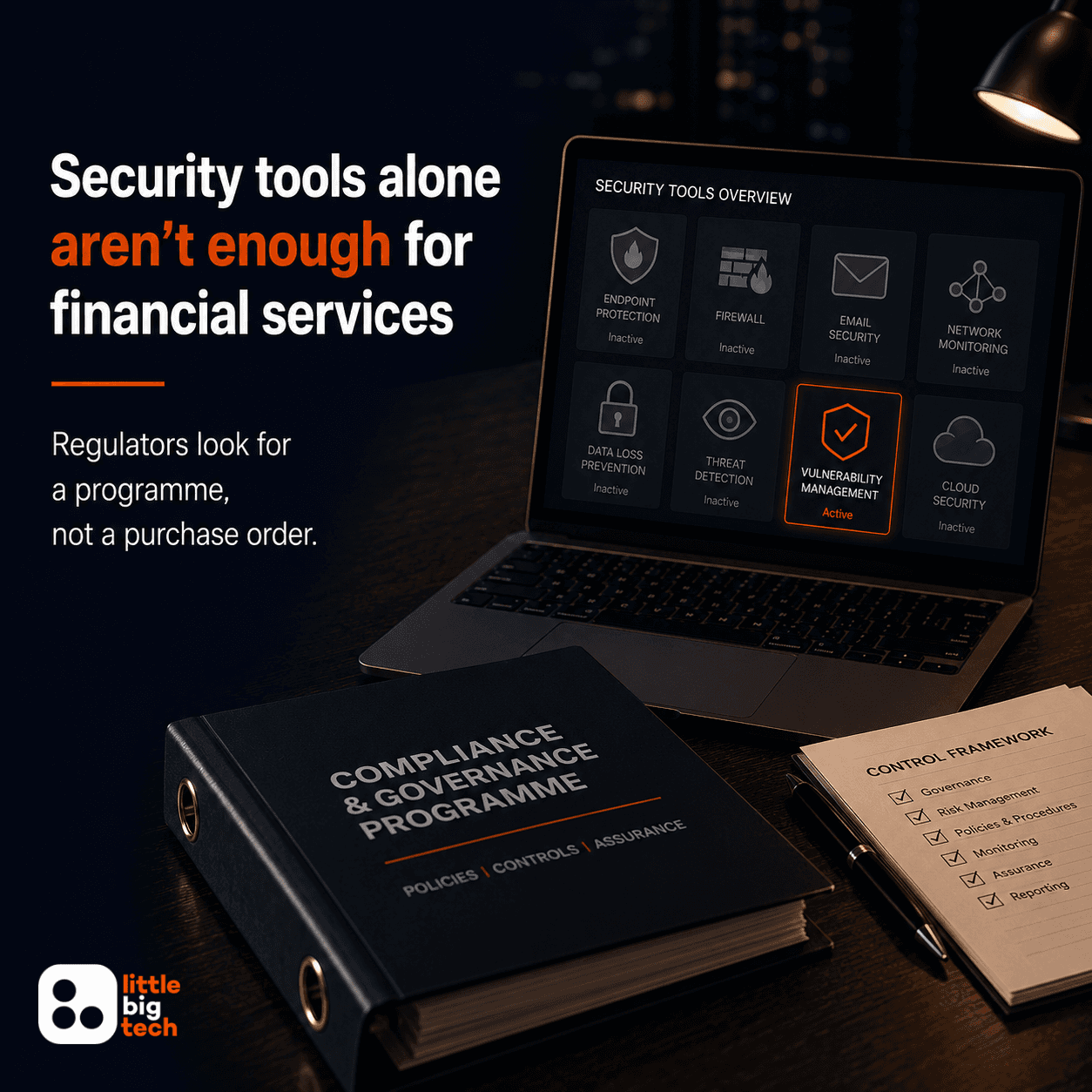
A lot of firms believe they're secure because they've bought security software. Antivirus, a firewall, maybe multi-factor authentication on email. All useful. None of it, on its own, amounts to security.
Tools without oversight are just expensive assumptions. Financial services firms, holding some of the most attractive data on the internet, can't afford to run on assumptions.
This article relates to the Cyber Security Controls domain of the Technology Resilience Score. It looks at whether your firm's security tools are actually working, or just installed.
Why security controls are different for financial services firms
Attackers target financial services firms specifically because of what sits behind the login screen: client money, deal information, personal financial data. That makes the sector a higher-value target than most, and a proportionately weaker security posture more dangerous.
- Boutique firms are often seen as easier targets than larger institutions with bigger security budgets
- Attackers increasingly research a firm's deals and clients before crafting an attack
- A successful breach can affect multiple client relationships and investor commitments at once
- Reputational damage in a trust-based business can outlast the technical incident itself
Security tools are a starting point, not a finishing line.
Cyber Security Controls in an operationally resilient firm
The FCA's operational resilience expectations don't stop at having controls in place — they extend to a firm's ability to detect and respond when those controls are tested. A tool that silently fails, or an alert that no one is watching, doesn't reduce risk; it just hides it. Firms need to be able to show that their security controls are actively managed, not just deployed once and left.
This is where many firms fall short — not in the tools they've bought, but in the process wrapped around them. The key question becomes: "If our security software flagged something suspicious at 11pm tonight, would anyone see it, and would anyone know what to do?"
Is your firm's technology environment resilient?
Find out whether your security tools are actively managed, or simply switched on and forgotten.
Get your Technology Resilience ScoreThe problem with tools alone
Buying security software is easy. Running it properly is the part most firms underinvest in.
- Security tools installed but never tuned to the firm's actual environment
- Alerts generated but nobody responsible for reviewing them
- No clear process for what happens when a genuine threat is detected
- Tools purchased in response to a specific worry, without a coordinated overall approach
A tool nobody is watching provides the appearance of security without the substance of it.
What weak security controls look like in a financial services firm
These are recurring patterns in firms that have invested in tools but not in the process around them.
- No one actively reviewing security alerts on a regular basis
- Multi-factor authentication applied inconsistently across systems
- No defined incident response process if a threat is confirmed
- Security configurations left at default settings since installation
- No regular testing of whether controls actually catch realistic threats
- Different tools from different providers with no coordinated oversight
Each gap means a real threat has a better chance of going unnoticed.
What strong looks like
A well-secured firm treats tools as one part of a coordinated programme. Controls are configured deliberately for the firm's environment, alerts are reviewed by someone with the expertise to act on them, and there is a clear, rehearsed process for what happens when a threat is confirmed.
Security in this model is a discipline, not a purchase — reviewed, adjusted and tested over time as threats and the firm's own environment change.
How this TRS domain helps financial services firms improve
The Cyber Security Controls domain of the Technology Resilience Score looks beyond whether tools are installed, to whether they are actively monitored, properly configured and backed by a clear response process.
- Reviews the coverage and configuration of existing security tools
- Assesses whether alerts are actively monitored and acted upon
- Checks whether an incident response process exists and has been tested
- Identifies gaps where tools operate independently rather than as a coordinated programme
The result is a score out of 5, giving your firm a clear baseline and a structured improvement path from tools to a genuine security programme.
From tools to a programme
The firms that stay ahead of cyber threats are not necessarily the ones with the most software. They're the ones who treat security as an ongoing discipline, with clear ownership and regular review, rather than a one-off purchase.
The Technology Resilience Score gives ambitious financial services firms a benchmark across 10 domains, including Cyber Security Controls, so security spend translates into genuine protection.
Related reading
Is your firm's technology environment resilient?
Find out how prepared your firm really is to keep operating and evidence its resilience, with a free Technology Resilience Score™ for financial services.
Our services