Security · IT Support
Every Device Is a Doorway Into Your Business
6 July 2026
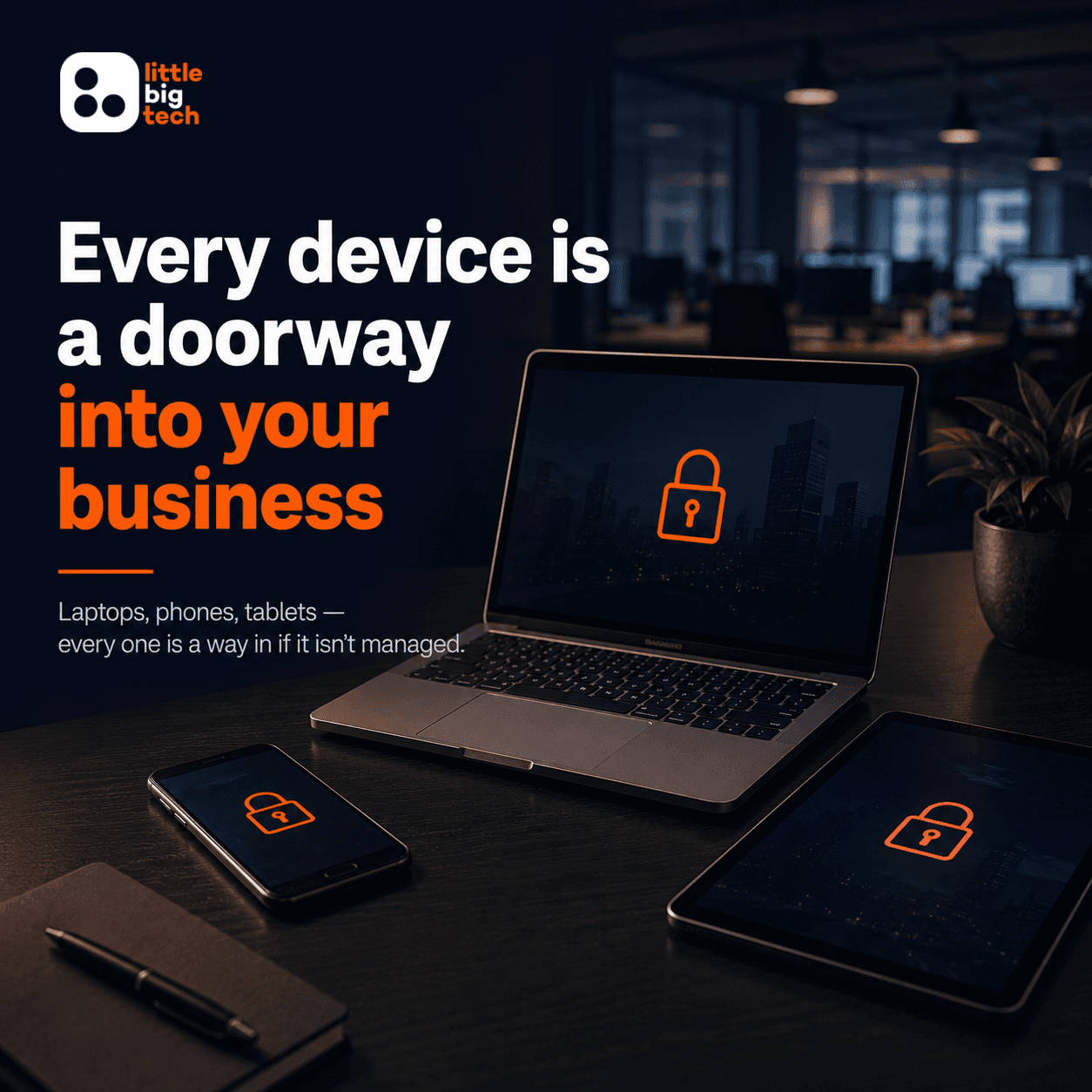
Somewhere in your business right now, there's a laptop that hasn't been updated in months, a phone with company email on it that nobody in IT knows about, or a tablet a former employee still technically has access from. None of this is unusual. It's simply what happens when devices multiply faster than the processes for managing them.
Every one of those devices is a way into your business — into your email, your customer data, your finance systems. If you can't say with confidence which devices exist, who has them, and how secure they are, then you don't really know how exposed you are.
This article relates to the Endpoint & Device Management domain of the Technology Resilience Score. It looks at whether your business can track, secure and manage the devices your team relies on every day.
Why endpoint management matters for growing businesses
Endpoint and device management is the process of tracking, securing and managing the laptops, desktops, phones and tablets that access business systems and data. Done properly, it means the organisation always knows which devices exist, who has them, and can act quickly if one is lost, stolen or compromised.
- A live, accurate inventory of every device that can access company data
- Security settings — encryption, screen locks, updates — applied consistently across all devices
- The ability to remotely lock or wipe a device that's lost or stolen
- A clear process for removing access when someone leaves the business
Without this, every new laptop or phone added to the business is another blind spot rather than another asset.
What this looks like without dedicated IT
In a business without a dedicated IT function, devices tend to get bought reactively — a new starter needs a laptop, someone loses their phone, a manager wants a tablet for site visits. Each purchase solves an immediate problem but rarely gets folded into any central record. Personal phones checking work email is common, and nobody's quite sure how many devices are actually out there.
This isn't negligence — it's what happens when the business is focused on winning work, not managing an asset register. But it does create real risk as headcount grows. The key question becomes: "If a laptop went missing tomorrow, would we know what data was on it and be able to act immediately?"
Is your business's technology environment resilient?
Find out whether every device connecting to your systems is properly tracked, secured and accounted for.
Get your Technology Resilience ScoreThe problem with informal device management
Without a structured approach, device management becomes reactive — dealt with only when something breaks or goes missing, rather than managed continuously.
- No central record of which devices hold company data
- Inconsistent security settings between company and personal devices
- No way to remotely lock or wipe a device if it's lost
- Leavers retaining access to email or files on personal devices
Each gap on its own seems minor. Together, they add up to a business that genuinely doesn't know its own exposure.
What weak device management looks like in a growing business
These patterns tend to appear as headcount grows faster than the processes supporting it.
- No single list of every device that can access company systems
- Personal phones and laptops used for work with no security requirements applied
- Software updates and security patches applied inconsistently, if at all
- No process for wiping devices when staff leave or upgrade
- Lost or stolen devices reported informally, if reported at all
- No encryption on laptops carrying sensitive customer or financial data
Individually these look like small oversights. Collectively, they represent an open door.
What strong looks like
A well-managed environment has a live inventory of every device, with security policies enforced automatically rather than left to individual judgement. Lost or stolen devices can be remotely locked or wiped within minutes, and access is revoked the moment someone leaves the business — not weeks later when someone remembers.
Devices are treated as an extension of the network they connect to, not as separate personal property that happens to touch company data. That shift in mindset is what separates resilient businesses from exposed ones.
How this TRS domain helps businesses improve
The Technology Resilience Score assesses Endpoint & Device Management as one of ten domains, giving a structured picture of how well your devices are tracked and protected.
- Reviews whether a complete, accurate device inventory exists
- Assesses security configuration and patching consistency across devices
- Checks whether lost or stolen devices can be remotely secured
- Confirms leaver processes actually remove access on every device
The outcome is a score out of 5 for this domain, giving you a clear baseline and a structured improvement path.
Closing the gaps before they're exploited
As teams grow and hybrid working becomes the norm, the number of devices touching your systems only increases. Getting ahead of that now is far cheaper than dealing with the fallout of a lost laptop full of customer data.
The Technology Resilience Score gives ambitious SMEs a benchmark across 10 domains, including Endpoint & Device Management.
Related reading
Is your business's technology environment resilient?
Find out how prepared you really are to keep operating and recover quickly if disruption hits — with a free Technology Resilience Score™.
Our services