Security · IT Support
Your People, Your Biggest Security Risk
6 July 2026
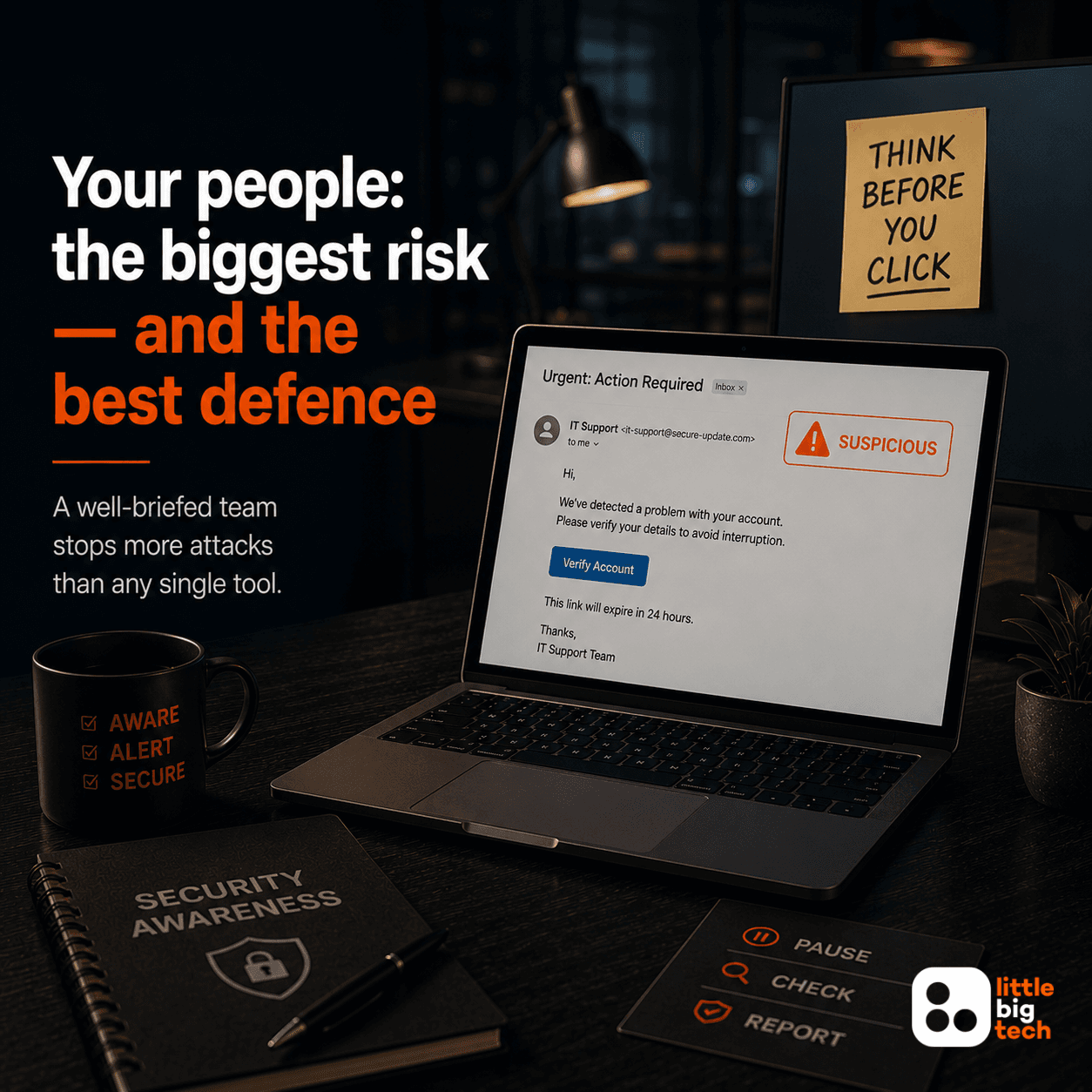
Every serious security incident eventually gets traced back to a moment where a person made a decision — clicked a link, approved a payment, plugged in a USB stick, reused a password. That's not a design flaw in your staff. It's how attackers have chosen to operate, because it's usually easier than breaking through technical defences.
This means the people in your business are simultaneously your biggest source of risk and, done right, your strongest line of defence. Which one they turn out to be depends almost entirely on how well they're trained and how safe they feel raising concerns.
This article relates to the User Awareness & Culture domain of the Technology Resilience Score. It looks at whether your staff can recognise and respond to threats, and whether your culture supports them in doing so.
Why user awareness matters for growing businesses
User awareness and culture covers the training and education of staff to recognise and respond to threats such as phishing and social engineering. Culture refers to the environment created around reporting and acceptable use — whether people feel able to flag a mistake or a suspicious email without fear of blame.
- Staff who can recognise the common signs of phishing and social engineering
- Clear, simple guidance on acceptable use of business systems and data
- A culture where people report suspicious activity quickly, without fear
- Regular refreshers, because awareness fades and tactics evolve
Without this, even the best technical defences are working around a gap that attackers actively look for.
Why this matters as you scale
As a business grows and hires faster, security awareness training often becomes a box ticked once during induction and never revisited. New starters absorb the culture around them rather than any formal guidance — and if that culture treats mistakes as something to hide rather than report, problems go unnoticed for longer.
This is rarely a deliberate choice; it's simply what happens when growth outpaces the time available to build a genuine security culture. The key question becomes: “If a member of staff clicked a suspicious link tomorrow, would they tell someone straight away?”
Is your business's technology environment resilient?
Find out whether your people are equipped to spot threats, and confident enough to report them.
Get your Technology Resilience ScoreThe problem with one-off training
A single induction session on security rarely changes behaviour long-term, especially as threats evolve faster than any annual refresher.
- Training delivered once, at induction, and never repeated
- No simulated phishing or practical testing of what's been learned
- A culture where reporting a mistake feels riskier than staying quiet
- No clear, simple channel for staff to flag something suspicious
Awareness that isn't reinforced fades quickly, leaving the same vulnerability it was meant to close.
What weak user awareness looks like in a growing business
These patterns tend to appear as teams grow beyond the size where informal culture alone can carry security awareness.
- No regular, structured security awareness training for staff
- Staff unsure what to do if they suspect a phishing email
- No simulated exercises to test how staff actually respond under pressure
- A blame culture that discourages people from admitting mistakes
- Passwords shared or reused across multiple business systems
- Security treated as an IT problem rather than everyone's responsibility
Each of these makes it more likely a genuine threat succeeds simply because no one felt able to stop it in time.
What strong looks like
A resilient business trains staff regularly, using realistic scenarios rather than one-off presentations, and reinforces that training over time as threats change. Reporting a mistake or a suspicious message is treated as the right thing to do, not a source of embarrassment — which means problems surface quickly, while they're still small.
Security becomes something the whole business owns, rather than a responsibility handed entirely to whoever manages the IT.
How this TRS domain helps businesses improve
The Technology Resilience Score assesses User Awareness & Culture as one of ten domains, recognising that people are as central to resilience as any technical control.
- Reviews what training exists and how regularly it's delivered
- Assesses whether staff can recognise common attack techniques
- Checks whether the reporting culture actually encourages disclosure
- Benchmarks awareness maturity against comparable businesses
The result is a score out of 5 for this domain, giving you a clear baseline and a structured improvement path.
Turning your people into your defence
Technology alone was never going to be enough. The businesses that hold up best under pressure are the ones where every member of staff understands their role in keeping the business safe, and feels able to speak up the moment something feels wrong.
The Technology Resilience Score gives ambitious SMEs a benchmark across 10 domains, including User Awareness & Culture.
Related reading
Is your business's technology environment resilient?
Find out how prepared you really are to keep operating and recover quickly if disruption hits — with a free Technology Resilience Score™.
Our services