Security · IT Support
Why Growing Firms Need Real IT Governance
6 July 2026
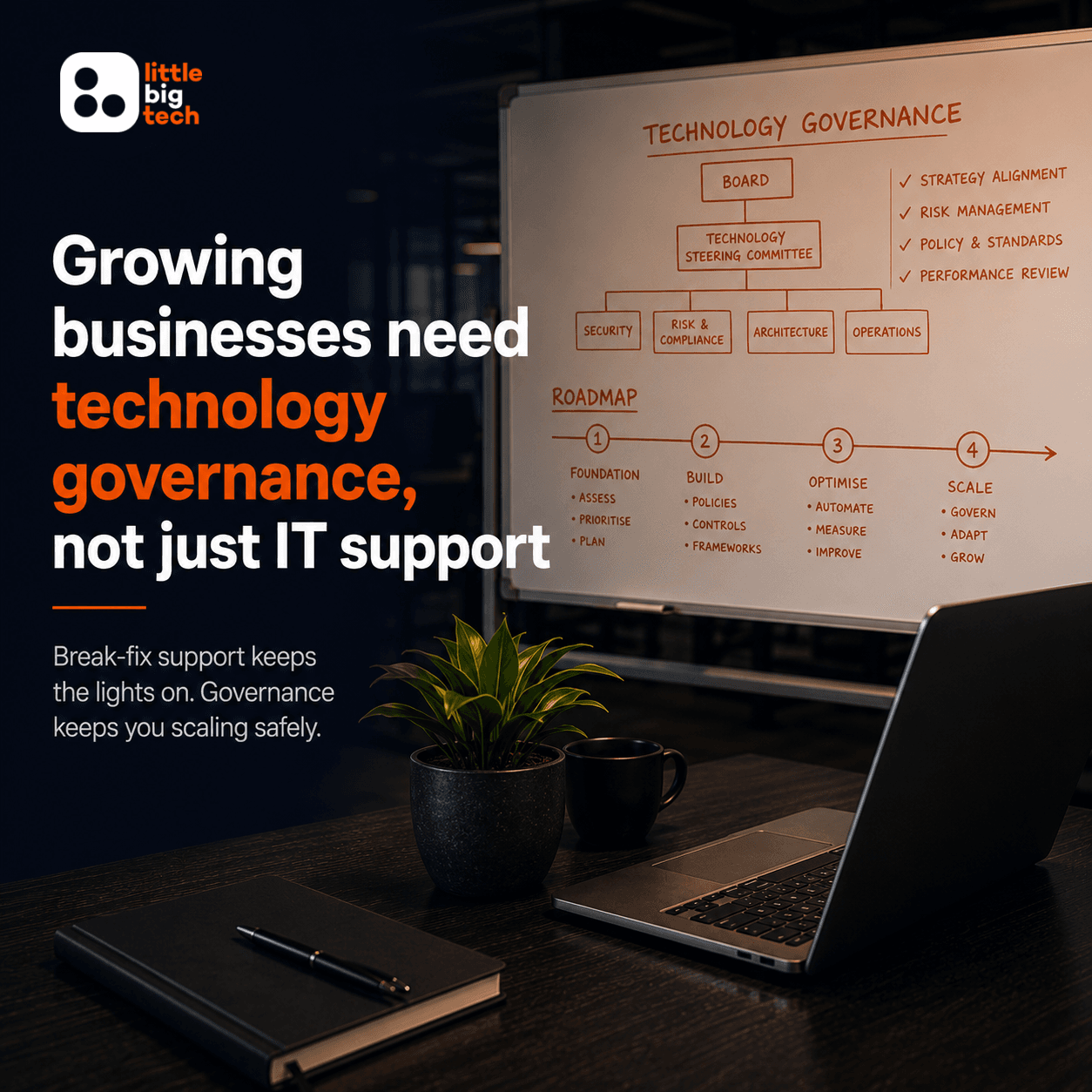
Most SMEs start their technology journey the same way: something breaks, somebody fixes it. That model works fine when the business is five people and two laptops. It stops working somewhere around the point where technology decisions start affecting revenue, compliance and customer trust — and most businesses cross that line without noticing.
What replaces break-fix isn't more support tickets. It's governance — someone actually deciding, deliberately, what the business's technology should look like and why, instead of it accumulating by accident.
This article relates to the IT Strategy & Governance domain of the Technology Resilience Score. It looks at whether your business has clear ownership and planning over its technology environment, rather than just people who fix things when they break.
Why governance matters for growing businesses
IT strategy and governance is how an organisation makes decisions about systems, data, risk and technology investment. It's about whether a business has clear ownership, visibility, planning and accountability across its technology environment, rather than decisions being made ad hoc by whoever happens to be dealing with the problem that day.
- Clear ownership of technology decisions, rather than decisions made by default
- Visibility over what systems exist and why they were chosen
- A plan for technology investment that's tied to business priorities
- Accountability when something goes wrong, rather than confusion about whose job it was
Without governance, technology decisions get made reactively, by whoever's most available, with no thought for how they fit the bigger picture.
Why this matters as you scale
Early on, technology decisions in an SME are usually made by the founder or a generalist member of staff, alongside a dozen other responsibilities. That's a sensible way to start. But as the business grows, those same ad hoc decisions start to compound — mismatched systems, duplicated tools, security gaps nobody owns.
Nobody sets out to run technology this way; it's just what happens without anyone stepping back to take a strategic view. The key question becomes: "If we asked who owns our technology risk and roadmap, would we get a clear answer?"
Is your business's technology environment resilient?
Find out whether your technology decisions are genuinely governed, or simply happening by default.
Get your Technology Resilience ScoreThe problem with reactive technology management
Without governance, technology stops serving the business's direction and starts constraining it — because nobody's steering.
- No one person or group accountable for technology decisions
- Systems chosen by individual teams with no view of the whole business
- No plan connecting technology spend to business priorities
- Risk decisions made informally, if they're made consciously at all
The result is a technology environment that reflects a series of individual choices rather than a coherent strategy.
What weak governance looks like in a growing business
These patterns are common in businesses that have grown quickly without investing in oversight.
- No regular review of technology risk or investment
- Decisions about new systems made without any security or compliance check
- No documented view of what's owned, licensed or contracted
- Leadership unaware of what technology risk the business is actually carrying
- IT support treated purely as a cost to minimise, not a lever for growth
- No forward plan for how technology will need to change as the business grows
Each of these leaves a business vulnerable to decisions that felt sensible individually but don't add up collectively.
What strong looks like
A well-governed business has clear ownership of technology decisions, whether that sits with a leadership team member or an outsourced partner acting in that capacity. There's a documented view of what systems exist, why they're there, and what risk they carry, alongside a forward plan that ties technology investment to where the business is heading.
Crucially, governance means someone is accountable — not just for fixing problems, but for making sure fewer of them happen in the first place.
How this TRS domain helps businesses improve
The Technology Resilience Score assesses IT Strategy & Governance as one of ten domains, helping growing businesses see clearly whether they're steering their technology or simply reacting to it.
- Reviews whether clear ownership exists for technology decisions
- Assesses whether risk and investment decisions are documented and planned
- Checks visibility over the full technology estate
- Benchmarks governance maturity against comparable businesses
The result is a score out of 5 for this domain, giving you a clear baseline and a structured improvement path.
Moving from reactive to strategic
The businesses that scale successfully are the ones that stop treating technology as a cost centre to be minimised and start treating it as a set of decisions worth making deliberately. That shift doesn't require a huge internal team — it requires clear ownership and a structured view of risk.
The Technology Resilience Score gives ambitious SMEs a benchmark across 10 domains, including IT Strategy & Governance.
Related reading
Is your business's technology environment resilient?
Find out how prepared you really are to keep operating and recover quickly if disruption hits — with a free Technology Resilience Score™.
Our services