Security · IT Support
Why SMEs Need Strategy, Not Break-Fix IT
6 July 2026
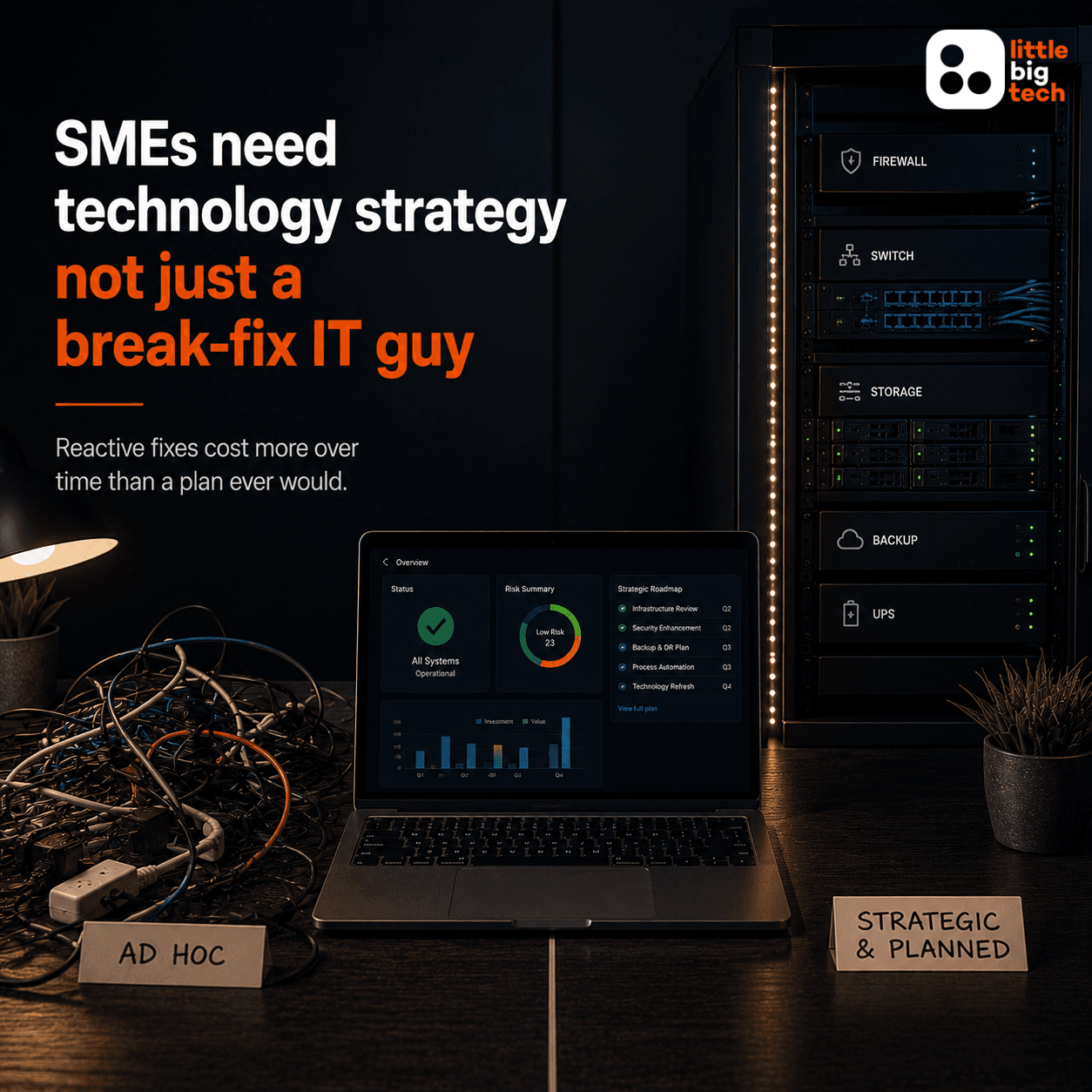
There's a particular pattern common to growing SMEs: a trusted individual — sometimes internal, sometimes a local contractor — who gets called whenever something technical goes wrong. They're reliable, responsive, and genuinely good at fixing the immediate problem. What they're rarely asked to do is plan.
That's not a criticism of the person. It's a description of the relationship, which is built around reaction rather than direction. As a business grows, the absence of a plan starts to cost more than any individual fix ever saves.
This article relates to the Technology Strategy & Governance domain of the Technology Resilience Score. It looks at whether your business is making deliberate decisions about its technology, or simply reacting to whatever breaks next.
Why technology strategy matters for growing businesses
Technology strategy and governance is how an organisation makes decisions about systems, data, risk and technology investment. It's about whether a business has clear ownership, visibility, planning and accountability across its technology environment, connecting day-to-day IT decisions to where the business is actually heading.
- A forward-looking view of what technology the business will need as it grows
- Investment decisions tied to business priorities, not just urgent problems
- Clear ownership of risk, rather than risk sitting with whoever's available
- Regular review of whether the current setup still fits the business
Without this, technology decisions get made one fire at a time, with no connection between them.
Why this matters as you scale
Break-fix support suits a small, simple business well — it's affordable, responsive and low-commitment. But once a business has multiple systems, remote staff, sensitive customer data and growth ambitions, the model starts to strain. Nobody is looking two steps ahead; everyone is responding to whatever's urgent today.
This isn't a failure of the individuals involved — it's a mismatch between what the relationship was designed to do and what the business now needs. The key question becomes: "Who in our business is actually planning our technology future, rather than just fixing today's problem?"
Is your business's technology environment resilient?
Find out whether your technology is being planned strategically, or just patched up as it breaks.
Get your Technology Resilience ScoreThe problem with break-fix as a long-term model
Break-fix support solves the problem in front of it but has no incentive or mandate to look further ahead.
- No forward plan for how systems will need to change as headcount grows
- Investment decisions made only when something has already gone wrong
- No one accountable for the overall shape of the technology estate
- Security and compliance treated as separate concerns, rarely addressed proactively
The business ends up with a collection of fixes rather than a coherent environment.
What weak technology strategy looks like in a growing business
These signs are common in businesses that have outgrown a break-fix relationship without realising it.
- No documented plan for technology beyond the next few months
- Recurring problems that get fixed repeatedly rather than resolved at the root
- Leadership with limited visibility into technology risk or spend
- New systems added without any assessment of how they fit the wider environment
- No regular strategic conversation about where technology needs to go next
- Support relationships that are transactional rather than advisory
None of this shows up as a crisis immediately — it shows up as slow, compounding drag on the business.
What strong looks like
A business with real technology strategy has a partner — internal or outsourced — who understands where the business is heading and plans the technology environment accordingly. Investment decisions are made ahead of need, not in response to failure, and there's a clear, regularly reviewed roadmap connecting technology to business goals.
Support still matters, and things will still occasionally break. The difference is that fixing them is no longer the whole relationship — it's one part of a much bigger, more deliberate picture.
How this TRS domain helps businesses improve
The Technology Resilience Score assesses Technology Strategy & Governance as one of ten domains, helping SMEs see clearly whether they have a plan or just a habit of reacting.
- Reviews whether a documented technology roadmap exists
- Assesses whether investment is planned or purely reactive
- Checks ownership and accountability for technology risk
- Benchmarks strategic maturity against comparable businesses
The result is a score out of 5 for this domain, giving you a clear baseline and a structured improvement path.
Moving beyond the break-fix guy
Outgrowing break-fix support isn't a criticism of the people who've kept things running — it's a natural consequence of growth. The businesses that plan for that transition early tend to scale with far fewer expensive surprises.
The Technology Resilience Score gives ambitious SMEs a benchmark across 10 domains, including Technology Strategy & Governance.
Related reading
Is your business's technology environment resilient?
Find out how prepared you really are to keep operating and recover quickly if disruption hits — with a free Technology Resilience Score™.
Our services