Security · IT Support
Why Security Tools Aren't Enough for Law Firms
26 June 2026
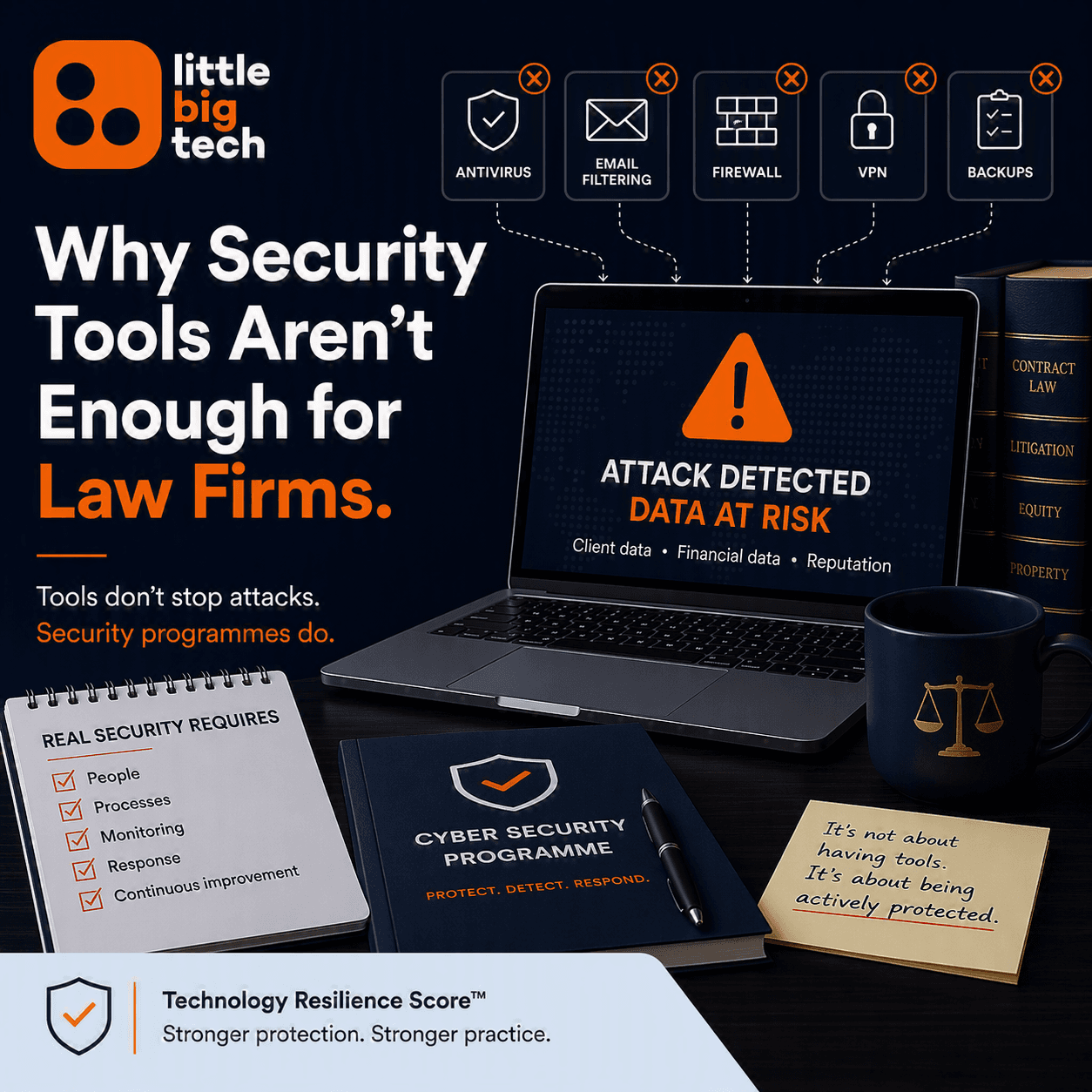
Law firms are a prime target for cyber attacks.
They hold sensitive client information, manage financial transactions and work to deadlines that make disruption costly. Most SME firms have invested in security tools — antivirus, email filtering, firewalls. But tools alone do not stop attacks.
As firms increasingly rely on platforms like Clio for matter management, billing and communication, the impact of a security failure becomes more significant.
This article relates to the Cyber Security Controls domain of the Technology Resilience Score. It looks at whether your firm's defences are working as a programme — or simply installed as products.
Why cyber risk is higher for law firms
Law firms present a valuable target. They hold confidential information, handle client funds and operate under time pressure. This combination makes them attractive to attackers using:
- phishing attacks
- credential theft
- payment redirection fraud
- unauthorised access to sensitive data
If security controls are not properly configured and monitored, these attacks can succeed quickly. This creates financial, regulatory and reputational consequences for the firm.
Where Clio fits into security controls
Platforms like Clio are becoming central to how SME law firms operate. They support case management, billing and client communication. This centralisation increases efficiency, but also concentrates critical data and activity. That makes strong security controls essential.
A practice management platform must sit within a wider security programme that includes:
- secure user access
- protected endpoints
- strong email security
- continuous monitoring and response
As a Clio partner, Little Big Tech helps firms ensure that practice management platforms are supported by a secure, actively managed environment. The key question becomes: "Are our systems actively protected, or just configured?"
Is your firm's technology environment resilient?
If your firm relies on platforms like Clio, the question is not just whether they are in place — it is whether the surrounding environment is resilient.
Get your Technology Resilience ScoreThe problem with tool-based security
Many firms believe they are secure because they have purchased the right tools. In practice:
- configurations may be left at default
- alerts may not be monitored
- vulnerabilities may not be addressed quickly
- response processes may not be defined
This creates gaps that attackers can exploit. A tool that is not actively managed does not provide reliable protection.
What weak looks like in a law firm
Weak cyber security controls often appear as:
- reliance on traditional antivirus
- default email security settings
- lack of enforcement for protections such as DMARC
- firewalls that are not reviewed regularly
- inconsistent patching and updates
- no structured response to security alerts
These issues are common — and they create exposure.
What strong looks like
A well-protected firm operates a coordinated security programme. Security tools are configured properly, monitored continuously and integrated into clear processes. Threats are detected early and responded to quickly. Email, endpoints and network controls work together as part of a structured defence.
This allows the firm to operate confidently and reduce the likelihood of successful attacks.
How this TRS domain helps law firms improve
The Cyber Security Controls domain of the Technology Resilience Score helps firms assess whether their security is effective in practice. It looks at whether:
- controls are properly configured
- threats can be detected
- alerts are acted on
- vulnerabilities are managed
- the overall programme works together
The result is a score out of 5. That score provides a clear baseline and a structured path to improvement.
Why this matters for modern, AI-supported firms
As firms adopt AI features and rely more on platforms like Clio, the pace of work increases. This means that a successful attack can have faster and wider impact. Strong cyber security controls allow firms to adopt new technology with confidence, knowing that risks are being actively managed and contained.
The Technology Resilience Score gives SME law firms a clear benchmark across 10 domains, including Cyber Security Controls. As a Clio partner, Little Big Tech helps firms build a security programme around the platforms they rely on every day. Find out more about our approach at our Technology Resilience Score™ framework.
Related reading
Is your firm's technology environment resilient?
Find out how well protected your matter files, client account and email really are, with a free Technology Resilience Score™ written for law firms.
Our services