Security · IT Support
Every Device Is a Doorway to Client Data
26 June 2026
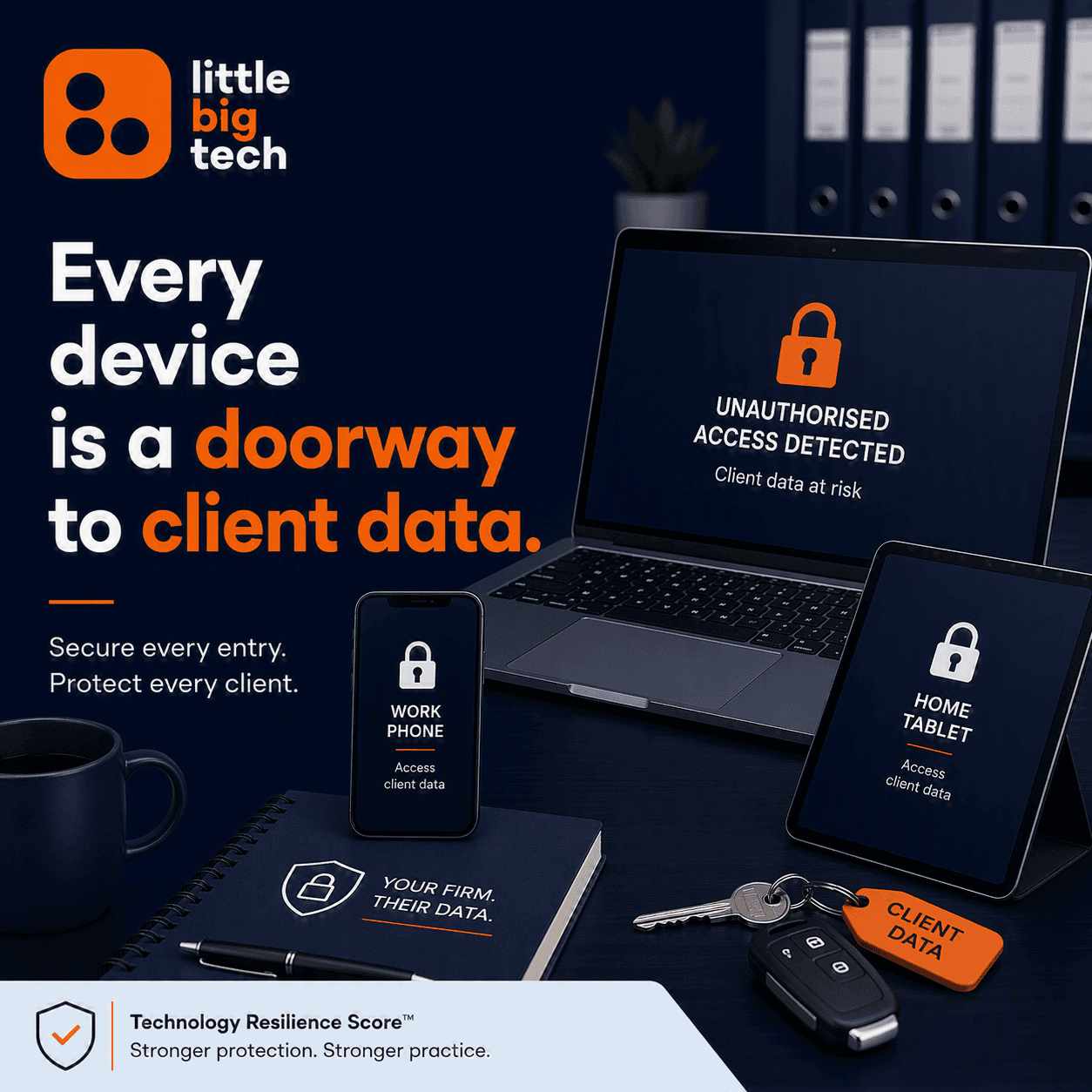
A modern law firm no longer works from one office or one set of fixed computers.
Fee earners draft documents on laptops, check emails on phones, review matters remotely and work from home, court, client sites and trains. That flexibility is now part of how SME law firms operate. But every device used to access client information is also a doorway into the firm.
As firms increasingly use platforms like Clio for matter management, documents, billing and client communication, device control becomes even more important.
This article relates to the Endpoint & Device Management domain of the Technology Resilience Score. It looks at whether your firm can see, manage and secure every device that touches client data.
Why device management is different for law firms
Law firms handle confidential, privileged and personal information every day. That information is no longer only accessed from office desktops — it is accessed from laptops, phones and tablets across multiple locations.
If a device is lost, stolen or compromised, the issue is not simply the cost of replacing it. The firm may need to consider:
- whether client data was accessible
- whether the device was encrypted
- whether access can be revoked
- whether the device can be wiped
- whether the incident creates reporting obligations
- whether clients need to be informed
A lost laptop in a well-managed firm is an inconvenience. A lost laptop in a poorly managed firm can become a data breach. That is why endpoint and device management matters.
Where Clio fits into device management
Platforms like Clio allow law firms to manage matters, documents, billing and client communication from more locations and devices. That flexibility is valuable. But it also means that confidential client data may be accessed from laptops, phones and tablets outside the office.
A practice management platform should sit within a wider device management model that includes:
- managed laptops and desktops
- secure mobile access
- device encryption
- remote wipe capability
- controlled access from personal devices
- consistent patching and configuration
As a Clio partner, Little Big Tech helps firms ensure that modern practice management is supported by a secure and controlled device environment. The key question becomes: "Can we secure every device that can access our client data?"
Is your firm's technology environment resilient?
If your firm relies on platforms like Clio, the question is not just whether they are in place — it is whether the surrounding environment is resilient.
Get your Technology Resilience ScoreThe problem with unmanaged devices
Many firms have more devices accessing data than they realise. Some are firm-owned. Some are personal. Some are old devices that were never formally retired. Some belong to former staff whose access was not fully removed.
If the firm does not know a device exists, it cannot secure it, update it, encrypt it, lock it, wipe it, or prove what data it could access. That lack of visibility makes incidents harder to manage and harder to explain.
What weak looks like in a law firm
Weak endpoint and device management often appears as:
- no complete register of laptops, desktops, phones and tablets
- personal devices accessing firm email or matter data without control
- devices that are not consistently encrypted
- patching left to individual users
- no ability to remotely wipe lost or stolen devices
- old devices remaining in circulation
- unclear ownership of device lifecycle management
These issues may feel operational rather than strategic. But they directly affect confidentiality, compliance and resilience.
What strong looks like
A well-managed firm has clear control over every device that touches client data. Every laptop, desktop, phone and tablet is recorded in an asset register. The firm knows who has each device, what it can access and when it should be replaced.
Devices are encrypted, patched and configured to a defined baseline. Mobile device management is in place so devices can be secured, locked or wiped where needed. In this environment, flexible working becomes safer — fee earners can work from home, court or client sites without the firm losing control of its data.
How this TRS domain helps law firms improve
The Endpoint & Device Management domain of the Technology Resilience Score helps law firms assess how much control they really have over the devices accessing client information. It looks at whether:
- devices are visible and recorded
- ownership and lifecycle information is maintained
- mobile devices are managed
- devices are encrypted and patched
- security baselines are consistently applied
- lost or stolen devices can be controlled quickly
The result is a score out of 5. That score gives the firm a clear baseline and a practical route to stronger control.
Why this matters for modern, mobile and AI-enabled firms
Modern law firms need people to work securely from anywhere. Platforms like Clio support that flexibility by making matter information, documents and workflows easier to access. AI-enabled features increase the value of that access by helping fee earners draft, summarise and work faster. But the more useful that access becomes, the more important device control becomes.
Strong endpoint management allows firms to embrace modern, mobile and AI-supported working without scattering client data across uncontrolled devices.
The Technology Resilience Score gives SME law firms a benchmark across 10 domains, including Endpoint & Device Management. As a Clio partner, Little Big Tech helps firms build a secure device environment around the platforms their people rely on every day. Find out more about our approach at our Technology Resilience Score™ framework.
Related reading
Is your firm's technology environment resilient?
Find out how well protected your matter files, client account and email really are, with a free Technology Resilience Score™ written for law firms.
Our services