Security · IT Support
Would Your Law Firm Even Know?
26 June 2026
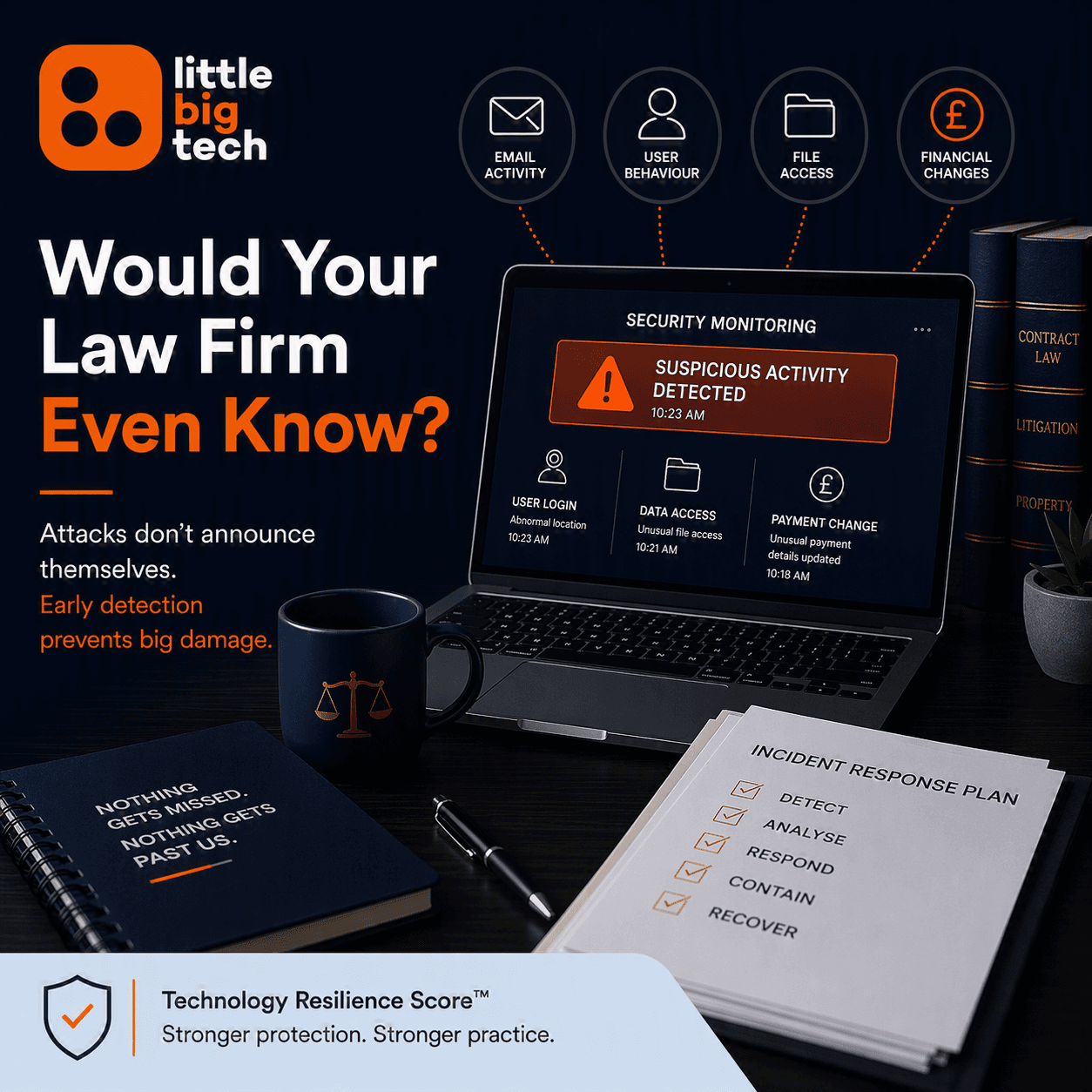
A security incident does not begin when a firm notices it.
It begins when access is gained — often silently.
For many SME law firms, the real question is not whether an incident could happen. It is whether the firm would detect it quickly enough to prevent serious damage. As firms increasingly rely on platforms like Clio for matter management, communication and billing, visibility across systems becomes more important. More activity, more data and more integrations mean more to monitor.
This article relates to the Monitoring, Logging & Incident Response domain of the Technology Resilience Score. It looks at whether your firm can detect suspicious activity early and respond effectively when it matters.
Why detection and response are critical for law firms
Law firms handle high-value, sensitive information and financial transactions. If an attacker gains access and remains undetected, they may:
- read confidential client correspondence
- understand billing and payment workflows
- intercept or redirect funds
- compromise active matters
Detection time directly affects impact. A compromise detected after weeks can lead to serious financial and reputational damage. A compromise detected within hours is far more likely to be contained.
For law firms, this is not just technical risk. It is commercial risk and professional responsibility.
Where Clio fits into monitoring and visibility
Platforms like Clio are increasingly central to how SME law firms operate. They support matter management, communication, billing and workflow. This centralisation improves efficiency — but it also concentrates activity and data. That makes visibility more important.
A well-managed environment ensures that activity across platforms like Clio, alongside email, devices and other systems, is logged and monitored.
As a Clio partner, Little Big Tech helps firms ensure that practice management sits within a wider environment that is visible, monitored and responsive to risk. The key question is: "Would we know if something unusual was happening?"
Is your firm's technology environment resilient?
If your firm relies on platforms like Clio, the question is not just whether they are in place — it is whether the surrounding environment is resilient.
Get your Technology Resilience ScoreThe problem with delayed detection
Most firms do not deliberately choose slow detection. They simply lack the visibility to detect issues early. Logs may exist, but they are:
- not centralised
- not actively reviewed
- not connected across systems
This means suspicious activity can go unnoticed. By the time an issue becomes visible — through a failed transaction or a client complaint — the damage has often already been done.
What weak looks like in a law firm
Weak monitoring and response may look like:
- no centralised logging
- alerts that are not reviewed consistently
- no defined incident response process
- reliance on IT support reacting after the fact
- limited ability to investigate incidents
- unclear understanding of what activity is normal
These issues create a reactive environment where issues are discovered late.
What strong looks like
A well-prepared firm has continuous visibility across its systems. Activity is logged centrally. Alerts are monitored and investigated. Suspicious behaviour is identified early.
An incident response plan defines how the firm reacts. It has been tested and improved over time. This allows the firm to detect, contain and recover quickly. In this environment, monitoring supports confident, modern ways of working.
How this TRS domain helps law firms improve
The Monitoring, Logging & Incident Response domain of the Technology Resilience Score helps firms assess their visibility and response capability. It asks questions such as:
- Do we have centralised visibility across systems?
- Are alerts actively monitored?
- How quickly would we detect a problem?
- Do we have a tested response plan?
- Can we investigate and report incidents accurately?
The result is a score out of 5. That score provides a clear baseline and a structured path to improvement.
Why this matters for modern, AI-supported firms
As firms adopt AI features and increase reliance on platforms like Clio, the pace of activity increases. That makes fast detection even more important. More automation and faster workflows reduce the time available to spot and respond to abnormal activity.
Strong monitoring ensures that the firm can adopt modern tools while maintaining visibility and control.
The Technology Resilience Score gives SME law firms a clear benchmark across 10 domains, including Monitoring, Logging & Incident Response. As a Clio partner, Little Big Tech helps firms build a resilient, monitored and responsive technology environment. Find out more about our approach at our Technology Resilience Score™ framework.
Related reading
Is your firm's technology environment resilient?
Find out how well protected your matter files, client account and email really are, with a free Technology Resilience Score™ written for law firms.
Our services