Security · IT Support
Could Your Law Firm Survive a Bad Week?
26 June 2026
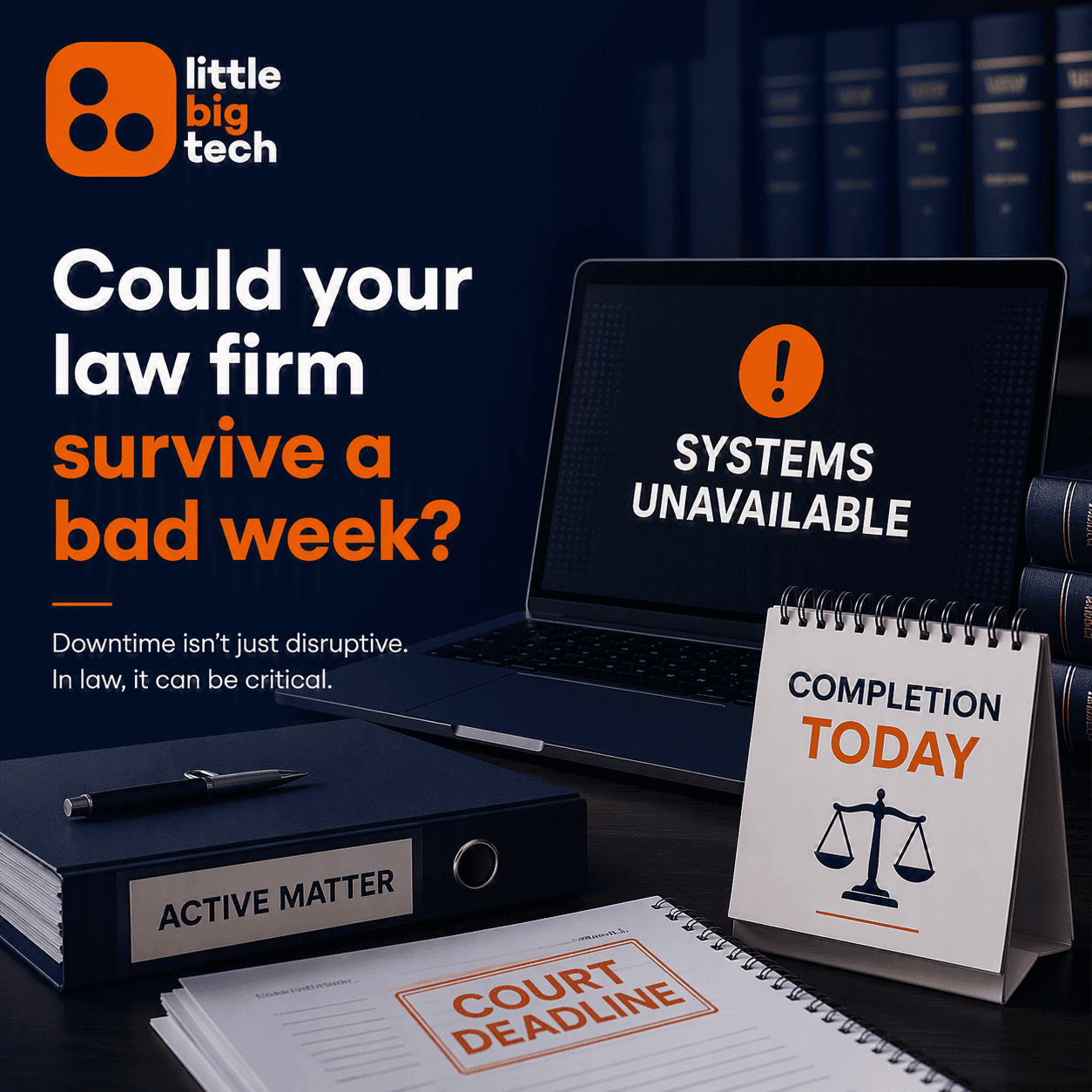
SME law firms depend on technology for almost every part of their operation.
Matter management, client communication, document handling, billing, deadlines and compliance all rely on systems being available when they are needed.
Many firms now centralise this work into platforms like Clio, bringing case data, workflows and client interactions into one place. That improves efficiency — but it also increases dependency. If systems become unavailable, the impact is immediate.
This article relates to the Business Continuity & Disaster Recovery domain of the Technology Resilience Score. It looks at whether your firm could continue operating through disruption and recover quickly when it matters most.
Why continuity and recovery are different for law firms
In most businesses, downtime is disruptive. In a law firm, it can be critical.
Deadlines are fixed. Court filings, completions and limitation dates cannot be missed without consequence. If systems are unavailable:
- matter files may be inaccessible
- client communication may stop
- billing may be delayed
- deadlines may be missed
That creates more than operational inconvenience. It introduces professional negligence risk, regulatory exposure and reputational damage.
Law firms are also attractive targets for cybercrime due to the sensitive and high-value nature of the data they hold. That makes continuity and recovery a professional requirement, not just an IT concern.
Where Clio fits into continuity and recovery
For many SME law firms, a platform like Clio sits at the centre of operations. It supports case management, document handling, time recording, billing and client communication. This centralisation improves control and productivity. But it also means the firm becomes more dependent on access to that platform and the data within it.
Software alone does not create resilience. A practice management platform must sit within a properly planned and tested continuity and recovery strategy. That includes:
- secure access and identity controls
- protected endpoints and devices
- backup and recovery assurance
- documented continuity planning
- integration and dependency awareness
As a Clio partner, Little Big Tech works with firms to ensure that practice management sits within a secure, joined-up and resilient technology environment. The question is not just: "Do we have Clio?" It is: "Could we continue operating if access to our systems was disrupted?"
Is your firm's technology environment resilient?
If your firm relies on platforms like Clio, the question is not just whether they are in place — it is whether the surrounding environment is resilient.
Get your Technology Resilience ScoreThe problem with assumed recovery
Many firms believe they are protected because they have backups. But a backup that has never been tested is not a safeguard. It is an assumption.
Common issues include:
- backups that fail silently
- incomplete coverage across systems
- backups that are exposed to ransomware
- recovery processes that are undocumented
- no validation of how long recovery actually takes
These issues are not visible until recovery is needed. At that point, the firm is no longer planning. It is reacting.
What weak looks like in a law firm
Weak continuity and recovery often show up as:
- no recent restore testing
- reliance on third parties without validation
- unclear recovery expectations
- no documented recovery plan
- no plan for continuing work during outages
- dependency on systems that have not been tested under failure
The firm may operate normally day-to-day, but it is exposed to a single point of failure.
What strong looks like
A well-prepared law firm treats continuity and recovery as proven capability. Backups are automated, offsite and protected from ransomware. Restore testing is carried out and recorded regularly.
A disaster recovery plan exists and has been exercised. Recovery time objectives are aligned to the firm's actual deadlines. A business continuity plan ensures that critical operations can continue even while systems are being restored.
In this environment, disruption is serious — but manageable.
How this TRS domain helps law firms improve
The Business Continuity & Disaster Recovery domain of the Technology Resilience Score gives SME law firms a clear, evidence-based view of their recovery capability. It looks at whether the firm can:
- restore critical systems and data
- meet operational deadlines during disruption
- continue serving clients
- recover within acceptable timeframes
- rely on tested, proven processes
The outcome is a score out of 5. More importantly, it defines a clear improvement path — often moving firms from reactive and exposed to stable and resilient in a focused, measurable way.
Why this matters for modern, platform-led firms
As firms centralise onto platforms like Clio and adopt more automated and AI-supported workflows, access to data becomes even more critical. Efficiency increases — but so does dependency.
Stronger continuity and recovery allow firms to adopt modern working practices with confidence, knowing that disruption will not compromise their ability to operate.
The Technology Resilience Score gives SME law firms a clear benchmark across 10 domains, including Business Continuity & Disaster Recovery. As a Clio partner, Little Big Tech helps firms connect practice management with a resilient operating model that supports growth, security and stability. Find out more about our approach at our Technology Resilience Score™ framework.
Related reading
Is your firm's technology environment resilient?
Find out how well protected your matter files, client account and email really are, with a free Technology Resilience Score™ written for law firms.
Our services