Security · IT Support
Data Protection as a Law Firm Advantage
26 June 2026
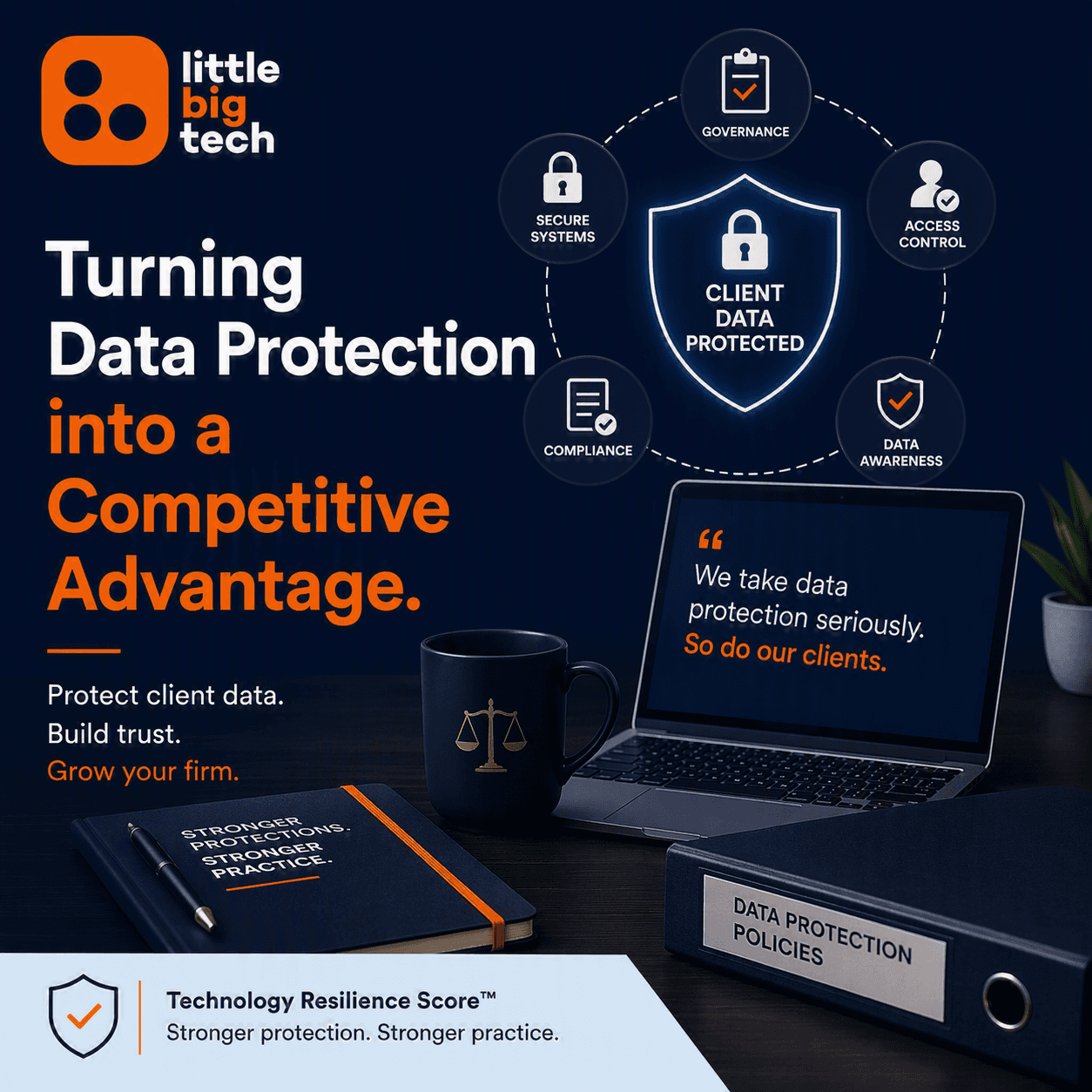
Few sectors depend on sensitive data as much as law firms.
Client information, financial details, identity documents, correspondence and privileged material all sit at the centre of legal work. Many SME firms now manage this through platforms like Clio, alongside email, document storage and other systems. This centralisation improves efficiency and client service — but it also increases the importance of understanding and controlling data.
This article relates to the Data Protection & Compliance domain of the Technology Resilience Score. It looks at whether your firm truly understands its data and can protect it effectively.
Why data protection is different for law firms
Data protection in a law firm is both a regulatory requirement and a professional obligation. Firms are expected to protect client confidentiality while also meeting data protection requirements such as GDPR.
If data is exposed, the firm may face:
- regulatory scrutiny
- client impact and loss of trust
- reputational damage
- difficulty assessing and reporting the incident
If the firm does not know exactly what data it holds or where it is stored, responding becomes significantly harder. This turns a contained issue into a prolonged and uncertain situation.
Where Clio fits into data protection
Platforms like Clio are becoming the operational centre of many SME law firms. They support matter management, documents, billing and client communication. This allows firms to centralise and standardise how work is handled. But it also means large volumes of sensitive data are concentrated within managed platforms and connected systems.
That makes data visibility and classification more important. As a Clio partner, Little Big Tech helps firms ensure that practice management sits within a wider data governance and protection framework. The key question becomes: "Do we understand what data we are handling, and how it should be protected?"
Is your firm's technology environment resilient?
If your firm relies on platforms like Clio, the question is not just whether they are in place — it is whether the surrounding environment is resilient.
Get your Technology Resilience ScoreThe problem with unclear data ownership
Many firms operate with a general awareness of data protection requirements. But in practice:
- data may be spread across systems without a clear map
- classification may not exist or be applied consistently
- processes may rely on individual knowledge
- breach response plans may not be tested
This creates uncertainty at the point of incident. The firm may not be able to determine what data is affected or how serious the impact is.
What weak looks like in a law firm
Weak data protection often appears as:
- no clear data inventory
- inconsistent storage of client information
- lack of data classification
- limited control over how sensitive data is shared
- unclear breach response processes
- reliance on policies rather than enforced controls
These issues may not be visible day-to-day. But they create risk that becomes clear when something goes wrong.
What strong looks like
A well-governed firm has a clear understanding of its data. It knows what it holds, where it is stored and how sensitive it is. Classification is applied and enforced. Sensitive information is handled consistently across systems and processes.
Breach response procedures are defined and tested. The firm can assess impact quickly and respond appropriately. This allows the firm to protect client data and demonstrate control to regulators, clients and insurers.
How this TRS domain helps law firms improve
The Data Protection & Compliance domain of the Technology Resilience Score helps firms assess whether they truly control their data. It looks at whether:
- data is visible and understood
- classification is applied and enforced
- response processes are defined and tested
- compliance requirements are met in practice
The result is a score out of 5. That score provides a clear baseline and a structured improvement path.
Why this matters for modern, AI-enabled firms
As firms adopt AI features within platforms like Clio, data handling becomes even more important. AI processes documents and matter data. This means firms need to understand which types of data are appropriate to use with these tools and which are not.
Without classification and control, this decision becomes guesswork. Strong data governance allows firms to adopt new tools with confidence while maintaining control over sensitive information.
The Technology Resilience Score gives SME law firms a clear benchmark across 10 domains, including Data Protection & Compliance. As a Clio partner, Little Big Tech helps firms build a secure, well-governed data environment around the systems they rely on every day. Find out more about our approach at our Technology Resilience Score™ framework.
Related reading
Is your firm's technology environment resilient?
Find out how well protected your matter files, client account and email really are, with a free Technology Resilience Score™ written for law firms.
Our services