Security · IT Support
The Risk Your Law Firm Didn't Choose
26 June 2026
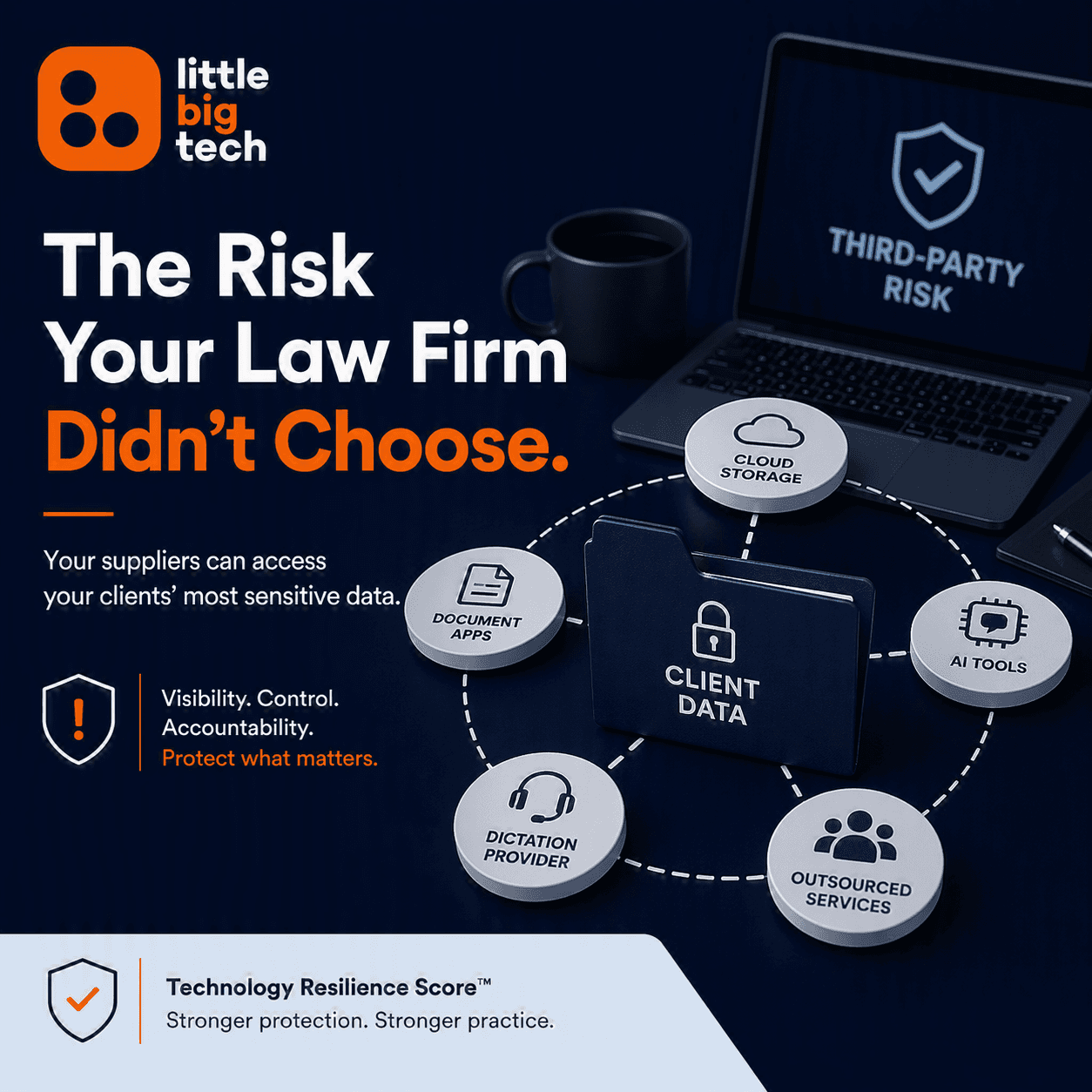
A law firm's technology does not exist in isolation.
Every platform, supplier and integration that supports client work becomes part of the firm's operating environment. For many SME firms, this includes platforms like Clio, along with document storage, dictation tools, outsourced services and growing use of AI-powered tools. Each of these may handle confidential client data. That means the firm's risk extends beyond its own systems.
This article relates to the Third-Party & Supply Chain domain of the Technology Resilience Score. It looks at whether your firm understands and manages the risk introduced by the suppliers it depends on.
Why supply-chain risk is different for law firms
Law firms handle highly sensitive client information. If that information is exposed through a third party, the firm carries the consequences — regardless of where the failure occurred. That can include:
- confidentiality breaches
- regulatory and SRA exposure
- client complaints and reputational damage
- loss of trust
- operational disruption
Unlike internal risk, supply-chain risk is often invisible. It only becomes visible after something goes wrong. That makes it particularly important for law firms to manage proactively.
Where Clio fits into supply-chain risk
For many SME law firms, platforms like Clio are central to how the firm operates. They support matter management, documents, billing and client communication. This creates a more efficient and modern operating model. But it also means the firm is trusting external platforms to handle its most sensitive data.
That trust needs to be backed by visibility and control. A practice management platform should sit within a wider, managed supply chain that includes:
- clear understanding of who processes firm data
- visibility of integrations and sub-processors
- defined contractual protections
- ongoing assessment of supplier security
As a Clio partner, Little Big Tech helps firms ensure that practice management platforms are part of a secure, well-governed and resilient technology environment. The key question becomes: "Do we understand the risk across our supplier ecosystem?"
Is your firm's technology environment resilient?
If your firm relies on platforms like Clio, the question is not just whether they are in place — it is whether the surrounding environment is resilient.
Get your Technology Resilience ScoreThe problem with unmanaged supplier risk
Most firms do not deliberately ignore supplier risk. They simply never formalise how it is assessed. Suppliers are chosen based on functionality, price or recommendation. Security commitments are assumed rather than verified. Contracts may not include clear obligations.
That creates a situation where sensitive client data is shared externally without full visibility or control. When an issue occurs, the firm has limited warning and limited protection.
What weak looks like in a law firm
Weak supply-chain management often appears as:
- no formal vendor assessment process
- limited visibility of where client data is stored
- supplier selection based on convenience rather than risk
- lack of contractual clarity around data protection
- no defined breach notification expectations
- integrations enabled without reviewing risk
- no tracking of supplier relationships over time
These are not unusual. But they create exposure that is outside the firm's direct control.
What strong looks like
A well-managed firm treats supplier risk as part of its overall technology strategy. Before onboarding a supplier, the firm assesses who they are, what they handle and what they commit to. Contracts define clear expectations. Supplier relationships are tracked. Higher-risk vendors are reviewed regularly.
Integrations are introduced deliberately, with an understanding of how they extend the firm's data environment. In this model, the firm can adopt new tools with confidence — because it understands the risk it is introducing.
How this TRS domain helps law firms improve
The Third-Party & Supply Chain domain of the Technology Resilience Score gives law firms a clear view of supplier risk. It assesses whether:
- vendors are properly assessed
- contracts provide adequate protection
- supplier relationships are visible and managed
- risk is tracked and reviewed over time
The result is a score out of 5. More importantly, it creates a structured path to improving how the firm manages external risk.
Why this matters for growth and modern platforms
As firms adopt more platforms, integrations and AI tools, the supply chain expands. Each new tool represents another party handling firm data. Platforms like Clio can support a more efficient and centralised way of working, but they also increase the importance of managing the wider supplier environment.
Strong supply-chain management allows firms to adopt new capabilities without accumulating unmanaged risk.
The Technology Resilience Score gives you a clear benchmark across 10 domains, including Third-Party & Supply Chain. As a Clio partner, Little Big Tech helps law firms build a resilient technology environment around the platforms they rely on every day. Find out more about our approach at our Technology Resilience Score™ framework.
Related reading
Is your firm's technology environment resilient?
Find out how well protected your matter files, client account and email really are, with a free Technology Resilience Score™ written for law firms.
Our services