Security · IT Support
Why Cloud Foundations Matter: Law Firms
26 June 2026
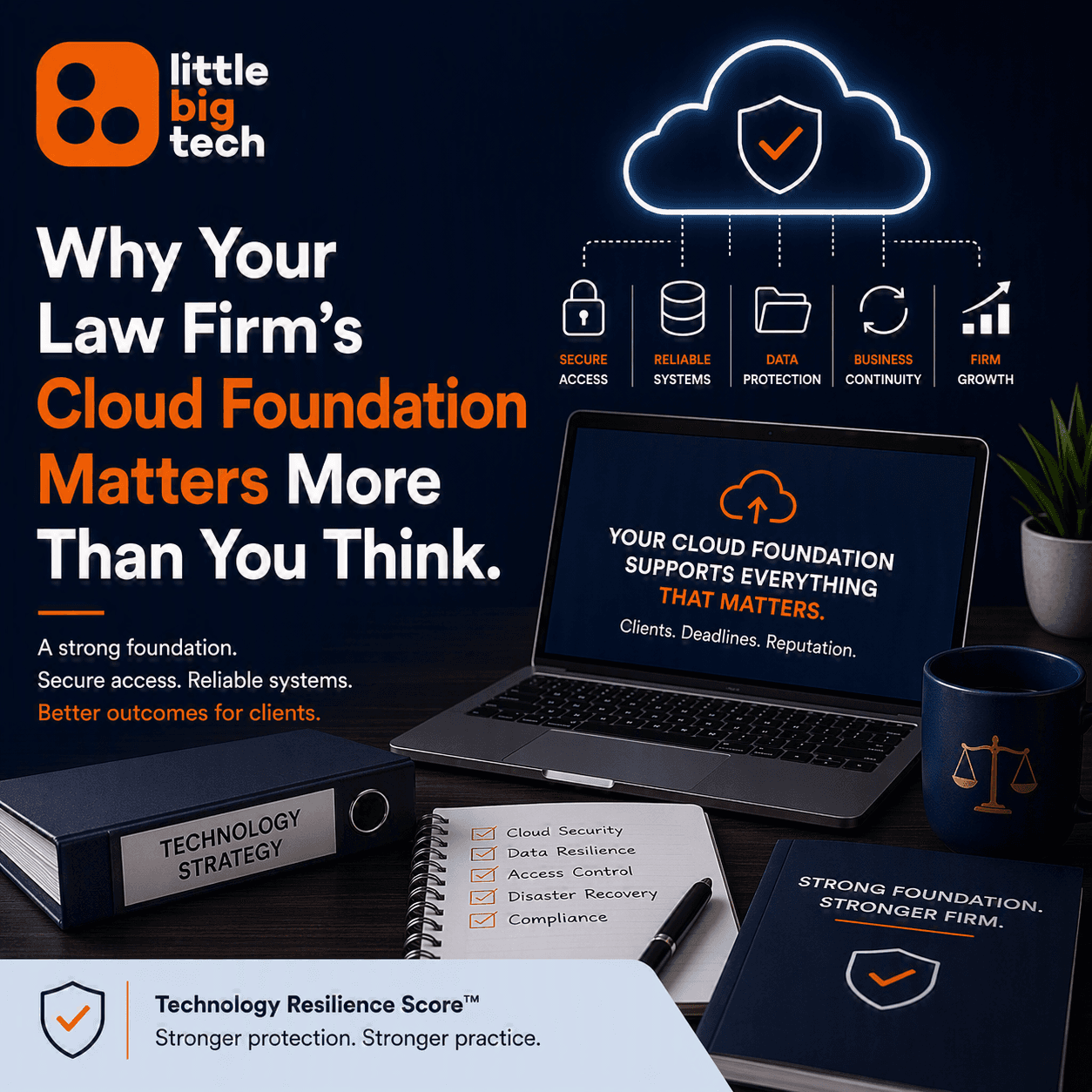
Many SME law firms describe themselves as "in the cloud."
Email is in Microsoft 365. Practice management runs in platforms like Clio. Documents are stored online. But in many cases, the reality is more complex. Legacy systems still exist. Data is spread across locations. Configuration has not been reviewed for years. This creates a gap between convenience and resilience.
This article relates to the Infrastructure & Cloud domain of the Technology Resilience Score. It looks at whether your firm's technology foundation is strong enough to support secure, modern ways of working.
Why infrastructure is critical for law firms
Law firms depend on constant access to systems and data. That includes:
- matter files
- client communication
- document storage
- billing systems
- deadlines and workflow management
If infrastructure fails, the impact is immediate. Missed completion dates, delayed filings or inability to access client information can create professional, financial and reputational consequences. That makes infrastructure more than an IT concern. It is part of how the firm delivers its service.
Where Clio fits into infrastructure
Platforms like Clio are cloud-native and central to how many firms operate. They provide matter management, billing and client communication in a single environment. But those benefits depend on the wider infrastructure.
If data is fragmented across legacy systems, shared drives and individual storage locations, the firm cannot fully benefit from a centralised platform.
As a Clio partner, Little Big Tech helps firms ensure that practice management sits on top of a secure, well-structured cloud foundation. The key question becomes: "Is our data and infrastructure organised well enough to support how we want to work?"
Is your firm's technology environment resilient?
If your firm relies on platforms like Clio, the question is not just whether they are in place — it is whether the surrounding environment is resilient.
Get your Technology Resilience ScoreThe problem with fragmented environments
Many firms sit in a partially migrated state. Some systems are cloud-based. Others remain on local servers. Documents may be stored in multiple places. This creates:
- inconsistent access to information
- difficulty maintaining security
- challenges in monitoring and control
- increased risk of downtime
It also limits the firm's ability to standardise how work is carried out.
What weak looks like in a law firm
Weak infrastructure often appears as:
- reliance on legacy servers alongside cloud platforms
- data spread across multiple storage locations
- cloud environments configured with default settings
- limited visibility of system health
- lack of proactive monitoring
- unclear ownership of infrastructure decisions
These issues reduce resilience and create hidden risk.
What strong looks like
A well-structured firm has a consolidated cloud environment. Core systems are hosted in secure platforms. Data is organised and accessible. Configuration is actively managed. Monitoring provides visibility across the environment. This allows the firm to operate reliably and scale without disruption.
How this TRS domain helps law firms improve
The Infrastructure & Cloud domain of the Technology Resilience Score helps firms assess whether their foundation is strong enough. It looks at whether:
- systems are properly hosted
- data is structured and visible
- cloud environments are securely configured
- monitoring is in place
The result is a score out of 5. That score provides a clear baseline and a structured path to improvement.
Why this matters for modern, AI-enabled firms
As firms adopt AI features within platforms like Clio, the quality and accessibility of data become more important. AI relies on structured, accessible information. If data is fragmented, results are inconsistent. If infrastructure is insecure, risk increases. Strong infrastructure allows firms to adopt AI features confidently and effectively.
The Technology Resilience Score gives SME law firms a clear benchmark across 10 domains, including Infrastructure & Cloud. As a Clio partner, Little Big Tech helps firms build a secure, scalable cloud foundation that supports modern legal work. Find out more about our approach at our Technology Resilience Score™ framework.
Related reading
Is your firm's technology environment resilient?
Find out how well protected your matter files, client account and email really are, with a free Technology Resilience Score™ written for law firms.
Our services