Security · IT Support
Why SME Law Firms Need Real Governance
26 June 2026
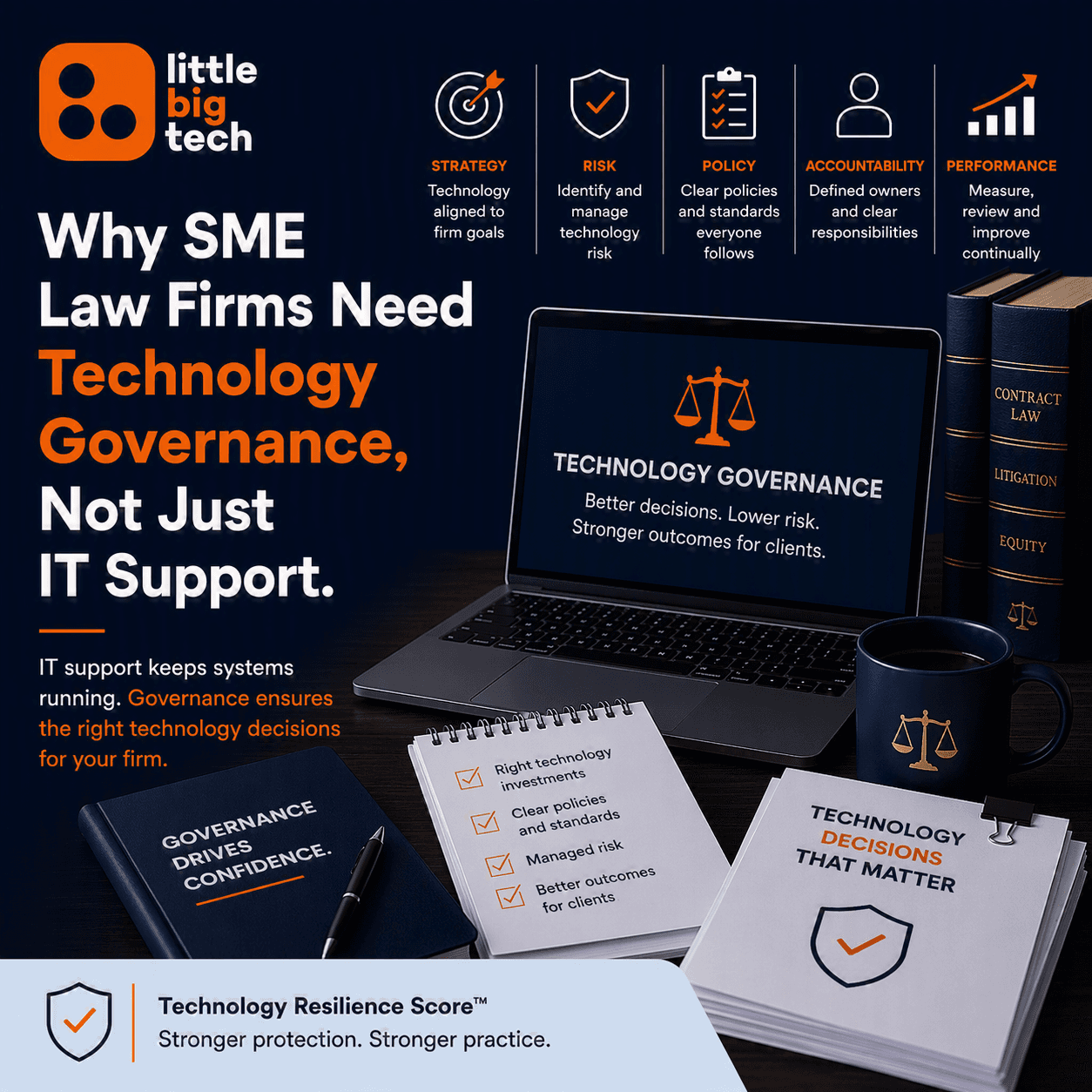
SME law firms do not just use technology in the background.
Technology now sits at the centre of how matters are managed, how documents are stored, how clients are updated, how time is recorded, how bills are issued and how deadlines are controlled.
That makes technology governance a business issue, not just an IT issue.
A firm may have IT support in place, but that does not automatically mean its technology is well-governed. Partners may still lack visibility of risk. Systems may have grown around workarounds. Client data may sit across too many locations. Access controls may be unclear. Practice management may be underused. Cyber security may be treated separately from day-to-day operations.
This article relates to the Technology Strategy & Governance domain of the Technology Resilience Score. It looks at whether your firm has clear ownership, visibility and direction across the technology that supports client service, compliance, productivity and growth.
What is technology governance for law firms? Technology governance for law firms is the way a firm manages the systems, data, users, suppliers and security controls that support client work. It helps partners ensure that platforms such as email, document management, billing and Clio practice management are secure, reliable and aligned to the way the firm operates.
Why technology governance is different for law firms
In a law firm, weak technology governance can quickly become more than an internal inconvenience.
If fee earners cannot access matter information, client service suffers. If documents are stored inconsistently, productivity drops. If access permissions are unclear, confidentiality risk increases. If billing systems are inefficient, cash flow is affected. If cyber security is treated as an isolated project, day-to-day working practices can leave the firm exposed.
The SRA warns that law firms and their clients are attractive cybercrime targets because legal transactions often involve large sums of money and firms hold sensitive client information. The Law Society also notes that law firms and in-house legal teams manage commercially sensitive information and depend on computer systems to interact with clients, business partners and financial institutions.
That is why technology governance matters. It gives partners and practice leaders a structured way to understand whether the firm's technology is secure, stable, accountable and improving.
Where Clio fits into technology governance
For many SME law firms, practice management software is becoming the operational centre of the firm.
A platform like Clio can support matter management, client communication, document handling, time recording, billing and workflow automation. The Law Society's member offer page for Clio describes features including case and matter management, client onboarding, CRM, scheduling, time recording, document management, e-signatures, task automation, billing, online payments and legal aid billing for England and Wales.
But software alone does not create resilience.
A practice management platform needs to sit inside a properly governed technology environment. That means clear user access, secure devices, strong identity controls, documented workflows, backup and continuity planning, integration management, training, reporting and regular review.
As a Clio partner, Little Big Tech helps firms think beyond implementation. The question is not just, "Do we have Clio?" The better question is: "Is our practice management environment part of a secure, joined-up and resilient operating model?" That is where the Technology Resilience Score helps.
Is your firm's technology environment resilient?
If your firm relies on platforms like Clio, the question is not just whether they are in place — it is whether the surrounding environment is resilient.
Get your Technology Resilience ScoreThe problem with reactive IT support in law firms
Traditional IT support usually starts when someone reports a problem. That might be a login issue, a slow laptop, an email problem, a printer fault or a system access request. Those things matter. But they do not give partners the full picture.
A helpdesk can tell you how many tickets were closed. It may not tell you whether your firm has a clear technology roadmap, whether access risks are being reduced, whether your practice management platform is being used effectively, or whether technology is supporting the way the firm wants to grow.
For an SME law firm, that gap matters. The firm depends on technology to protect client information, manage deadlines, maintain communication and keep fee earners productive. If the firm only thinks about IT when something breaks, it is already operating reactively.
What weak technology governance looks like in an SME law firm
Weak governance often shows up as everyday friction:
- partners do not have a clear view of technology risk
- matter information is spread across email, local folders and cloud storage
- practice management software is only partly adopted
- staff use inconsistent processes for documents, tasks or client updates
- new starters and leavers are handled manually
- access permissions are not reviewed regularly
- billing and time-recording workflows are inefficient
- support and cyber security are handled separately
- system decisions are made only when something becomes painful
- there is no roadmap for improving the firm's technology resilience
These issues may not stop the firm immediately. But over time, they create operational drag, security exposure and management uncertainty.
What strong technology governance looks like
A well-governed SME law firm has clear visibility across its technology environment. Partners know which systems matter most. Access is controlled. Practice management workflows are documented. Cyber security is built into daily operations. Suppliers are reviewed. Recurring issues are tracked. Staff know where key information should live. Technology decisions are connected to the firm's commercial goals.
In a stronger environment, platforms like Clio are not treated as isolated software. They become part of a wider operating model that connects matter management, client communication, document control, billing, security and reporting. That is what improves resilience.
How this TRS domain helps law firms improve
The Technology Strategy & Governance domain of the Technology Resilience Score helps SME law firms assess whether they have the right structure around technology. It asks questions such as:
- Who owns technology decisions in the firm?
- Are risks visible to partners?
- Is there a roadmap for improvement?
- Are IT support and cyber security joined up?
- Are systems reviewed against how the firm actually works?
- Is the practice management platform being used consistently?
- Are workflows documented and repeatable?
- Are recurring problems being reduced?
- Is technology helping the firm grow, or creating more friction?
The output is a clear score out of 5. That score gives the firm a baseline. More importantly, it creates an improvement journey.
Why this matters for growth
Many SME law firms want to grow, but growth exposes weak technology governance. Adding more fee earners, more matters, more locations, more remote working or more practice areas increases complexity. If the firm's systems are already messy, growth makes the mess bigger.
Strong governance helps the firm scale with more control. It makes it easier to onboard people, standardise workflows, manage access, improve reporting and keep client service consistent.
A legal practice management platform like Clio can support that journey, but the wider technology environment still needs to be assessed, secured and improved. That is why LBT Resilience combines support, security and strategic improvement as one service.
Why support and security cannot be separated
For law firms, support and security are inseparable. The same systems that need to work smoothly also need to be protected. Email, devices, cloud storage, case management, document management, billing and client portals all affect both productivity and risk.
A user access request is a support task, but it is also a security control. A leaver process is an operational task, but it is also a confidentiality issue. A slow or poorly configured system is a productivity problem, but it can also drive people towards risky workarounds.
The NCSC's legal-sector cyber threat report says cyber threats apply to law practices of all sizes, from sole practitioners and high street firms to mid-sized firms and larger organisations. That is why SME firms should not treat cyber security as something separate from the way people work every day.
The Technology Resilience Score gives SME law firms a clear benchmark out of 5 across 10 domains, including Technology Strategy & Governance. As a Clio partner, Little Big Tech helps law firms think beyond individual software decisions and build a more resilient technology operating model around the systems they rely on every day. Find out more about our approach at our Technology Resilience Score™ framework.
Related reading
Is your firm's technology environment resilient?
Find out how well protected your matter files, client account and email really are, with a free Technology Resilience Score™ written for law firms.
Our services