Security · IT Support
Could Your Clinic Survive a Bad Week?
6 July 2026
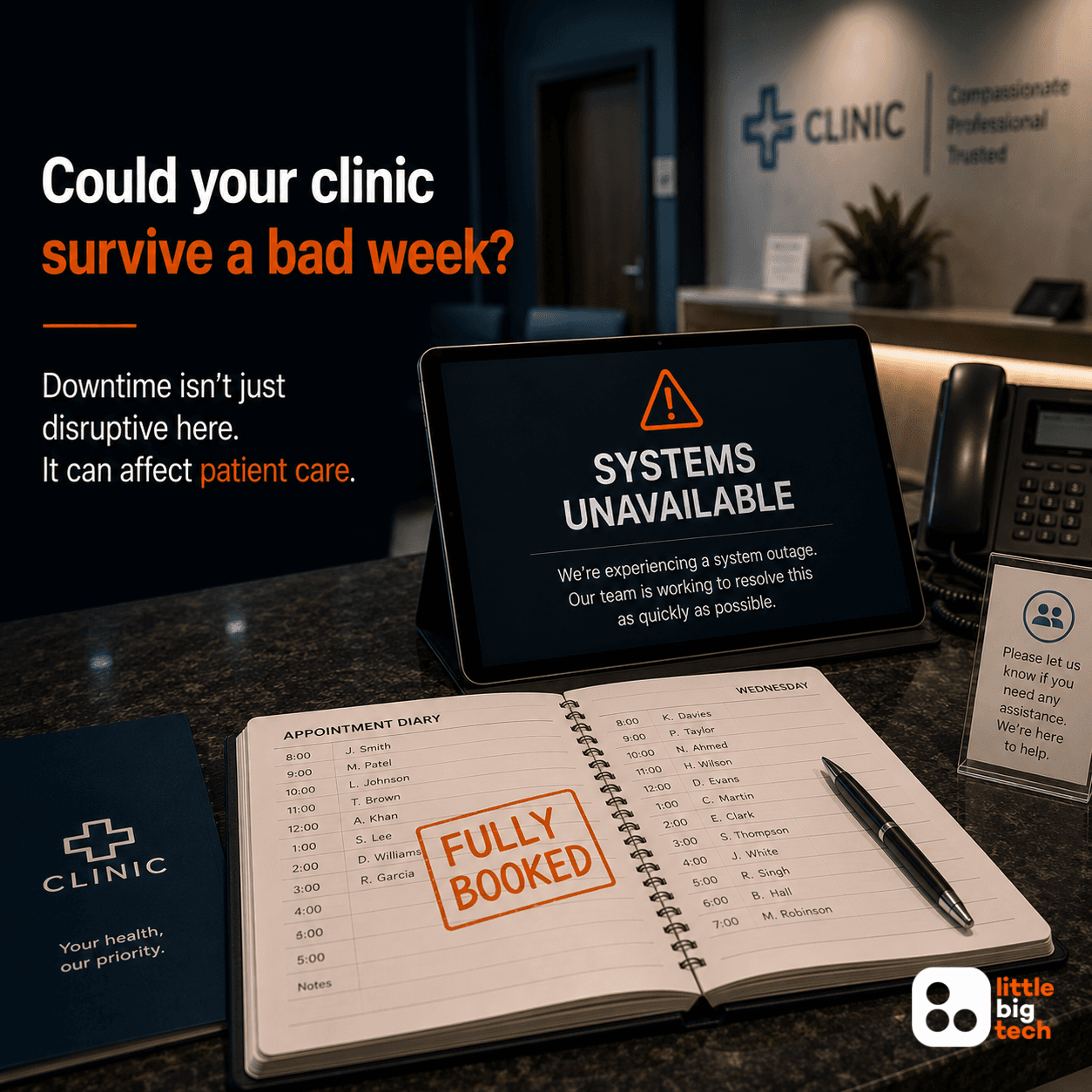
Most clinics plan for clinical emergencies with practised precision. Far fewer plan with the same rigour for a technology emergency, even though a server outage, ransomware attack or cloud failure can bring a private healthcare provider to a standstill just as fast as any clinical incident.
A bad week does not announce itself in advance. It arrives as a ransomware note on a reception screen, a failed backup nobody tested, or a supplier outage that takes booking systems offline during a full clinic day. The question worth asking now, while everything is working, is simple: if it happened today, would your clinic keep functioning?
This article relates to the Business Continuity & Disaster Recovery domain of the Technology Resilience Score. It looks at whether your clinic could keep operating, and recover cleanly, if a major disruption hit tomorrow.
Why continuity is different in private healthcare
In most sectors, a day of downtime is an inconvenience. In private healthcare, it can mean cancelled consultations, delayed diagnostic results, and patients left without care they are paying to receive promptly. Continuity planning in a clinical setting has to account for both the business and the person on the other end of the appointment.
- Appointment booking and patient record systems are often the single point of failure for an entire day's clinical activity
- Diagnostic and imaging data may be time-sensitive, not just business-sensitive
- Patients expect continuity of care, and a technology outage can be read as a failure of care itself
- Smaller providers often run lean IT, with no formal recovery plan tested beyond a backup job running silently in the background
None of this is reason for alarm. It is reason for a plan that has actually been tested, not just assumed to work.
Where CQC expectations meet technology resilience
CQC-registered providers are expected to deliver safe, well-led care, and that includes the systems behind the scenes that keep clinical operations running. A provider that cannot demonstrate how it would maintain or restore access to patient information during an outage is exposed on more than one front — operationally and in terms of governance. Business continuity is not a side issue to safe care; it underpins it.
The key question becomes: "If our core systems went down for a day, could we still deliver safe, well-led care to the patients booked in?"
Is your clinic's technology environment resilient?
Find out whether your continuity and recovery plans would actually hold up under pressure.
Get your Technology Resilience ScoreThe problem with assumed resilience
Many clinics believe they have continuity covered because backups run automatically and a server sits in a cupboard somewhere. Assumed resilience is one of the most common gaps we see, and it usually only becomes visible once something has already gone wrong.
- Backups exist, but nobody has confirmed they can actually be restored
- There is no documented order of priority for which systems come back online first
- Recovery time expectations exist only in someone's head, not in writing
- No one outside IT knows what to do in the first hour of an outage
A plan that has never been tested is not really a plan. It is a hope.
What weak continuity planning looks like in a private healthcare provider
Weak continuity planning tends to look ordinary right up until the moment it is tested by a real incident.
- Patient booking and records systems have no documented failover or manual workaround
- Backup restoration has never been rehearsed end to end
- Reception and clinical staff have no defined process for operating during an IT outage
- Recovery responsibility sits with a single individual, with no cover if they are unavailable
- There is no clear view of how long the clinic could operate on paper-based workarounds
- Communication plans for patients affected by an outage do not exist
Individually, each gap seems manageable. Together, they turn a technical hiccup into a full clinical disruption.
What strong looks like
A resilient clinic knows, in advance, exactly which systems matter most and in what order they need to be restored. Recovery time and recovery point expectations are written down, agreed, and tested at a sensible interval rather than assumed.
Staff at every level, not just IT, know what to do in the first hour of a disruption. Patients can still be looked after, appointments can still be triaged, and the organisation can communicate confidently rather than scrambling for a message while systems are down.
How this TRS domain helps healthcare providers improve
The Business Continuity & Disaster Recovery domain of the Technology Resilience Score looks specifically at how prepared your clinic is to keep operating and to recover cleanly.
- Reviews whether backups exist, where they sit, and whether restoration has actually been tested
- Assesses whether recovery priorities and timeframes are documented and realistic
- Checks whether staff, not just systems, have a defined role during an incident
- Looks at single points of failure across booking, records and communication systems
The outcome is a score out of 5, giving your clinic a clear baseline and a structured improvement path rather than a vague sense that things are probably fine.
Building resilience before you need it
Continuity planning is not about predicting every possible failure. It is about making sure that when something does go wrong, the clinic has a rehearsed response rather than an improvised one.
Little Big Tech already supports U Clinic, and continuity planning is a consistent theme across the private healthcare providers we work with. The Technology Resilience Score gives private healthcare providers a benchmark across 10 domains, including Business Continuity & Disaster Recovery.
Related reading
Is your practice's technology environment resilient?
Find out how well patient data and clinical continuity are protected, with a free Technology Resilience Score™ for private healthcare providers.
Our services