Security · IT Support
Why Cloud Foundations Matter for Clinics
6 July 2026
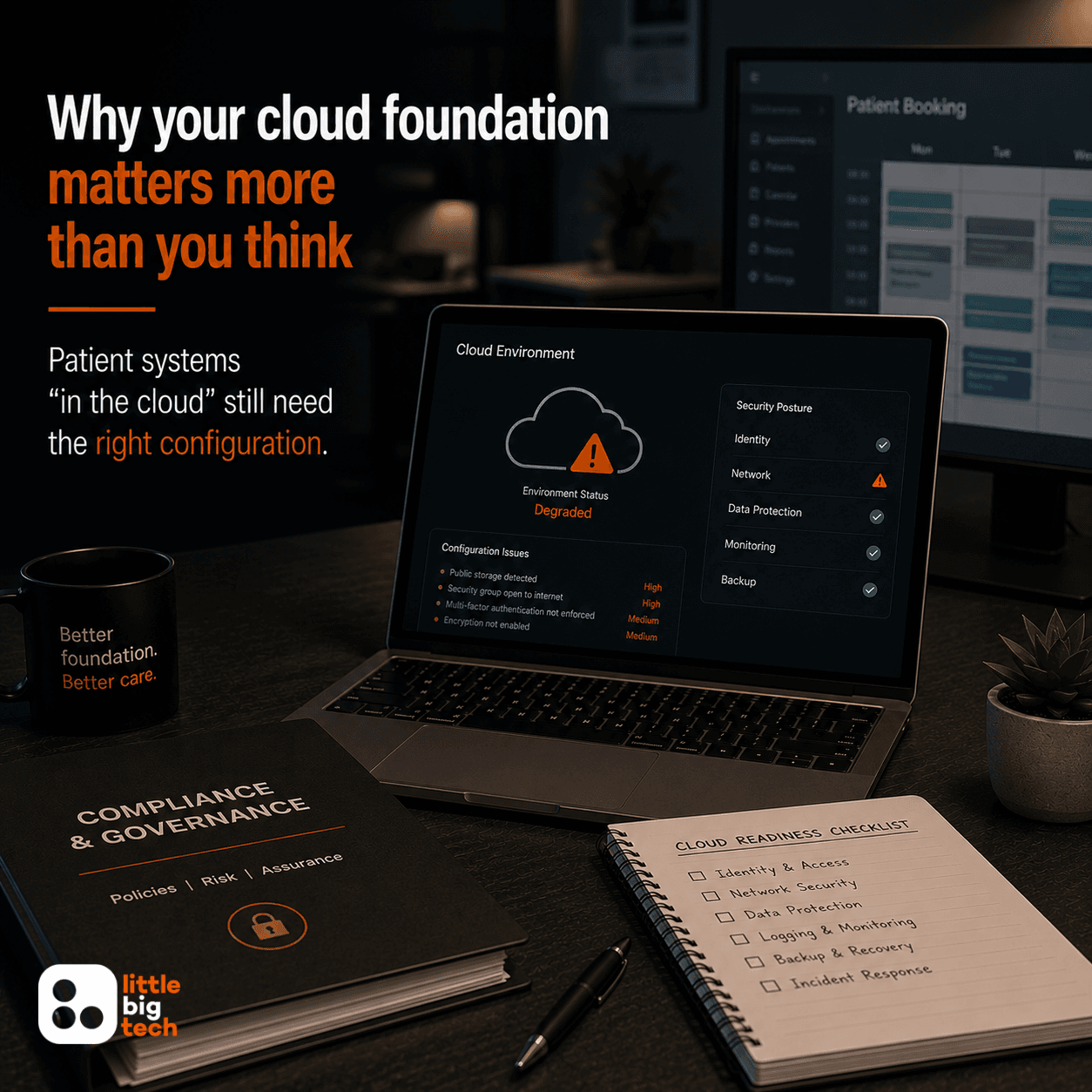
Few people outside IT ever think about where their clinic's systems actually run. Patient records, booking platforms and clinical applications simply appear on screen, and it is easy to assume the infrastructure underneath is someone else's problem to worry about. It is not. It is the foundation everything else in the technology environment is built on.
A well-designed cloud and infrastructure setup is close to invisible — systems are fast, available and secure without anyone noticing the engineering behind it. A poorly designed one eventually makes itself known, usually at the worst possible moment.
This article relates to the Infrastructure & Cloud domain of the Technology Resilience Score. It looks at where your clinic's systems and data are hosted, and how well that environment is secured and managed.
Why infrastructure is different in private healthcare
Clinical systems place particular demands on infrastructure: availability during clinic hours, fast access to records during consultations, and strict control over where sensitive data physically or logically resides.
- Downtime during clinic hours has an immediate impact on patient care, not just productivity
- Data residency and access controls need to be understood clearly, not assumed to be "handled by the cloud provider"
- A mix of legacy on-premises equipment and newer cloud systems is common, and the join between them is often the weakest point
- Smaller providers may not have anyone whose job it is to actively manage the infrastructure layer
Infrastructure decisions made years ago quietly shape what is possible today, for better or worse.
Where hosting choices intersect with UK GDPR
Special category health data under UK GDPR requires a higher standard of protection, and that standard has to be reflected in how and where the data is hosted — not just in the policies written about it. A clinic that cannot clearly describe where its patient data is stored, who has administrative access to that environment, and how it is backed up and secured, has a gap in exactly the area regulators and patients care about most.
The key question becomes: "Do we actually know where our patient data lives, who can access the infrastructure it sits on, and how well that environment is secured?"
Is your clinic's technology environment resilient?
Understand whether the infrastructure behind your patient systems is as solid as it needs to be.
Get your Technology Resilience ScoreThe problem with unmanaged infrastructure
Infrastructure that "just works" can mask serious underlying weaknesses, because the absence of visible problems is mistaken for the absence of risk.
- No clear inventory of what infrastructure exists, on-premises or in the cloud
- Administrative access to critical systems poorly controlled or overly broad
- Ageing on-premises equipment kept running past its sensible working life
- No proactive monitoring of infrastructure performance or security configuration
Infrastructure problems rarely announce themselves gradually. They tend to surface all at once, usually during a busy clinic day.
What a weak cloud and infrastructure setup looks like in a private healthcare provider
Weak infrastructure can be difficult to spot precisely because it often keeps working, right up until it does not.
- Patient data hosted without a clear understanding of the provider's security responsibilities versus your own
- Administrative accounts shared between staff rather than individually controlled
- Ageing servers running clinical or booking systems with no replacement plan
- No separation between test, development and live systems that touch patient data
- Cloud services adopted individually over time with no coordinated architecture
- No regular review of infrastructure security configuration
Each of these weaknesses tends to be discovered only when something forces a closer look — an incident, an audit, or a growth milestone the current setup cannot support.
What strong looks like
A clinic with a strong infrastructure and cloud foundation knows exactly where its systems and data are hosted, understands the division of security responsibility with any cloud provider, and keeps administrative access tightly controlled. Ageing equipment is replaced on a planned cycle rather than run until it fails.
The result is an environment that supports clinical operations quietly and reliably, freeing staff and leadership to focus on patient care rather than worrying about what is running underneath it.
How this TRS domain helps healthcare providers improve
The Infrastructure & Cloud domain of the Technology Resilience Score examines where your clinic's systems and data are hosted and how securely that environment is managed.
- Reviews the security and structure of cloud and on-premises environments
- Assesses administrative access controls across critical infrastructure
- Checks the age and resilience of on-premises equipment still in use
- Looks at whether infrastructure decisions are coordinated or made in isolation
It produces a score out of 5, giving your clinic a clear baseline and a structured improvement path towards a stronger, better-managed foundation.
Building on solid ground
Every other part of a clinic's technology environment — security, data protection, continuity — depends on the strength of the infrastructure underneath it. Getting the foundation right makes everything built on top of it easier to trust.
Infrastructure review is typically one of the first steps we take with any new private healthcare client. The Technology Resilience Score gives private healthcare providers a benchmark across 10 domains, including Infrastructure & Cloud.
Related reading
Is your practice's technology environment resilient?
Find out how well patient data and clinical continuity are protected, with a free Technology Resilience Score™ for private healthcare providers.
Our services