Security · IT Support
Why Clinics Need Strategy, Not an IT Guy
6 July 2026
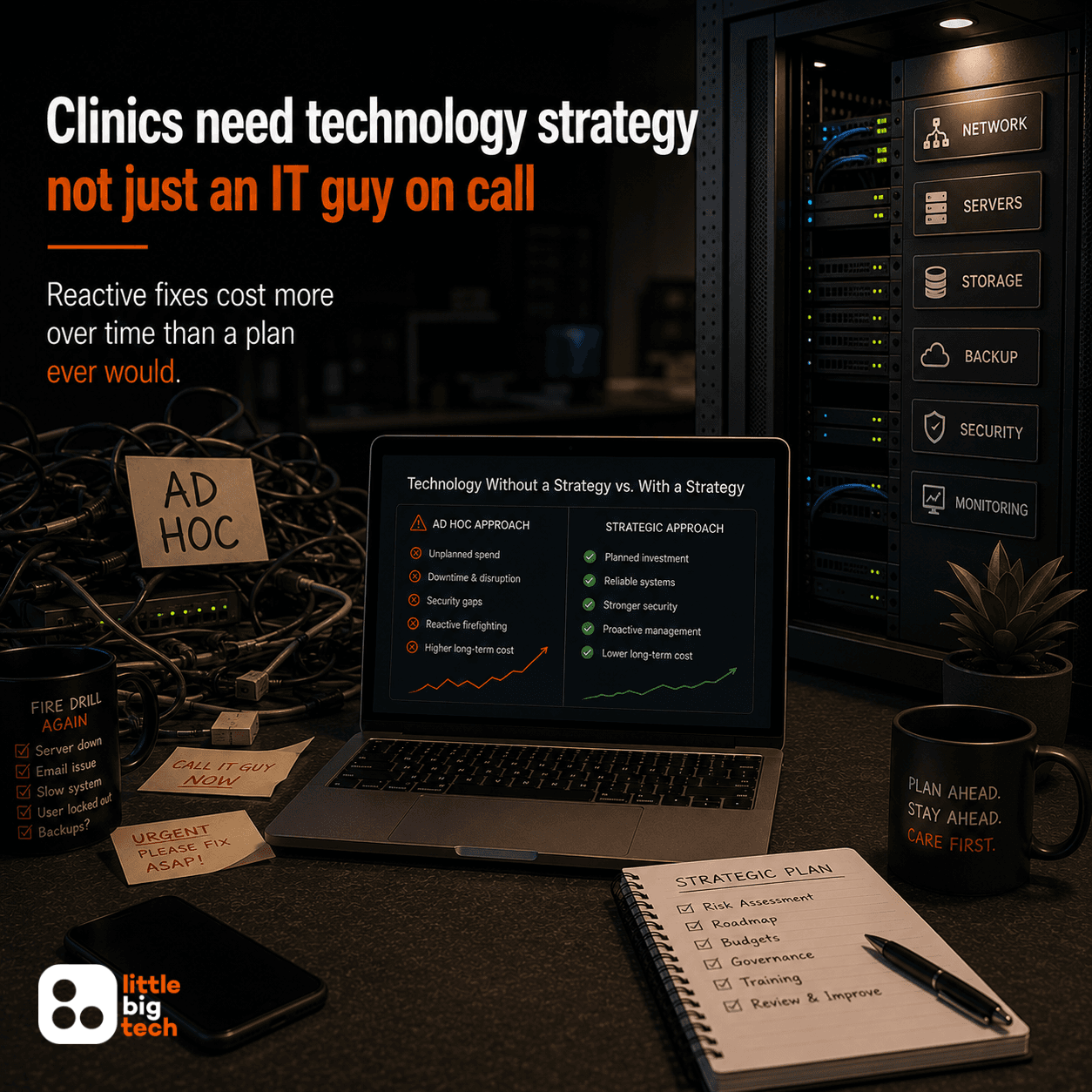
Many independent clinics start their technology journey the same way: someone reliable who can fix a printer, sort out email, and get the booking system working again. That relationship is genuinely valuable in the early days. The problem is when a growing healthcare provider still relies on that same informal setup years later, with far more at stake.
An IT guy on call answers the question "what's broken right now." A technology strategy answers a very different set of questions — where is the business heading, what will the technology environment need to support that, and what risks are being carried along the way.
This article relates to the Technology Strategy & Governance domain of the Technology Resilience Score. It looks at whether your clinic has genuine forward planning behind its technology decisions, not just reactive fixes.
Why strategy is different in private healthcare
Clinics grow in ways that put direct pressure on technology: new consulting rooms, new specialisms, new sites, more patients, more data. Each stage of growth changes what the technology environment needs to do, and reactive support rarely keeps pace with that change.
- Adding a new site or service line usually means new systems, new data flows and new risk to manage
- Patient volume growth increases the consequences of any technology weakness
- Regulatory expectations do not pause while a clinic scales up informally
- Systems bought individually over time rarely integrate well without a coordinated plan
Growth without a technology strategy tends to store up problems that surface later, at a less convenient moment.
Where governance and clinical safety intersect
CQC-registered providers are expected to operate with clear oversight and planning as part of delivering safe, well-led care, and that expectation naturally extends to the technology decisions supporting clinical operations. A provider that cannot describe its technology direction, beyond "we call someone when it breaks," is not demonstrating the kind of structured oversight regulators and patients alike expect from a well-run organisation.
The key question becomes: "Do we have an actual plan for how our technology environment needs to evolve over the next few years, or are we simply reacting as things come up?"
Is your clinic's technology environment resilient?
See whether your clinic is planning its technology future, or just reacting to whatever breaks next.
Get your Technology Resilience ScoreThe problem with reactive IT relationships
A reactive relationship with technology support is built to solve immediate problems, which is exactly why it struggles to prevent the bigger ones from developing in the background.
- Decisions get made system by system, with no view of the whole environment
- Nobody is asking whether current systems will still work in two or three years
- Security and compliance improvements happen only after something forces the issue
- Cost and risk both increase quietly over time without anyone tracking the trend
By the time the gaps become obvious, they are usually more expensive and more disruptive to fix.
What weak technology strategy looks like in a private healthcare provider
Weak strategy tends to be invisible in the day-to-day running of a clinic, until growth or an incident exposes it.
- No written view of what the technology environment should look like in the future
- Systems added over time with no consideration of how they fit together
- Technology decisions made by whoever is available, rather than by a consistent process
- No regular review of whether current systems still meet clinical and business needs
- Budget for technology treated as an unpredictable cost rather than a planned investment
- No link between business growth plans and technology planning
None of these issues stop a clinic functioning today. All of them make tomorrow harder than it needs to be.
What strong looks like
A clinic with strong technology strategy has a clear, documented view of where its technology environment needs to go, aligned with where the business itself is heading. Decisions are made with that direction in mind, rather than in isolation, and technology investment is planned rather than triggered by crisis.
Growth — new sites, new services, more patients — happens with the technology foundation already accounted for, rather than being bolted on afterwards under pressure.
How this TRS domain helps healthcare providers improve
The Technology Strategy & Governance domain of the Technology Resilience Score examines whether your clinic has clear ownership, visibility and planning across its technology environment.
- Reviews whether a documented technology roadmap exists and is followed
- Assesses how well technology planning aligns with business growth plans
- Checks whether technology decisions are made consistently, not ad hoc
- Looks at how investment and risk are planned for over time
It produces a score out of 5, giving your clinic a clear baseline and a structured improvement path from reactive fixes towards genuine strategy.
Planning for where the clinic is heading
An IT guy on call will always have a place. But a growing private healthcare provider needs more than a fixer — it needs a technology partner thinking a step ahead of where the business is going.
The Technology Resilience Score gives private healthcare providers a benchmark across 10 domains, including Technology Strategy & Governance.
Related reading
Is your practice's technology environment resilient?
Find out how well patient data and clinical continuity are protected, with a free Technology Resilience Score™ for private healthcare providers.
Our services