Security · IT Support
Why Healthcare Needs Governance, Not IT
6 July 2026
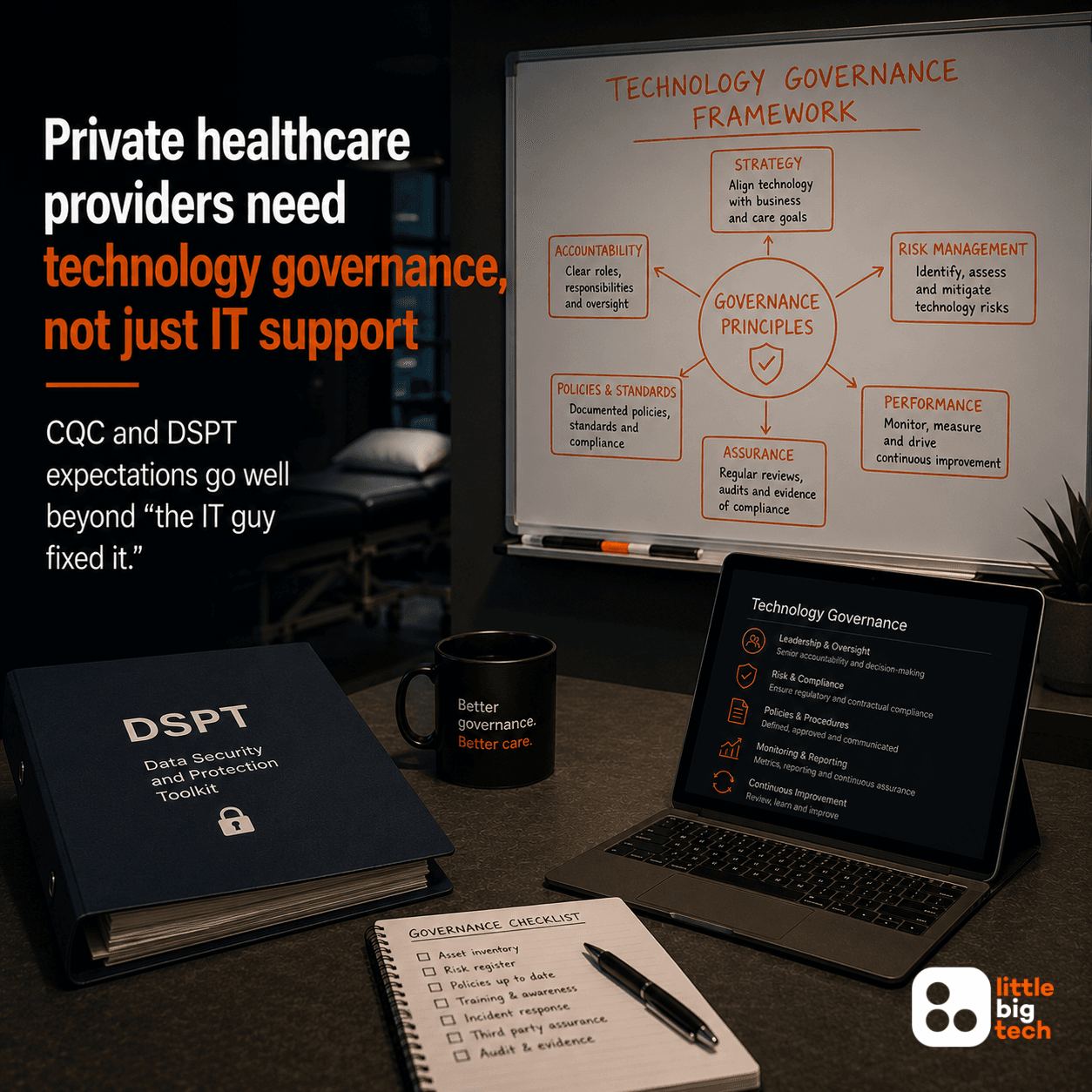
Ask most clinic leaders who owns technology risk in their organisation, and the honest answer is often nobody in particular. IT support fixes what breaks. A practice manager juggles supplier relationships alongside a dozen other responsibilities. Nobody sits above it all asking whether the technology strategy actually matches the clinical and commercial direction of the business.
That gap is not a failure of any individual. It is what happens when a growing healthcare provider outgrows informal IT arrangements without anyone noticing the moment it happened.
This article relates to the IT Strategy & Governance domain of the Technology Resilience Score. It looks at whether your clinic has clear ownership, visibility and planning across its technology environment, not just responsive support.
Why governance is different in private healthcare
Private healthcare providers face a specific combination of pressures: clinical safety obligations, patient confidentiality, commercial growth ambitions, and regulatory scrutiny, all resting on the same technology foundation. Decisions about that foundation cannot be left to whoever happens to answer the support ticket.
- Technology decisions affect clinical safety and patient confidentiality, not just office productivity
- Growth — new clinics, new services, new specialisms — usually depends on technology scaling with it
- Regulatory expectations from CQC and data protection law require clear accountability, not shared ambiguity
- Investment decisions made without governance often solve today's problem while creating tomorrow's
Support keeps things running. Governance decides what "running well" should actually look like.
Where governance meets CQC's expectation of well-led care
CQC's framework for safe, well-led care extends beyond clinical leadership into how an organisation is run overall, and that includes the systems and decisions that sit behind clinical delivery. A provider without clear technology ownership struggles to demonstrate the kind of structured oversight that well-led care implies. Governance is what turns scattered technology decisions into a coherent, accountable programme.
The key question becomes: "If we were asked who owns technology risk and technology investment decisions in this organisation, could we give a clear, single answer?"
Is your clinic's technology environment resilient?
Find out whether technology decisions in your clinic are genuinely governed, or just reactively managed.
Get your Technology Resilience ScoreThe problem with support-only IT
Support-only arrangements are reactive by design. They exist to resolve problems quickly, not to ask whether the underlying technology strategy is fit for where the business is heading.
- No one is accountable for technology risk at a leadership level
- Investment happens in response to failures rather than as part of a plan
- Security, compliance and infrastructure decisions are made in isolation from each other
- There is no mechanism to review whether the technology environment still matches business needs
A support desk can fix a broken laptop. It cannot tell you whether your entire technology approach is heading in the right direction.
What weak technology governance looks like in a private healthcare provider
Weak governance is easy to miss because everything can still appear to work day to day.
- No documented technology strategy or roadmap tied to business goals
- Security and compliance treated as IT's problem rather than a leadership responsibility
- Ad hoc purchasing decisions made without any risk assessment
- No regular reporting on technology risk to senior leadership or ownership
- Multiple systems introduced over time with no coordinated oversight
- Nobody able to explain the organisation's overall technology risk position in a single conversation
None of this shows up in day-to-day operations until a decision needs to be made quickly, and there is no framework to make it well.
What strong looks like
A clinic with strong technology governance has clear ownership of technology risk at leadership level, a documented view of where the technology environment needs to go, and a regular rhythm of review that keeps strategy aligned with the reality of running a healthcare business.
Decisions about investment, risk and priorities are made deliberately, with visibility across the whole environment, rather than being made piecemeal by whoever is closest to the problem at the time.
How this TRS domain helps healthcare providers improve
The IT Strategy & Governance domain of the Technology Resilience Score examines how your clinic makes decisions about systems, data, risk and technology investment.
- Reviews whether clear ownership of technology risk exists at leadership level
- Assesses whether a documented technology roadmap aligns with business goals
- Checks whether technology risk is reported to leadership on a regular basis
- Looks at how investment decisions are made and prioritised
It produces a score out of 5, giving your clinic a clear baseline and a structured improvement path towards genuine governance rather than reactive support.
Moving from support to strategy
Good IT support will always matter. But it answers a narrower question than the one healthcare leaders actually need answered: is our technology environment set up to support safe, compliant, sustainable growth.
The Technology Resilience Score gives private healthcare providers a benchmark across 10 domains, including IT Strategy & Governance.
Related reading
Is your practice's technology environment resilient?
Find out how well patient data and clinical continuity are protected, with a free Technology Resilience Score™ for private healthcare providers.
Our services