Security · IT Support
Turning Data Protection Into Patient Trust
6 July 2026
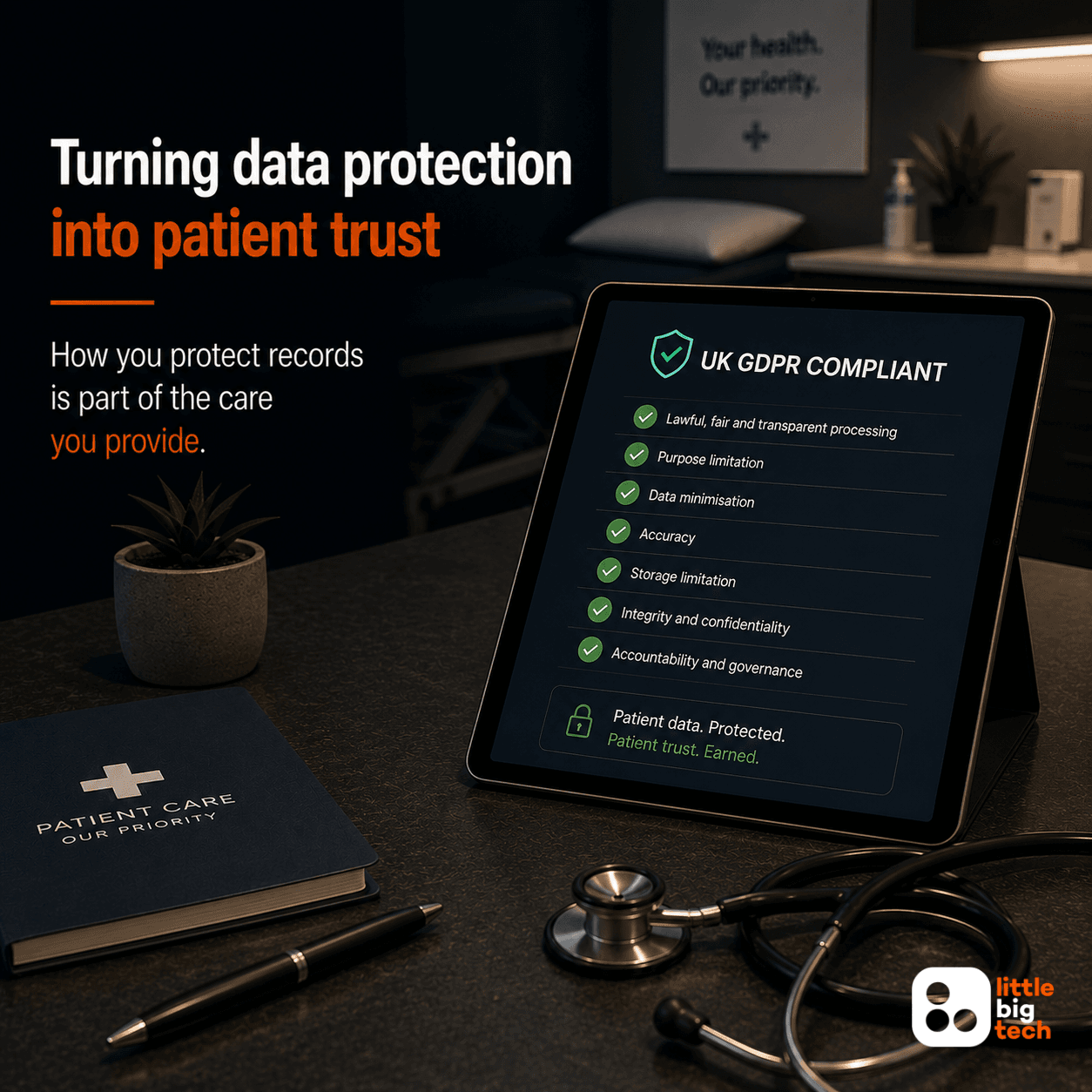
Patients disclose things to private healthcare providers they would not tell most other organisations — medical history, diagnoses, family circumstances, financial details tied to treatment. That disclosure only happens because patients trust it will be handled properly. Data protection is the mechanism that keeps that trust intact.
Too often, data protection is treated as paperwork: a policy filed away, a form signed once, a checkbox ticked during onboarding. In reality, it is an ongoing discipline of knowing what data exists, where it lives, and who can reach it — and it directly shapes whether a patient feels safe walking through your door.
This article relates to the Data Protection & Compliance domain of the Technology Resilience Score. It looks at whether your clinic genuinely knows what patient data it holds and how well it is protected.
Why data protection is different in private healthcare
Health data is not ordinary personal data. It reveals things about a person's body, mind and circumstances that they may never disclose elsewhere, and a mishandling of it carries a different weight than a mishandled email address or delivery note.
- Patient records often combine clinical notes, financial information and personal identifiers in one place
- Data may be duplicated across booking systems, clinical systems, billing platforms and email
- Retention periods for health records can be longer and more complex than standard business data
- A data protection failure directly damages the trust that underpins the clinical relationship, not just the commercial one
Getting this right is not about compliance for its own sake. It is about honouring the reason patients came to you in the first place.
Special category data and the CQC connection
Under UK GDPR, health data relating to an identified individual is explicitly defined as special category data, requiring stronger safeguards than standard personal information. For CQC-registered providers, this sits alongside an expectation of safe, well-led care — information governance is not treated as a separate technology concern, but as part of how a provider demonstrates it runs a safe operation. Providers with NHS contracts or shared care record access are also commonly expected to complete the Data Security and Protection Toolkit each year, adding a further layer of accountability.
The key question becomes: "If a regulator or an inspector asked us right now what patient data we hold, where it lives, and who can access it, could we answer confidently?"
Is your clinic's technology environment resilient?
See whether your data protection practice matches the trust patients place in your clinic.
Get your Technology Resilience ScoreThe problem with reactive data protection
Many clinics only think hard about data protection when something forces the issue — a DSPT submission deadline, a CQC inspection, or worse, an actual incident. Reactive data protection is fragile because it treats compliance as an event rather than a continuous practice.
- No up-to-date record of what personal and special category data is held and where
- Policies exist on paper but are not reflected in day-to-day practice
- Data retention is inconsistent, with old records kept far longer than needed
- Data protection responsibility is unclear, with no named owner accountable for it
Compliance built only for the next audit tends to collapse the moment the audit is over.
What weak data protection looks like in a private healthcare provider
Weak data protection practice often looks perfectly normal from the outside, right up until it is tested.
- No accurate data map showing where patient information is stored across systems
- Staff sharing patient information over email or messaging tools without proper controls
- No clear process for handling patient requests to access or correct their own data
- Inconsistent access permissions, with more staff able to view records than actually need to
- Data protection impact assessments skipped when new systems or suppliers are introduced
- No defined breach response process specific to patient data incidents
Each of these gaps chips away at the trust a patient places in the organisation the moment they hand over personal information.
What strong looks like
A clinic with strong data protection practice can describe, clearly and confidently, what patient data it holds, where it lives, who can access it and why. Access is proportionate to role, retention periods are enforced rather than assumed, and new systems or suppliers are assessed for data risk before they go live, not after.
Patients experience this as quiet reliability — records are accurate, requests are handled properly, and their information is treated with the seriousness they expect from a healthcare provider.
How this TRS domain helps healthcare providers improve
The Data Protection & Compliance domain of the Technology Resilience Score examines how well your clinic identifies, manages and protects personal and special category data.
- Reviews whether an accurate data inventory exists across all systems
- Assesses access controls against genuine clinical and operational need
- Checks retention practices against legal and regulatory expectations
- Looks at how new systems and suppliers are assessed for data risk
It produces a score out of 5, giving your clinic a clear baseline and a structured improvement path towards stronger, more consistent data protection.
Trust as the outcome, not the by-product
Data protection in private healthcare is not a background function. It is one of the clearest ways a patient experiences whether your organisation takes their care seriously.
Getting data protection right consistently ranks among the top priorities for the private healthcare providers we assess. The Technology Resilience Score gives private healthcare providers a benchmark across 10 domains, including Data Protection & Compliance.
Related reading
Is your practice's technology environment resilient?
Find out how well patient data and clinical continuity are protected, with a free Technology Resilience Score™ for private healthcare providers.
Our services