Security · IT Support
Every Device Is a Doorway to Patient Data
6 July 2026
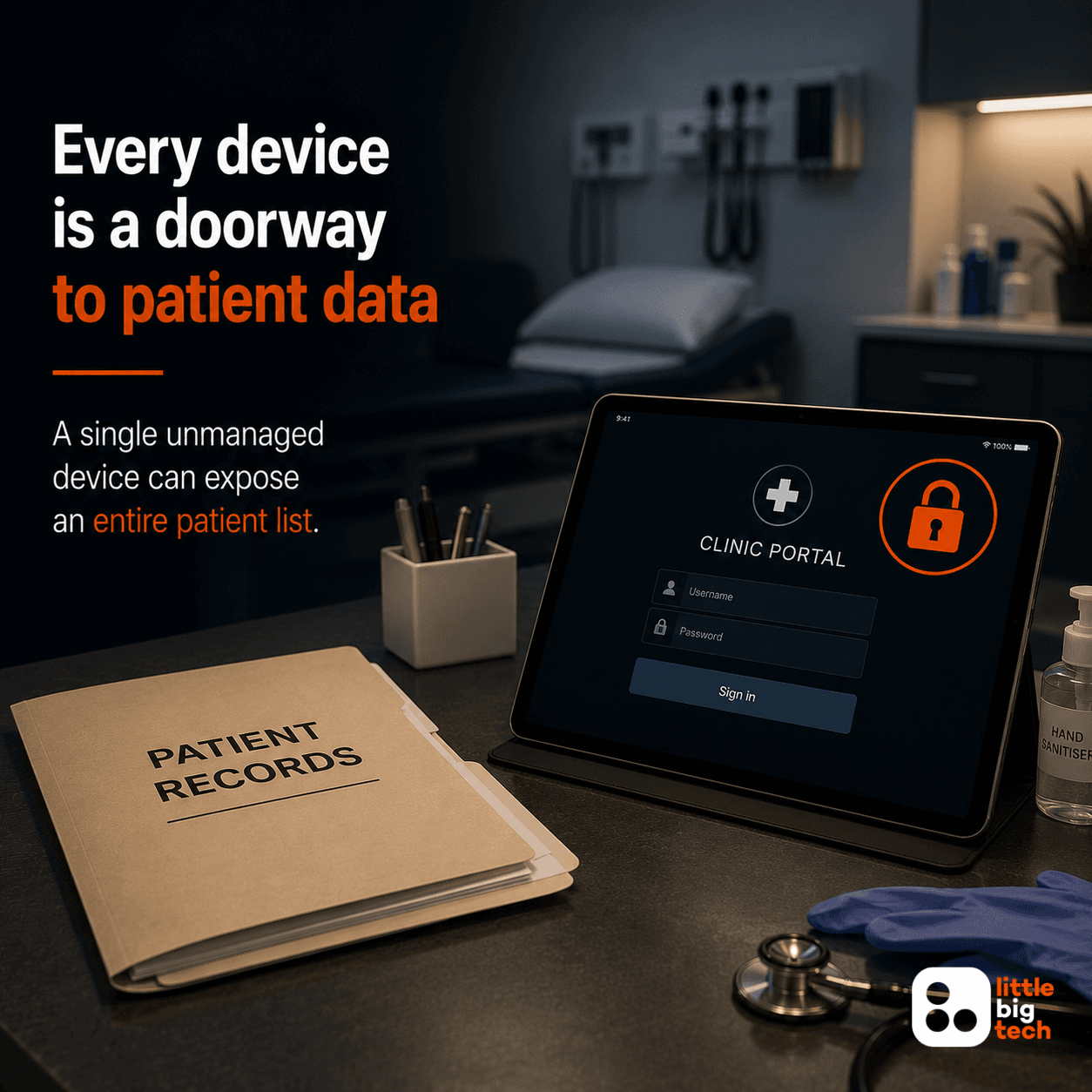
A clinic's most sensitive information rarely stays confined to one system. It travels across laptops used for consultations, tablets used at reception, and phones used by clinicians on the move between sites. Each of those devices is a doorway into patient data, and each one needs to be accounted for.
The question is not whether staff use devices to access patient information — of course they do. The question is whether your clinic actually knows which devices exist, who is responsible for them, and what happens the moment one goes missing.
This article relates to the Endpoint & Device Management domain of the Technology Resilience Score. It looks at whether your clinic can track, secure and respond to every device that touches patient data.
Why endpoint management is different in private healthcare
Clinical environments tend to have a wider mix of devices than a typical office. Shared workstations at reception, personal phones used for on-call queries, laptops that move between consulting rooms and home, and tablets used during patient assessments all sit alongside standard office equipment.
- Devices are often shared between clinicians, shift workers or locum staff, blurring who is responsible for what
- Personal devices sometimes get used for convenience, without formal approval or security controls
- A lost or stolen device can carry cached patient information, appointment details or clinical notes
- Smaller providers frequently lack a central inventory of what devices are in use across sites
Every one of these devices is a potential route to special category health data, and every one needs the same discipline applied to it.
Special category data raises the bar
Health information about identified patients is explicitly classed as special category data under UK GDPR, meaning it requires a higher standard of protection than ordinary personal data. That standard has to extend to the endpoints where the data is viewed, stored or cached, not just the central systems where it lives permanently. A device without encryption, remote-wipe capability or basic access controls undermines protections that may otherwise look solid on paper.
The key question becomes: "If a clinician's laptop or phone was lost tomorrow, could we act immediately, and would patient data actually be protected on that device?"
Is your clinic's technology environment resilient?
Understand whether every device accessing patient data is actually accounted for and protected.
Get your Technology Resilience ScoreThe problem with informal device management
Many clinics manage devices informally, relying on staff goodwill and memory rather than a documented process. That works fine until a device goes missing, a staff member leaves, or a regulator asks the question directly.
- No central record of which devices exist or who they are assigned to
- No consistent policy on encryption, screen locking or remote wipe
- Personal devices used for clinical purposes without any oversight
- Leavers' devices not reliably collected, wiped or deregistered
Without a system behind it, device security depends entirely on individual habits, and habits vary.
What weak endpoint management looks like in a private healthcare provider
Weak endpoint management often hides behind everyday convenience, right up until an incident exposes the gaps.
- Shared reception devices with no individual login accountability
- Clinicians' personal phones used to view appointment or patient information
- No remote-wipe capability if a device is lost or stolen
- Inconsistent or absent encryption across laptops and mobile devices
- No process for recovering devices when a locum or staff member leaves
- Software and security patches applied inconsistently, if at all
Any one of these gaps could turn a simple lost phone into a reportable data incident involving patient information.
What strong looks like
A clinic with strong endpoint management can list every device that touches its systems, knows exactly who is responsible for each one, and can act within minutes if a device is lost, stolen or compromised. Encryption, screen locking and remote-wipe capability are standard, not optional extras applied selectively.
Joiners and leavers are handled with the same discipline as clinical onboarding — devices issued, tracked and reliably recovered, so that access to patient data never outlives the reason for it.
How this TRS domain helps healthcare providers improve
The Endpoint & Device Management domain of the Technology Resilience Score examines how well your clinic tracks and secures the devices used to access patient data.
- Reviews whether a complete, accurate device inventory exists
- Assesses encryption, access controls and remote-wipe readiness
- Checks how leavers' devices and access are handled
- Looks at whether personal devices are managed or left unregulated
It produces a score out of 5, giving your clinic a clear baseline and a structured improvement path for closing the gaps that matter most.
Bringing device security up to the standard patients expect
Patients trust clinics with information they would not share elsewhere. That trust depends on every device in the chain being treated with the same seriousness as the systems it connects to.
Little Big Tech already supports U Clinic, and endpoint visibility is one of the first areas we assess with any new private healthcare client. The Technology Resilience Score gives private healthcare providers a benchmark across 10 domains, including Endpoint & Device Management.
Related reading
Is your practice's technology environment resilient?
Find out how well patient data and clinical continuity are protected, with a free Technology Resilience Score™ for private healthcare providers.
Our services