Security · IT Support
Your People, Biggest Risk: Healthcare
6 July 2026
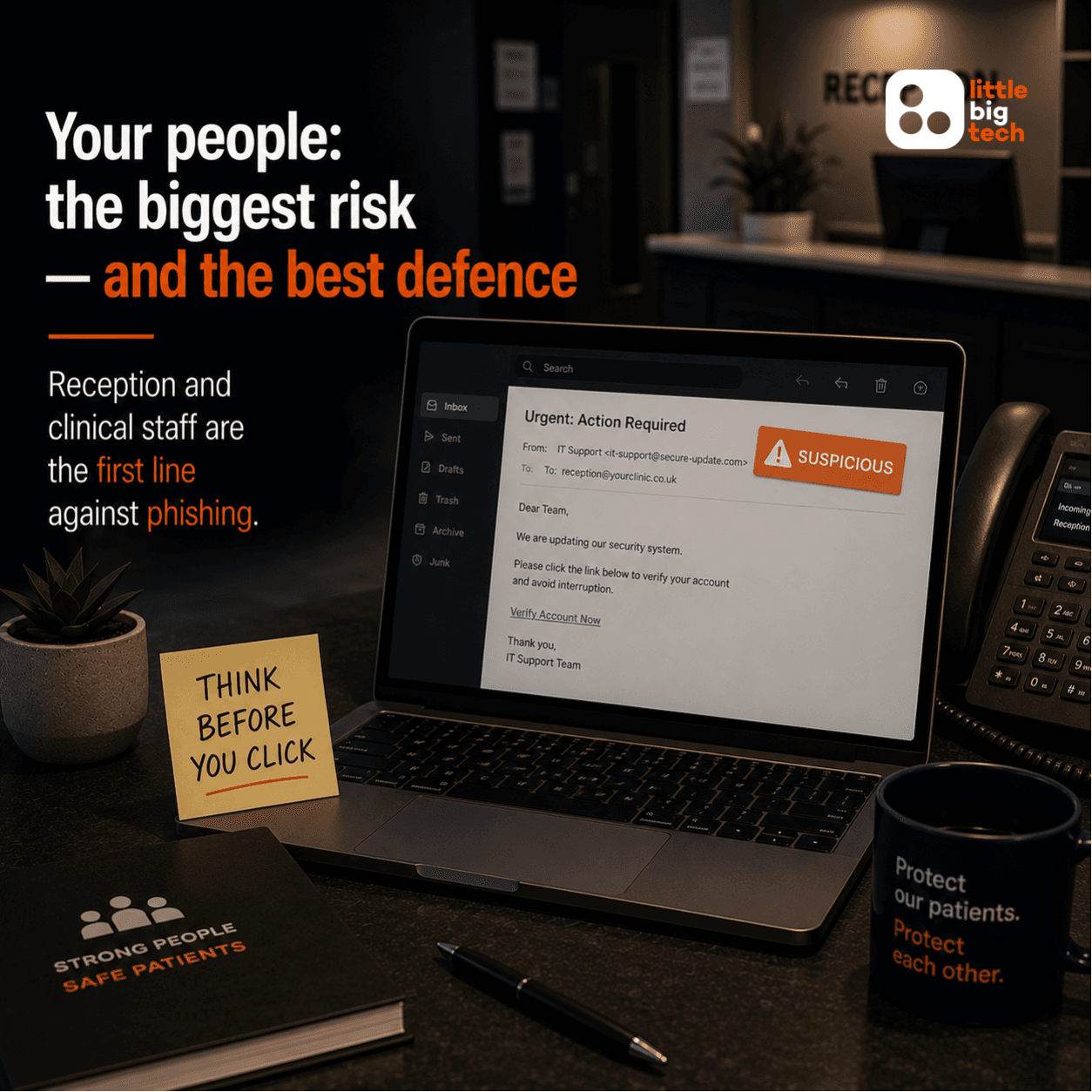
Most successful cyber attacks do not defeat a firewall. They walk through the front door because someone clicked a link, opened an attachment, or gave away a password to a caller who sounded convincing enough. Technology can reduce the odds of that happening, but it cannot eliminate the human decision at the centre of it.
In a clinic, that human decision might be made by a receptionist juggling three phone lines, a clinician between appointments, or an administrator processing a busy afternoon of paperwork. None of them are security specialists, and none of them should have to be, provided the organisation has built the right awareness and culture around them.
This article relates to the User Awareness & Culture domain of the Technology Resilience Score. It looks at whether your staff are equipped to recognise threats, and whether your culture makes it easy for them to report concerns.
Why staff awareness is different in private healthcare
Clinical and administrative staff handle sensitive patient information constantly, often under time pressure, which makes them a natural target for social engineering and phishing attempts designed to exploit exactly that pressure.
- Attackers frequently impersonate trusted contacts — suppliers, patients, even colleagues — to request information or payments
- Busy clinical environments leave little time to scrutinise every email or phone call carefully
- Staff turnover, locum cover and part-time working patterns make consistent training harder to maintain
- A single successful phishing attempt can expose patient data as easily as a technical vulnerability can
Well-informed, confident staff are one of the most effective defences a clinic has, and one of the most overlooked.
Where culture meets confidentiality obligations
Patient confidentiality depends as much on staff behaviour as it does on any system control. UK GDPR's higher standard for special category health data assumes that the people handling it understand the risks involved, not just that the right software is installed. A culture where staff feel able to report a suspicious email or a mistake without fear of blame is often what determines whether a small issue is caught early or allowed to grow into a serious one.
The key question becomes: "If a member of staff spotted something suspicious today, would they know what to do, and would they feel comfortable reporting it straight away?"
Is your clinic's technology environment resilient?
Find out whether your staff are genuinely equipped to spot and report a threat before it becomes an incident.
Get your Technology Resilience ScoreThe problem with one-off training
Many clinics treat security awareness as a box-ticking exercise: an induction video watched once, never revisited. That approach fades quickly, especially against threats that evolve constantly.
- Training delivered once at induction and never refreshed
- No simulated phishing exercises to test whether awareness translates into behaviour
- No easy, well-known way for staff to report something suspicious
- A culture where mistakes are met with blame rather than support
Awareness has to be maintained, not installed once and forgotten.
What weak user awareness and culture looks like in a private healthcare provider
Weak awareness and culture rarely look dramatic. They look like ordinary, busy days where the wrong habits quietly take hold.
- Staff unable to recognise common signs of a phishing attempt
- Passwords shared between colleagues for convenience during busy periods
- No clear, simple process for reporting a suspicious email or message
- Staff afraid to report a mistake for fear of getting in trouble
- Locum and temporary staff receiving little or no security induction at all
- Security treated as "IT's job" rather than everyone's responsibility
Each of these gaps increases the chance that a routine attack succeeds simply because nobody felt equipped, or safe enough, to stop it.
What strong looks like
A clinic with a strong awareness culture has staff who can recognise the common patterns of phishing and social engineering, and who know exactly how to report a concern the moment they see one. Training is refreshed regularly and adapted to how the organisation actually works, including locum and part-time staff.
Just as importantly, the culture supports openness. Staff who raise a concern, or admit to clicking something they should not have, are thanked for speaking up quickly rather than made to feel at fault.
How this TRS domain helps healthcare providers improve
The User Awareness & Culture domain of the Technology Resilience Score examines how well your staff are trained to recognise threats and how supported they feel in reporting concerns.
- Reviews the frequency and relevance of security awareness training
- Assesses whether phishing and social engineering resilience is actually tested
- Checks how easy and well-known the reporting process is for staff
- Looks at whether the organisational culture encourages openness rather than blame
It produces a score out of 5, giving your clinic a clear baseline and a structured improvement path towards a genuinely security-aware team.
People as the strongest layer of defence
Technology controls matter, but the people using those systems every day are often the first, and sometimes the only, line of defence against a well-crafted attack. Investing in awareness and culture is investing directly in patient confidentiality.
Staff awareness consistently comes up as a priority area across the private healthcare providers we work with. The Technology Resilience Score gives private healthcare providers a benchmark across 10 domains, including User Awareness & Culture.
Related reading
Is your practice's technology environment resilient?
Find out how well patient data and clinical continuity are protected, with a free Technology Resilience Score™ for private healthcare providers.
Our services