Security · IT Support
Why Security Tools Aren't Enough for Private Healthcare
6 July 2026
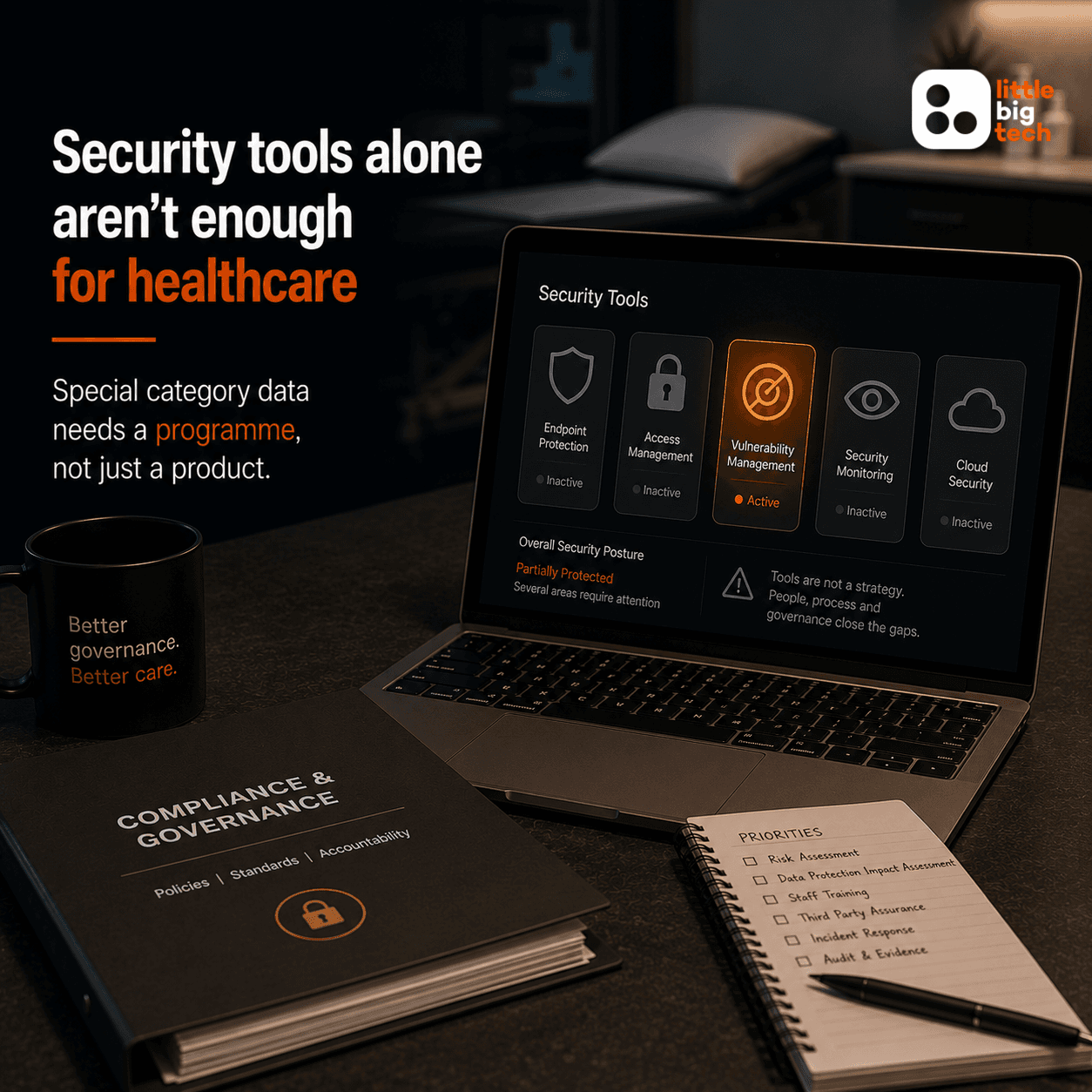
It is tempting to believe that buying good security tools solves the security problem. Install antivirus, switch on a firewall, add multi-factor authentication, and move on. In reality, tools are only as good as the way they are configured, monitored and acted upon — and that is where most gaps in private healthcare actually sit.
A clinic can own an impressive stack of security products and still be exposed, because ownership of a tool is not the same as control over the risk it was bought to manage. Nobody watching the alerts, nobody tuning the configuration, nobody clear on what happens when something is flagged.
This article relates to the Cyber Security Controls domain of the Technology Resilience Score. It looks at whether your clinic's security controls are actually working together, not just switched on.
Why security controls are different in private healthcare
Cyber security in a clinical setting is not only about protecting systems. It is about protecting the confidentiality of patient information and the continuity of care that depends on those systems staying available and trustworthy.
- A ransomware attack does not just cost money, it can halt appointments and delay clinical decisions
- Special category health data is a valuable target, making clinics an attractive prospect for attackers
- Smaller providers often run fewer dedicated security resources than the risk they carry would suggest
- Clinical staff need fast, frictionless access to systems, which can tempt providers to under-configure controls in the name of convenience
Security in this context is a balancing act between protection and usability, and it needs deliberate design, not default settings.
Where UK GDPR raises the stakes
Health data about identified patients is special category data under UK GDPR, which sets a higher expectation for the technical and organisational measures protecting it. A firewall and antivirus software satisfy neither the letter nor the spirit of that requirement on their own. What matters is whether controls are configured correctly, monitored consistently, and supported by a clear process for responding when something suspicious is detected.
The key question becomes: "If our security tools raised an alert right now, would anyone see it, understand it, and know what to do next?"
Is your clinic's technology environment resilient?
Find out whether your security tools are actually being monitored and acted on, not just installed.
Get your Technology Resilience ScoreThe problem with tool-only security
Buying security products feels like progress, and it often is a necessary step. But tools without oversight create a false sense of protection that can be more dangerous than having no tools at all, because it breeds complacency.
- Security software installed but left on default configuration
- Alerts generated but nobody assigned to review or act on them
- No regular testing of whether controls actually work as intended
- Overlapping tools that create noise without adding real protection
A security programme is a set of coordinated processes. A pile of tools is just a pile of tools.
What weak security controls look like in a private healthcare provider
Weak security controls often look reasonably solid on a supplier's feature list, but fall apart under real scrutiny.
- Multi-factor authentication enabled for some systems but not others
- No formal patching schedule for critical systems and software
- Security alerts sent to an inbox nobody actively monitors
- No defined escalation process when a genuine threat is detected
- Firewalls and endpoint protection configured once and never reviewed
- No independent testing of whether the security setup can withstand a real attempt
Each gap on its own might feel minor. Combined, they are exactly the kind of weaknesses attackers look for.
What strong looks like
A clinic with strong cyber security controls has more than a good tool stack — it has clarity on who is watching, what "normal" looks like, and what happens the moment something abnormal appears. Controls are configured deliberately, tested periodically, and reviewed as the organisation and its threats evolve.
Staff are not left guessing what to do if something looks wrong. There is a defined, rehearsed response, and security decisions are made with patient confidentiality and clinical continuity in mind, not treated as a purely technical exercise.
How this TRS domain helps healthcare providers improve
The Cyber Security Controls domain of the Technology Resilience Score examines whether your clinic's tools, configurations and processes work together as a coordinated programme.
- Reviews whether security tools are correctly configured and actively maintained
- Assesses whether alerts are monitored and acted upon consistently
- Checks for gaps such as inconsistent multi-factor authentication or patching
- Looks at whether a clear response process exists for genuine threats
It produces a score out of 5, giving your clinic a clear baseline and a structured improvement path towards a genuinely coordinated security programme.
From tools to protection that holds
Security tools are a starting point, not a finish line. What protects patient data in practice is the discipline behind those tools — the monitoring, the configuration, and the response plan that turns an alert into action.
Little Big Tech already supports U Clinic, and coordinated security is one of the areas we prioritise from day one with every private healthcare client. The Technology Resilience Score gives private healthcare providers a benchmark across 10 domains, including Cyber Security Controls.
Related reading
Is your practice's technology environment resilient?
Find out how well patient data and clinical continuity are protected, with a free Technology Resilience Score™ for private healthcare providers.
Our services