Security · IT Support
Would Your Clinic Even Know?
6 July 2026
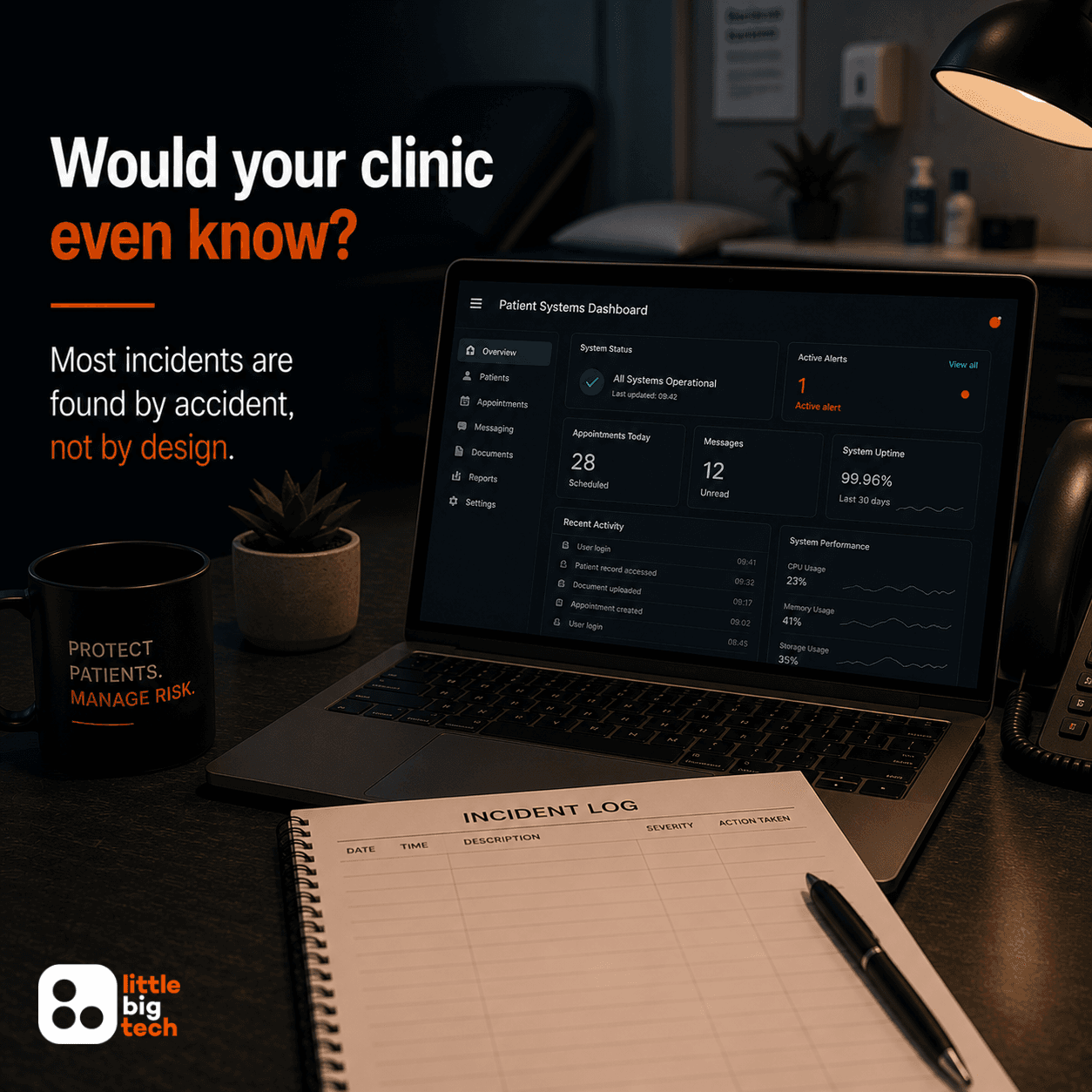
Suppose someone gained unauthorised access to your clinic's systems tonight. Not a dramatic, obvious attack — a quiet one, the kind that sits undetected while it explores what it has found. How long would it take before anyone noticed? For a worrying number of private healthcare providers, the honest answer is: far too long.
Prevention will never be perfect. No organisation, however well defended, can guarantee it will never be targeted. What separates a manageable incident from a catastrophic one is how quickly it is detected and how well the response is handled once it is.
This article relates to the Monitoring, Logging & Incident Response domain of the Technology Resilience Score. It looks at whether your clinic would actually detect a threat in progress, and what would happen next if it did.
Why detection and response are different in private healthcare
In a clinical setting, the clock on an undetected incident is not just a financial risk. Every additional hour a threat goes unnoticed is an hour where patient records could be accessed, altered or extracted without anyone's knowledge.
- Patient data sitting undetected in the wrong hands can remain exploitable long after the initial access
- Clinical systems being tampered with, even briefly, raises direct questions about the integrity of patient information
- Smaller providers often lack dedicated monitoring, relying instead on someone noticing something looks wrong
- A slow or confused response to an incident compounds the damage, both practically and reputationally
Speed and clarity of response matter as much as the strength of the defences themselves.
Where clinical safety meets incident response planning
A technology incident in a clinical environment is not purely an IT problem — it can directly disrupt patient care and appointments. CQC's expectation of safe, well-led care implies an organisation that can respond in a structured, competent way when something goes wrong, not one that discovers a problem by accident days later. Being able to detect and respond well is as much a patient safety matter as it is a technology one.
The key question becomes: "If something suspicious happened in our systems right now, would anyone notice today, this week, or not at all?"
Is your clinic's technology environment resilient?
Find out whether your clinic would actually detect and respond to a real threat in time.
Get your Technology Resilience ScoreThe problem with hoping someone will notice
Many clinics have no formal monitoring in place at all, relying instead on the hope that unusual activity will simply be spotted by someone, eventually. That is not a detection strategy — it is a gap dressed up as one.
- No centralised logging of activity across systems that hold patient data
- No one actively reviewing security alerts or unusual account behaviour
- No documented incident response plan for staff to follow under pressure
- Detection, if it happens at all, tends to happen by accident rather than by design
An incident discovered by chance, days or weeks later, is a far more damaging one than an incident caught within hours.
What weak monitoring and incident response looks like in a private healthcare provider
Weak detection and response capability tends to stay hidden until it is tested by a genuine incident, at which point the gaps become obvious fast.
- No system in place to detect unusual login activity or data access
- Logs that exist but are never reviewed by anyone
- No defined roles or responsibilities for the first hours of a suspected incident
- No practised process for containing a threat once it is found
- No plan for how or when to communicate an incident to patients or regulators
- Reliance on a single individual's availability to lead any response
Each of these gaps adds time to an incident that patients, regulators and the business itself cannot afford to lose.
What strong looks like
A clinic with strong monitoring and incident response capability has visibility over what is happening across its systems, with genuine oversight rather than assumption. Unusual activity is flagged and reviewed promptly, and there is a documented, rehearsed plan for what happens next.
Staff know their role in the first hour of a suspected incident, containment happens quickly, and communication — to leadership, to regulators where required, and to patients if necessary — follows a plan rather than being improvised under pressure.
How this TRS domain helps healthcare providers improve
The Monitoring, Logging & Incident Response domain of the Technology Resilience Score examines whether your clinic can detect suspicious activity and respond to it in a structured way.
- Reviews whether system activity is logged and actively monitored
- Assesses how quickly unusual behaviour would realistically be detected
- Checks whether a documented incident response plan exists and has been tested
- Looks at communication planning for affected patients and regulators
It produces a score out of 5, giving your clinic a clear baseline and a structured improvement path towards faster, more confident detection and response.
Closing the gap between attack and awareness
The organisations that come through a security incident well are rarely the ones that were never targeted. They are the ones that noticed quickly and knew exactly what to do next.
The Technology Resilience Score gives private healthcare providers a benchmark across 10 domains, including Monitoring, Logging & Incident Response.
Related reading
Is your practice's technology environment resilient?
Find out how well patient data and clinical continuity are protected, with a free Technology Resilience Score™ for private healthcare providers.
Our services