Security · IT Support
The Risk Your Clinic Didn't Choose
6 July 2026
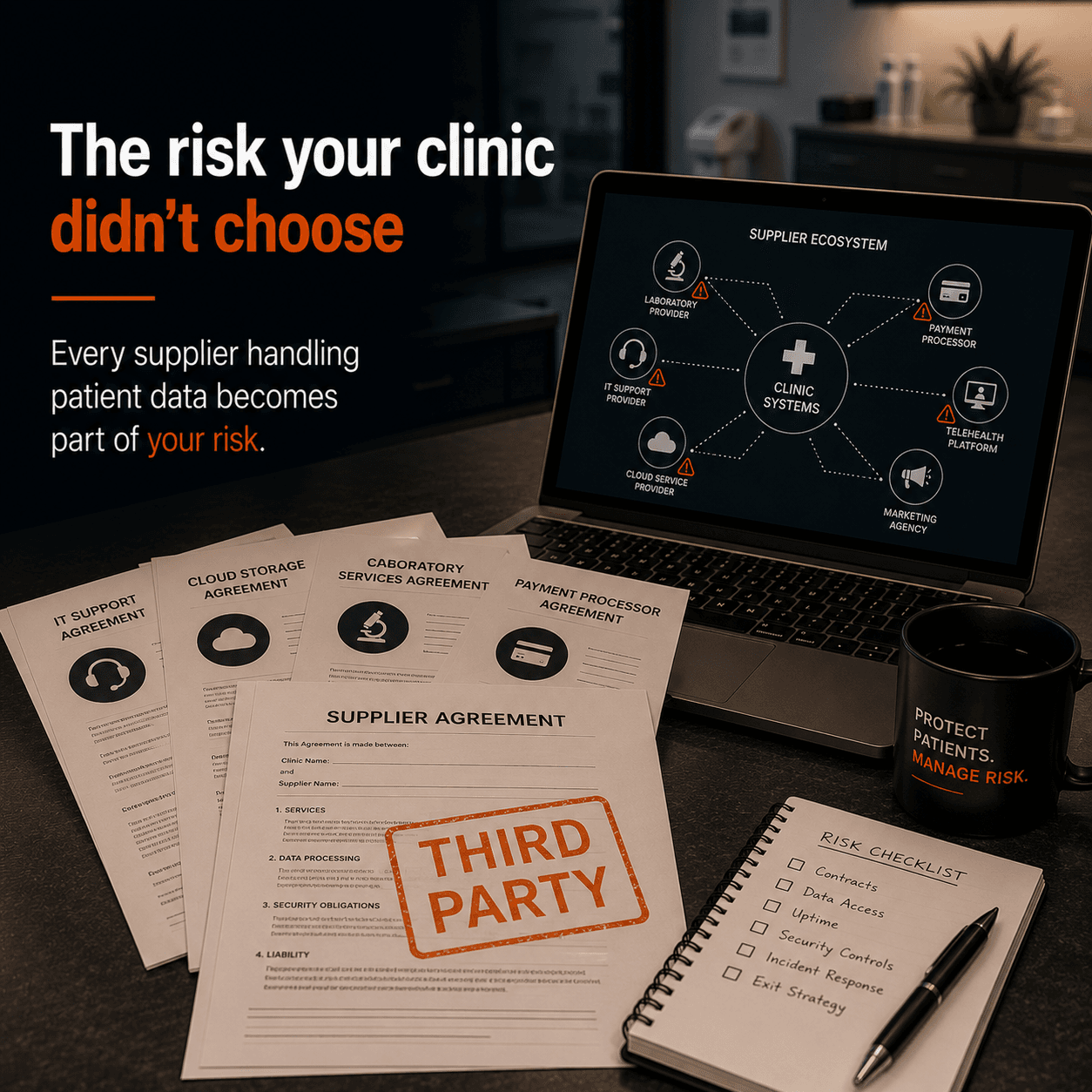
No clinic operates in isolation. Behind every appointment booking, billing process and diagnostic result sits a chain of third-party suppliers — software platforms, hosting providers, billing processors, couriers for samples, and specialist services that plug into your core systems. Each one holds a piece of the risk picture, whether your clinic chose to think about it or not.
The uncomfortable truth is that a security failure at a supplier can hurt your clinic just as much as a failure inside your own walls, and patients will not distinguish between the two. It will simply be your clinic's data, or your clinic's service, that was affected.
This article relates to the Third-Party & Supply Chain domain of the Technology Resilience Score. It looks at whether your clinic understands, and actively manages, the risk introduced by the suppliers it depends on.
Why supply chain risk is different in private healthcare
Private healthcare providers typically rely on a dense web of specialist suppliers, more than most businesses of a similar size. Diagnostic labs, referral networks, billing services, IT platforms and cloud providers can all touch patient information at some point in its journey.
- Multiple suppliers may each hold or process a slice of the same patient's data
- Smaller specialist suppliers may not have the security maturity of larger, more visible vendors
- Contracts are sometimes signed for clinical or commercial reasons without technology risk being assessed at all
- Once embedded, a supplier is rarely reviewed again after the initial onboarding
Every one of these suppliers extends your clinic's data footprint beyond your own systems and your own control.
Where DSPT and UK GDPR meet supplier risk
Many private providers with NHS contracts or access to shared care records are expected to complete the Data Security and Protection Toolkit annually, and that expectation does not stop at your own systems — it extends to how you manage the suppliers who can access or process that data on your behalf. UK GDPR reinforces the same principle: as a data controller, you remain accountable for how a processor handles special category health data, even when the processing happens inside somebody else's infrastructure.
The key question becomes: "If one of our suppliers had a data breach tomorrow, would we even know, and could we show we had assessed that risk in advance?"
Is your clinic's technology environment resilient?
Find out whether the suppliers touching your patient data have actually been assessed and reviewed.
Get your Technology Resilience ScoreThe problem with unmanaged supplier relationships
Supplier risk is easy to overlook because it sits outside the four walls of the clinic. It is not visible day to day, so it rarely gets prioritised until something goes wrong.
- No central register of which suppliers hold or access patient data
- Contracts signed without any review of the supplier's security or data handling practices
- No process for reassessing suppliers once the relationship is established
- Unclear responsibility for what happens if a supplier suffers a breach
A clinic can have excellent internal security and still be exposed entirely through a weak link three suppliers removed.
What weak supply chain management looks like in a private healthcare provider
Weak supplier management tends to be invisible until an incident, an audit, or a DSPT submission forces the question.
- No documented list of suppliers with access to systems or patient data
- Contracts with no data protection or security clauses at all
- No visibility of where a supplier physically or digitally stores patient data
- Suppliers onboarded years ago and never reassessed since
- No agreed process for notification if a supplier suffers an incident
- Reliance on verbal assurances rather than documented evidence of a supplier's controls
Each gap adds a link in the chain that your clinic cannot see, but remains accountable for.
What strong looks like
A clinic with strong supply chain management knows exactly which suppliers touch its data, has assessed each one proportionate to the risk it carries, and has contractual protection in place that reflects the sensitivity of what is being shared.
Reviews happen on a regular cycle rather than only at onboarding, and there is a clear, pre-agreed process for what happens if a supplier reports — or suffers — an incident. Nothing about supplier risk is left to assumption.
How this TRS domain helps healthcare providers improve
The Third-Party & Supply Chain domain of the Technology Resilience Score examines how well your clinic understands and manages the risk introduced by external suppliers.
- Reviews whether a complete supplier inventory exists, mapped to data access
- Assesses whether contracts include appropriate data protection terms
- Checks whether suppliers are reassessed over time, not just at onboarding
- Looks at incident notification processes with key suppliers
It produces a score out of 5, giving your clinic a clear baseline and a structured improvement path for tightening supplier oversight.
Taking ownership of risk you did not create
You cannot control every supplier's internal security programme, but you can control how carefully you choose, contract with and review them. That discipline is what separates a provider that inherits risk blindly from one that manages it deliberately.
The Technology Resilience Score gives private healthcare providers a benchmark across 10 domains, including Third-Party & Supply Chain.
Related reading
Is your practice's technology environment resilient?
Find out how well patient data and clinical continuity are protected, with a free Technology Resilience Score™ for private healthcare providers.
Our services