Security · IT Support
Who Holds the Keys to Your Clinic?
20 July 2026
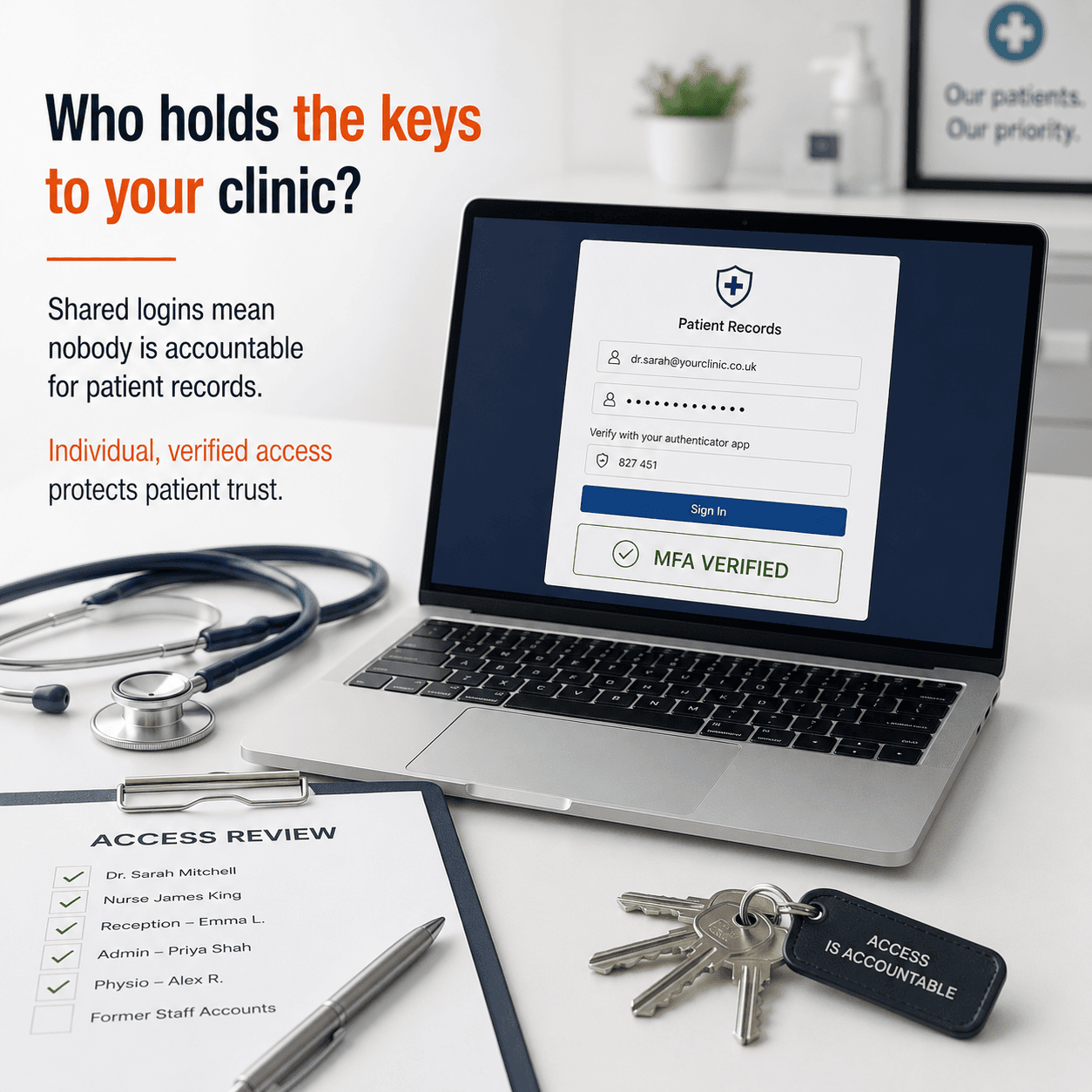
Patient records are the most sensitive data a business can hold.
And in most clinics, they sit behind logins — shared across reception, clinicians, practitioners and locums.
The question is not whether access is controlled on paper. It is whether you could prove, today, who can see a patient's record — and whether a phished password at the front desk would be enough to expose every patient your practice has ever treated.
This article relates to the Passwords & Access domain of the Technology Resilience Score. It looks at whether your practice controls access to patient data — and whether you could evidence it to the CQC or the ICO.
Why identity matters more in healthcare than almost anywhere
Patient data is special category data under UK GDPR. A breach involving it carries higher stakes by definition: greater harm to the people affected, closer regulatory attention, and damage to something clinics depend on completely — patient trust.
Most healthcare data incidents do not start with sophisticated attacks. They start with credentials: a password reused across systems, a shared reception login that half the team knows, a locum's account still active six months after their last shift.
The shared login problem
Shared logins are common in clinical settings because they feel efficient at the front desk. But they carry a hidden cost: when everyone logs in as the same user, no one is accountable, access cannot be traced to a person, and a single phished password opens the door for good. The Data Security and Protection Toolkit and CQC's well-led framework both point the same way — access should be individual, controlled and auditable.
Is your practice's technology environment resilient?
Find out where your practice stands on access to patient data, and every other domain of resilience, with a free assessment written for private healthcare.
Get your practice's Technology Resilience ScoreWhere access control quietly breaks down
It rarely breaks by decision. It breaks by accumulation: a practice manager with admin rights to everything because setup was easier that way; a departed practitioner whose account nobody disabled; MFA enabled on email but not on the clinical system that holds the records themselves; suppliers with remote access that was never time-limited.
Each shortcut feels harmless. Together they mean the practice cannot say with confidence who can see patient records today — which is precisely the question the ICO asks after an incident.
What good looks like
In a well-run practice, every member of staff — clinical and front of house — has their own login, protected by multi-factor authentication on email and the clinical system alike. Admin rights are limited to those who need them. When a locum finishes or a member of staff leaves, their access is removed the same day, and the record shows it. Access to patient records can be traced to a named person, every time.
In that environment, a stolen password achieves very little — and the practice can evidence its data protection position to the CQC, the DSPT and referring partners with confidence.
How this TRS domain helps healthcare providers improve
The Passwords & Access domain of the Technology Resilience Score helps practices assess how well identity is controlled. It asks questions such as:
- Does every member of staff have an individual login — no sharing, anywhere?
- Is multi-factor authentication enforced on email and clinical systems?
- How quickly is a leaver's or locum's access removed?
- Who holds admin rights — and do they need them?
- Could we trace access to a specific patient record back to a person?
The result is a score out of 5. That score provides a clear baseline and a structured path to improvement — protecting patients, and giving the practice evidence it can stand behind.
The Technology Resilience Score gives private healthcare providers a clear benchmark across 10 domains, including Passwords & Access. Little Big Tech helps clinics and practices build an environment where patient data is protected by design. Find out more about our approach at our Technology Resilience Score™ framework.
Related reading
Is your practice's technology environment resilient?
Find out how well patient data and clinical continuity are protected, with a free Technology Resilience Score™ for private healthcare providers.
Our services